THE MISSIONARY NURSE

9%

Pacific Press Publishing Company · Oakland, California · Nov 12, 1902

FromSigns of the Times, Vol. 28, No. 46.

Read the full edition

THE MISSIONARY NURSE.

[By Abbie M. Winegar, M.D., superintendent of the St. Helena Training School for Missionary Nurses.]
To the young woman or young man who wishes to devote the life to uplifting fallen humanity, there is no greater opportunity offered than that of the missionary nurse. In no way can we more closely follow in the footsteps of our blessed Master who went about doing good, healing all manner of diseases, and ministering in every way possible to those who were in need. The world will ever owe a debt of gratitude to Florence Nightingale who, with a heart of love for suffering humanity, braved the hardships and overcame the obstacles attendant upon the opening up of a new line of work; and especially as the nurses of her time were of the “Sairy Gamp” order, belonging to the ignorant and even degraded classes.
She met with opposition from physicians who feared that the educated and enlightened nurse would supersede the physician, and thus his profession be lowered; but amid discouragement and opposition she distinguished herself during the Crimean War in caring for the soldiers, and afterward established a training school for nurses, the first of the kind ever opened. Since the opening up of this school and the demonstration to the world of the superiority of the trained nurse over the ignorant, illiterate class of former days, there has been an increasing demand for trained nurses.
There is not one, not even the physician or Gospel minister, who comes in such close touch with suffering souls; no one to whom the patient is so likely to open the heart and unburden the soul. Here as at no other time has the God-fearing nurse an opportunity to speak words of comfort and to point the sin-sick soul to the Great Physician, who is the Healer not only of physical disease but of spiritual disease as well.
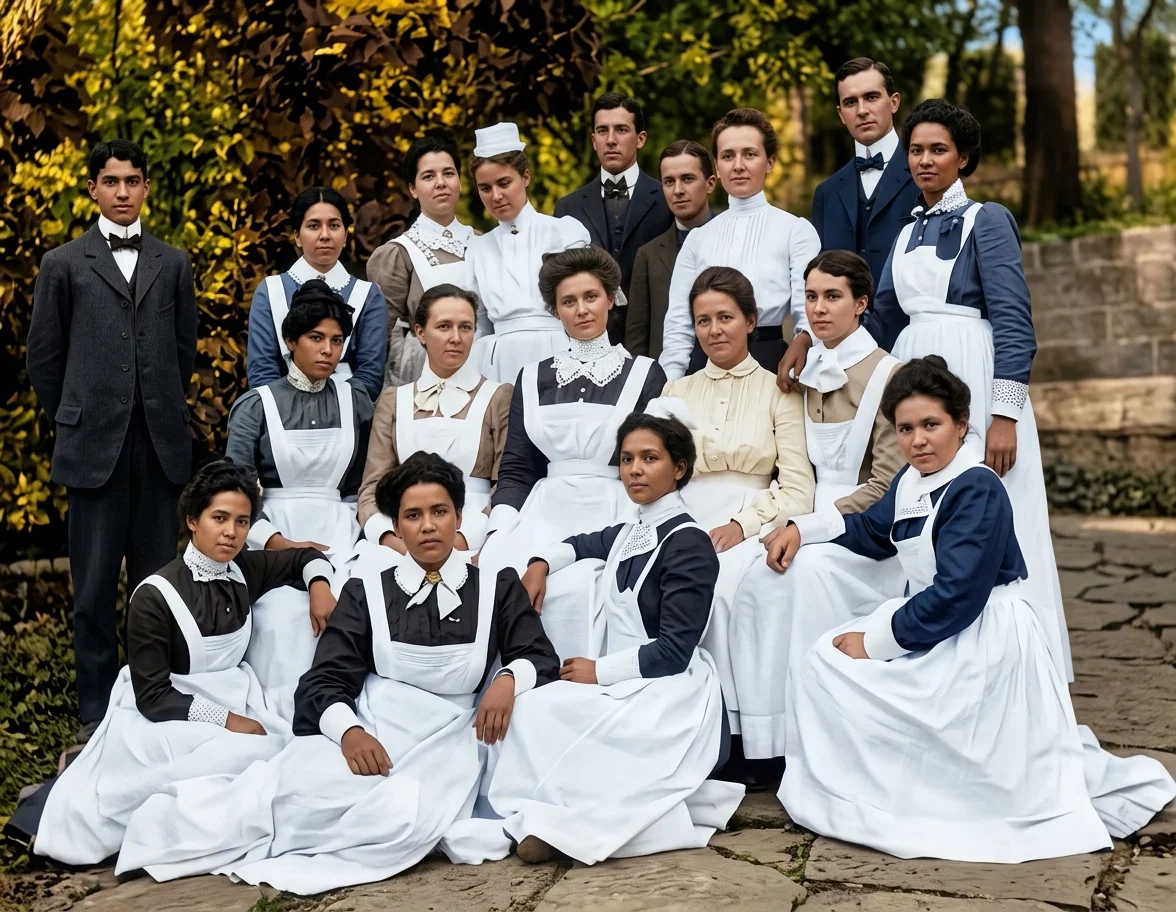
A Group of Missionary Nurses at St. Helena Sanitarium.
Probably no other profession or occupation requires more earnest consecration, and in none is there a less place for frivolity, lightness, jesting and such like. In such a high and holy calling all of the most noble and beautiful attributes of character must predominate. The nurse must recognize the divine call to this work and appreciate something of the great responsibility resting upon her. Her success in this work depends largely upon a recognition of this and the readiness with which she adapts herself to the situation.
One may be able to administer medicines or treatments thoroughly, to observe and report symptoms accurately, and yet be sadly lacking in some of the essential qualifications of the ideal nurse. Love for suffering humanity, with the numerous beautiful traits that follow in its train, must be the basis for success in this work. David said, “Thy gentleness hath made me great.” The gentleness of Christ dwelling within him had made David truly great; so may this same gentleness in each one of us make us indeed great. Gentleness is a very necessary element in the character of the nurse, but with it must be firmness which will enable her to be strength for her patient.
No young person should enter this work simply for a professional training for pecuniary purposes. The work is too sacred to permit any one to enter upon it for selfish gain; and those who enter it with no higher motive will undoubtedly fail, and will miss one of the grandest opportunities of bringing joy and happiness into the lives of others and thus of adding to their own happiness.
Neither should a young man or a young woman enter upon this work with merely a sentimental motive—dreaming of fame in bathing the brows or smoothing the pillows of imaginary heroes. Oftentimes the nurse will find it necessary to care for those who are uncongenial and repulsive, but there must be that divine love in the heart which will call forth a response even from those in whom the image of God seems almost effaced.
“And the King shall answer and say unto them, Verily I say unto you: Inasmuch as ye have done it unto one of the least of these My brethren, ye have done it unto Me.”