THE following is from a private letter written to the editor by Pastor W. A. Sweany, our missionary in Barbados. It speaks for itself; and we would that it might speak to the heart of every soul who reads the true and pitiful story. Any one who would be pleased to aid Brother Sweany in caring for poor suffering humanity there can send the money to this paper, and whatever is received will be promptly forwarded; or to his address, King Street, Bridgetown, Barbados, W. I. When one or two cents a day will keep a soul from starving, who could not and would not contribute something to the suffering ones in Barbados? Brother Sweany writes:—
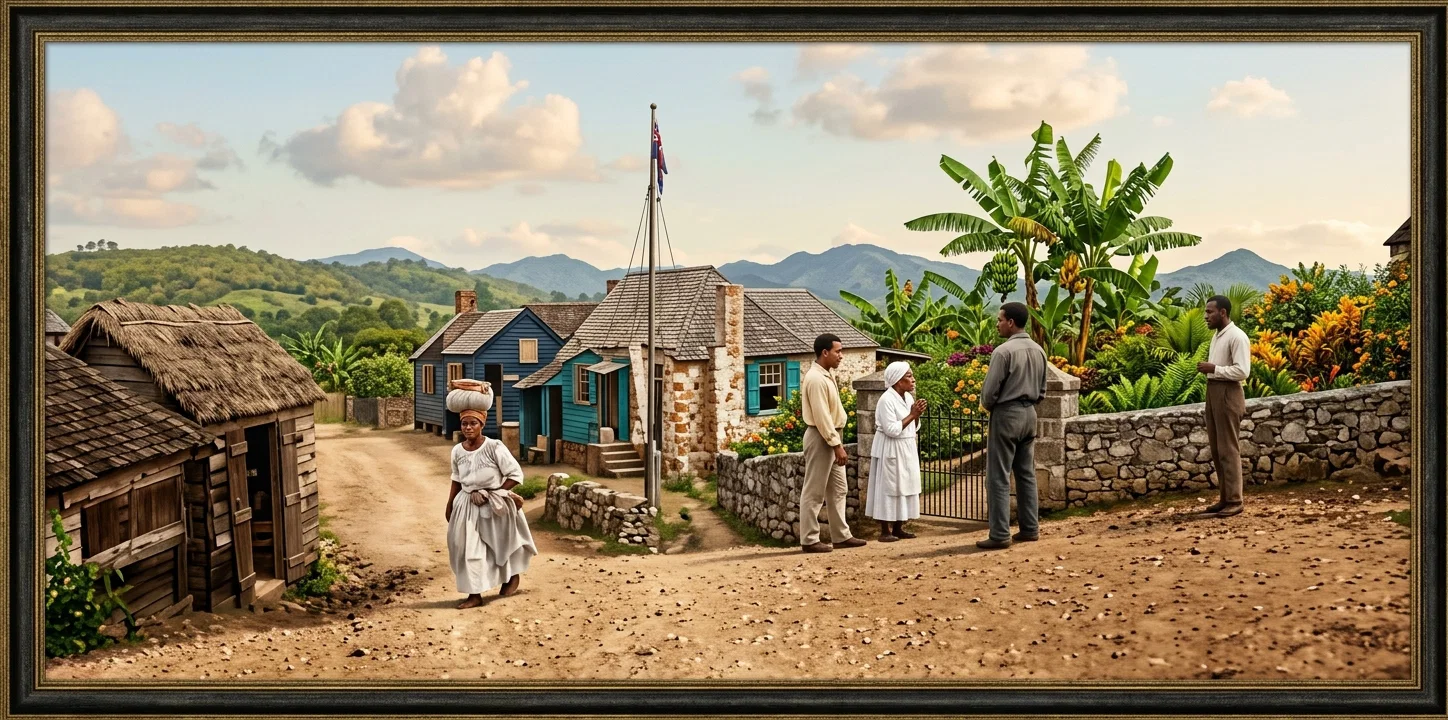
Corner of a Country Village, Barbados.
Conditions in Barbados just now are not the most enjoyable. Smallpox has been raging for more than two months, and has now become epidemic, there being over five hundred cases, with new ones developing daily at the rate of from ten to fifty cases per day. The mortality, however, is not very great—being about five per cent, I think. Hospital accommodations were entirely inadequate to cope with the sudden visitation, and so more than half the cases are still in their homes, where, of course, successful isolation and proper care are utterly impossible, owing to the awful density of the population, and the entire absence of proper appliances and facilities, or even the bare necessities of life. The huts of the masses (usually about 8x12 feet in size, and occupied by from six to a dozen persons) almost touch each other. On both sides of narrow lanes are alleys. These are but a few feet wide, and swarm with pigs, poultry, goats, etc.
At first the corpses of the smallpox victims were thrown into the sea, but that practise had to be abandoned . The people revolted against it, as funerals and weddings are among the most important events here. Among the masses, long lines of people on foot follow the hearse to the grave. The classes, of course, ride in carriages on such occasions.
While the practise prevailed of throwing smallpox corpses into the sea, the business of the fishermen (a large class) was ruined, as the people would not eat the fish, fearing they had devoured the dead bodies. This brought much additional suffering on the already poverty stricken masses.
Of course all other ports and colonies are closed against us, and commerce is almost entirely cut off. This is perhaps the greatest cause of suffering, as it cuts off our supplies, and raises prices, besides throwing out of employment thousands of persons—stevedores, lightermen, boatmen, cartmen, etc.—who are wholly dependent on the commerce of the port for a livelihood. Even in ordinary times, the masses here are enveloped in such poverty as people in your land of plenty never dream of; but in a time like this conditions are simply appalling. Relief measures, on a large scale, will soon have to be instituted by the government, if this epidemic continues. It is necessary already for us to assist many of our own dear people who are destitute, with absolutely no means of obtaining a livelihood. If we only had a small portion of the fulness and plenty of many of our well-to-do people in the States, we could accomplish an untold amount of good here. And could our brethren but get a glimpse of the awful poverty which we see, or hear some of the piteous appeals that continually sound in our ears, they would freely give, to palliate the sufferings of their fellow men. We are doing all in our power, but our means and efforts are only a drop in the bucket compared with the needs. A little goes a long way here. The people are used to getting along on very little. Wages for laborers are only 10 to 20 cents a day in ordinary times, and work is not steady even at that rate, nor plentiful enough for all. A penny a day will keep a man from starvation now. Sugar raising is the chief industry here, but the price has gone far below the cost of production. Because of this, ruin stares the planters in the face, and has already overtaken many of them. Imperial grants and loans serve to keep the plantations in operation for the present, but unless prices advance, which is not at all likely, they must soon be abandoned, and then the real crisis will have been reached. The last and only means of livelihood will be gone, and what will the masses do?
When the smallpox broke out, the people hid their sick, and opposed removal to the hospital, mobbing the sanitary officers in the performance of their duties. They also repudiated vaccination. However, these things are now changing. The government, pastors, school-teachers, newspapers, and intelligent people generally engaged in a crusade of education, and now the people no longer conceal their sick nor oppose their removal, and thousands are daily baring their arms to vaccination, which has been made free to them by the government. Lack of lymph hindered vaccination for some weeks, and lack of facilities, and jealousy and dissension among officials, still greatly hinders the proper management of the disease. None of our people have yet been attacked, and we are trusting in God still to shield us. We are doing all in our power to co-operate with Him, by carefulness in living, vaccination, etc.
We are of good courage, and our work is onward, despite these forbidding conditions. Many are deeply interested in the message, and some are yielding obedience to it from time to time. We are glad we are here, for the needs of humanity both spiritually and temporally, could not be greater than here, and we want to be where we are most needed.