OLD KING SOBA BANGA

4%

Pacific Press Publishing Company · Oakland, California · Oct 8, 1902

FromSigns of the Times, Vol. 28, No. 41.

Read the full edition

OLD KING SOBA BANGA.

[By a Missionary.]
THIS is the old king who called on us when we reached Malange, Africa, in September, 1885. He declared that he was king of all the earth that he could see, and gave us to understand that if we lived in this part of Africa it would be necessary to make him a good present. Our beloved Bishop Taylor said if he was the king he would willingly do the right thing with him, but as the bishop was in bed suffering with fever, caused by exposure and a long march from Dondo to Malange, he could not pay him then, but asked him to call another day. This the old king was not inclined to do, feeling that then was his time. This much perplexed our bishop, and he turned to me and said:—
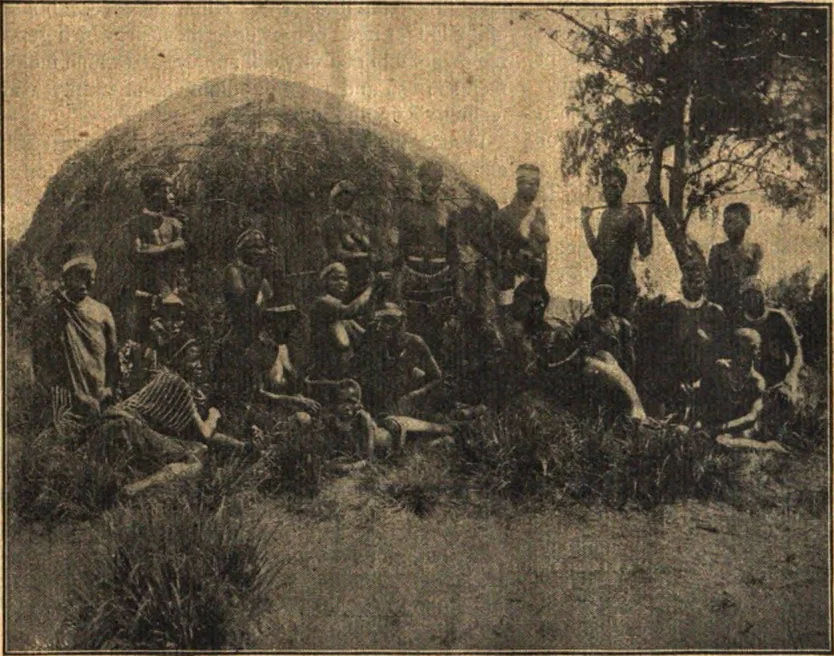
Group of Zulus at a Kraal Making Their Toilet.
“What can I do to get rid of this old fellow?”
I said, “Invite him to come another day.”
“I have done this repeatedly, and it seems to do no good.”
I said, “Bishop, you must first dismiss him, and then invite him to come again.”
“Well,” he said, “you manage it, then. I am too sick to attend to it.”
So I simply dismissed him and invited him to come again, and everything passed off quietly. Soon after this I was invited by Doctor Summers to go out and visit this old king at his home. I can never forget that evening. It was the first time that I ever saw the “heathen dance.” I think it was one of the saddest nights I ever saw in Africa. The old king’s women were the chief performers. One part that I remember well was the “muscle dance.” The dancer stood in the center and began with the muscles of her neck, twitching and swelling, then her arms, and so on down to her feet; but she did not seem to move once from her tracks. We did not know that this entertainment was gotten up for us till after we had gone.
I noticed in the dance several young men, one or two in particular, and also that one played the “marimba.” I wondered, as I looked into their faces, if God would ever call such as they into His service. Soon after that evening I invited several of these young men to come to our mission Sunday-school, which they did, and were very apt to learn.
In a few months after this I visited the village again. As I approached the village the moon was just rising over the hill, and I heard the sound of the “marimba,” and I groaned within myself as I thought they were having another dance; but as I drew nearer I did not hear the shouting and noise that always accompany dances, and, to my great surprise, there was no crowd there; but in the center, the full moon shining bright, a young man sat by the side of his “marimba,” and he sang in a plaintive voice as he played:—
“There is a happy land, Far, far away, Where saints immortal stand, Bright, bright as day.”
I listened and wept and prayed. Finally I went to the young man and said, “Do you know these words that you are singing?” He said, “O, yes; those are the words that I learned at the Sunday-school, and I wish I could learn to play this hymn on this instrument.” Then he explained to me how the “marimba” was used for a kind of heathen telegraph. By the sound of the “marimba” they could call people for war or feasting, or notify them that strangers were approaching, or whatsoever they wished to say, all the people of the village knowing the different sounds of the “marimba” and what the call meant.
Bernardo replied, “If I could play this piece all the people would know what it meant.”
Bernardo was the old king’s nephew. In a short time after this in Malange, when we had finished our evening prayers and retired for the night, I heard a gentle tap at the door, and some one in the native tongue said, “I am sick with fever; won’t you let me in?”
I opened the door, and there stood Bernardo, with his blanket wound around him.
I said to him, “Why have you come here.” He said, “I have the fever, and my people insist that I shall have the idol doctors, and while they were preparing I ran away and came here.”
I soon had a bed fixed for him on the floor, gave him some remedies, and in a few days he was himself again. He remained in the mission some months, and was a great help in our first mission buildings. His marvelous strength would often surprise us. He would carry upon his head what it would take two or three ordinary men to carry. His desire for learning was so great that in a very short time he learned to read and write the Portuguese language. He said to me one day, “I must return to my people,” and he did so.
I said to Mrs. Mead one day, “We must go and look up Bernardo; I fear he has gone wrong.”
We saddled our riding bullocks and rode into their native village. When we reached the square we heard many voices, and there stood Bernardo in the center of the circle with his Bible, preaching the Word of God to them.
It would be useless for me to say that our hearts rejoiced and praised God. After he had finished his discourse he greeted us as a Christian, and then introduced us to several of them in the circle, saying, “This man has left his idols; he has left his tobacco; he has left his women; he hears God’s words, and is glad. I believe he is in the way of salvation. Here is another one. He has left his idols, but he will not leave his beer and pipe.”
So he went around, giving us the characters of the different ones in his congregation. He continued his Sunday work until Bishop Taylor visited us again, and he brought his class to the bishop to be examined. The bishop baptized nine and took them into the church on probation.
George Grenfell, who has charge of the English Baptist missions on the upper Congo, came across the country to Malange, in the interest of the Belgian government. He preached to us in the morning, and Bernardo spoke to the people in the afternoon. After Bernardo had finished, George Grenfell wished to know where the young man received his education. When I told him that he had scarcely been out of his native village farther than Malange, he could hardly believe it. The strong stand that Bernardo took among his people brought fierce persecution. The old king was much tried with him, for Bernardo had commenced to learn and practise their fetish ways (his uncle being his teacher), and they did not wish to lose him.—World Wide Missions.