SIX hundred years before Christ the Lord declared by His prophet concerning Egypt, then struggling for supremacy in world-empire against Babylon: “It shall be the basest of the kingdoms; neither shall it any more lift itself up above the nations; and I will diminish them that they shall no more rule over the nations. . . . Her foundations shall be broken down. . . . They also that uphold Egypt shall fall; and the pride of her power shall come down. . . . And they shall be desolate in the midst of the countries that are desolate; and her cities shall be in the midst of cities that are wasted. . . . I will also destroy the idols, and I will cause the images to cease from Memphis; and there shall be no more a prince from the land of Egypt. . . . And I will . . . set a fire in Zoan, and will execute judgments upon No.” (See Ezekiel, chapters 29 to 32.)
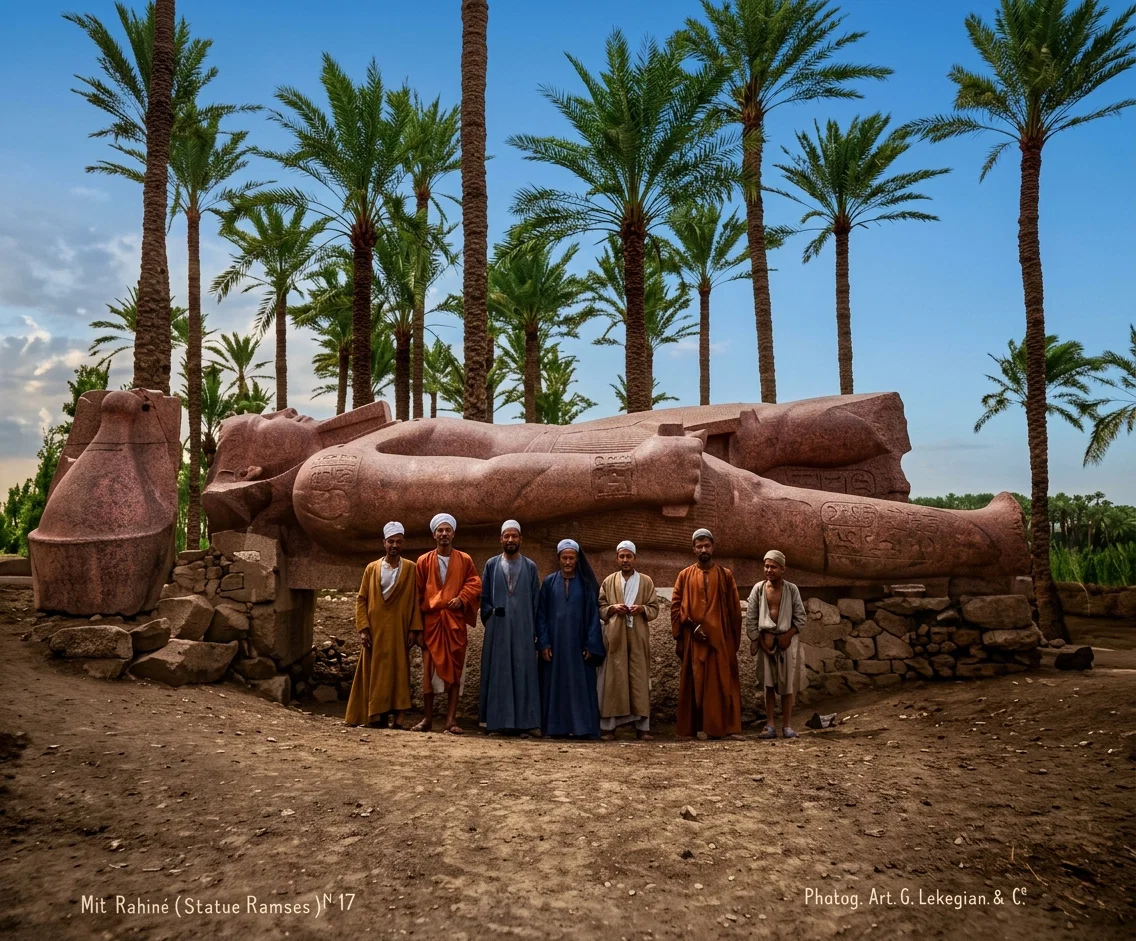
Statue of Ramses II., Pharaoh of the Oppression.
OUR illustration of the great prone statue of Ramses II., the Sesostris of the Greeks, the Pharaoh of the Oppression, is graphic evidence of this. For the long period of sixty-seven years in the nineteenth dynasty he ruled over Egypt. Other kings of Egypt were greater warriors; he was the greatest builder. From one end of Egypt to the other his name is found, not among the things of life, but now among the things of death and decay. One writer tells us, “It is almost impossible to find in Egypt a ruin or an ancient mound, without reading his name.” The great rock-temple at Ipsambul, with its enormous colossi of himself, with his image as one of four with three of the gods of Egypt, was not his only work made in honor of himself. He caused to be made the greatest statue of himself ever sculptured by mortal man. It was found at Tanis, the ancient Zoan of Scripture, founded seven years later than Hebron. Zoan was used as the capital city by the Hyksos, or Shepherd Kings, and it is thought by some that Joseph once lived there. When Ramses II. lived, it was celebrated for its beauty, the fertility of its fields, and the abundance of its wild birds and fish.
IT was in this great, noted, and ancient city that Ramses thought to glorify self by the mighty statue raised to his name. Erect and crowned it was ninety-two feet from head to foot, or one hundred and twenty-five feet including2 (546)pedestal. When found it had been broken up into rocks of tons each by a later king—Osorkon II., in the twenty-second dynasty—to build a mammoth gateway.
IT was Ramses who oppressed the Israelites, who made their bondage hard and bitter by exacting service in bricks and mortar. It was by the life-blood pressed from this oppressed people that his great monuments grew skyward. He thought only of himself and his own glory. He was the monopolist of the land. To his power and plans all else must bend. His ambitions all must feed. If a nation need to be sacrificed, what of that? There are others left; and the world is prolific. What are lives of slaves compared to a temple to Amen-Ra? What is their toil, their anguish, their sweat, their blood, in comparison with a great phallic monolith to the sun, which we now call a Cleopatra’s needle, tho the voluptuous queen never made one? One monument of stone to himself is worth more than a thousand slaves!
BUT God cared for His oppressed children. Speaking after the manner of men, He went down to the dark land to see how they fared. He saw their sufferings. He heard their groans. He felt their pain. He determined to deliver them. He sent Moses with the message, “Thus saith Jehovah, the God of Israel, Let My people go, that they may hold a feast unto Me in the wilderness;” “that they may serve Me.” It was in every way a reasonable request. Israel’s going into Egypt had been a blessing to the country, and the hard enforced bondage of later years was wholly unjust. Egypt owed Israel both wages and liberty. But the haughty monarch whose chief thought was to glorify himself, who knew neither mercy nor justice, refused to submit to Jehovah. He set himself against God. He ruined his kingdom in the vain strife, and the flower of his army went down in the Red Sea while pursuing the escaping bondmen. It was Jehovah for Israel and Egypt; for great blessings would have come to Egypt, and God’s name would have gotten great glory in the earth, if Ramses had submitted his proud will to God. But Ramses made it Egypt against God; and Egypt fell, never more to rule over the nations. Babylon was more worthy than she, and to Babylon and her successors Egypt became subject.
THE prone broken statue of the great king is a striking object lesson of the end of all human selfish greatness. The fame, the renown, the pomp, the grandeur, the seeming greatness gotten through selfishness, for the purpose of self-aggrandizement and self-exaltation, is doomed to perish. It may sway the world for a time; it may make the nations bow as fields of grass before the wind; it may seem to be solid and stable; but it is all doomed to perish, and those who have identified themselves with it will meet the same fate.
MOSES knew all of Egypt’s glory. He was brought up in the royal courts. He was learned in all the wisdom of the Egyptians. He was mighty in word and deed. He saw the vast difference in social life between the Pharaoh in his court and the slave in his pen. He knew Egypt’s greatness. He could possess it if he would. He was the “crown prince of Egypt.” But he rejected it all for Christ’s sake, and counted a lot with the Christian slave preferable. “By faith Moses, when he was grown up, refused to be called the son of Pharaoh’s daughter; choosing rather to share ill treatment with the people of God, than to enjoy the pleasures of sin for a season; accounting the reproach of Christ greater riches than the treasures of Egypt; for he looked unto the recompense of reward.”
EVERY man has the spiritual darkness of Egypt, the selfishness of Egypt, the lust of Egypt in his own carnal heart. Again and again when the God of Israel asks for the service of his faculties and members, the carnal mind, the king of his Egypt, asks the question, “Who is Jehovah, that I should obey His voice? I know not Jehovah, neither will I yield my all to His service.” (See Ex. 5: 1, 2; Rom. 6: 16–23.) The only way to meet the question is to yield to God. “The wages of sin is death,” and all selfishness is sin. The only hope of salvation from sin is to leave the Egypt of selfishness, and humbly, gladly go with Jesus Christ the only Deliverer.