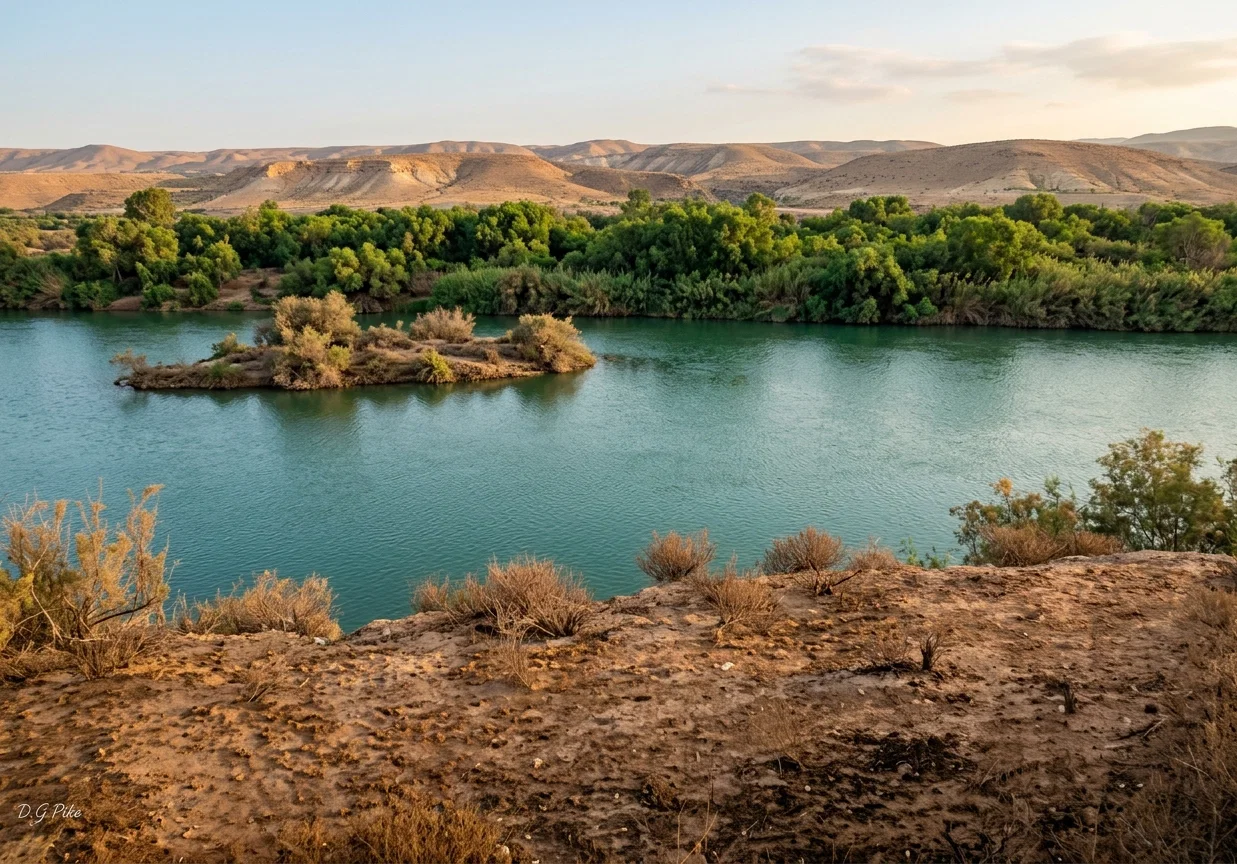
Jordan as a river is hardly worthy of particular notice. It does not compare in beauty or majesty at all with any of the great historic streams. But in its history there is none like it. The Nile, the Rhine, the Danube, the Mississippi, the Amazon, the Hudson, are all of minor importance in historic incident, in character moulding, and age-forming lessons.
The name Jordan means “descender.” Its principal sources are four in number, rising up among the mountains of Anti-Lebanon, at an altitude varying from 1,700 to 1,100 feet above sea level. It descends to “the waters of Merom,” 1,434 feet. Thence in the short distance of nine direct miles it falls 897 feet to “blue Galilee,” 682 feet below the Mediterranean. Down to the Dead or Salt Sea it flows through a deeply depressed valley varying in width from one to twelve miles, the hills on either side almost meeting at times. This valley, filled with a rich alluvial soil, is called the Plain of the Jordan. It formerly took in much of the surface now covered by the Dead Sea. The distance between Lake Tiberias and the Dead Sea in a straight line is only sixty-six miles, yet the length of the river, owing to its extreme crookedness, is 200 miles. Its whole descent from its source to the Dead Sea, a distance of 136 miles, is 2,999 feet. The devious windings of the stream are a blessing, as its flow would be much more rapid were it nearer straight. Its valley is semi-tropical in climate and fertile in soil, and its waters, saturated with alluvium, pour their fertilizing powers into the barren Dead Sea.
What incidents the very name Jordan recalls from the earliest times in connection with the cause of God and His people! Surely it were worth our while to recall some of the more striking, and learn anew the lessons God gave them record to teach.
The first mention of Jordan is in the thirteenth chapter of Genesis. Abraham and Lot were new-comers to Palestine, the former the leader and benefactor, the latter the blessed and benefited. Their flocks and herds grew apace, so that their herdmen strove against each other for room for pasturage. The old patriarch called his nephew and said: “Let there be no strife, I pray thee, between thee and me, and between my herdsmen and thy herdsmen; for we are brethren. Is not the whole land before thee? Separate thyself, I pray thee, from me; if thou wilt take the left hand, then I will go to the right; or if thou take the right hand, then I will go to the left.” What a noble utterance! and worthy of “the friend of God.” If men or their families can not agree when living together, it is better to agree by living separate. If the young man or young woman can not without strife remain in the parental home, it is better to seek a place elsewhere. It sometimes brings home and its blessed influences spiritually and lovingly nearer when we go physically away from it. But, O, be sure and make the wise choice, not the selfish choice of Lot. He looked from the heights of Bethel over into the fertile regions of Judea’s chief river, with its teeming, wealthy, luxury-loving cities; and Lot “beheld all the Plain of the Jordan, that it was well watered everywhere, before Jehovah destroyed Sodom and Gomorrah, like the garden of Jehovah;” and “so Lot chose him all the Plain of the Jordan; . . . and Lot dwelt in the cities of the Plain, and moved his tent as far as Sodom. Now the men of Sodom were wicked and sinners against Jehovah exceedingly.” The selfish choice led Lot to the selfish community, and his sad experience of the loss of all, including character. Jordan, the “descender,” surely did not belie its name to him.
Jordan was the boundary line between Jacob’s enforced journey from his father’s house, and the boundary line of his return from his semi-servitude with Laban. And yet God had blessed the sorely tried man. He went out from home empty, sad, and repentant of his sin that turned Esau’s face against him. He returned full. In his gratitude to God he declared: “I am not worthy of the least of all the loving-kindnesses, and of all the truth which Thou hast showed unto thy servant; for with my staff [only] I passed over this Jordan; and now I am become two companies.” Gen. 32:10. At Jordan Jacob gained the great victory of his life. When he recrossed Jordan it was not as Jacob, the “supplanter,” fleeing for his life, but as Israel, the prince, the prevailer with God. The swift descending river marked upward work in his life.
Jordan marked the boundary of the promised land on the east; and Moses could lead the host of God no farther. His sin in taking glory to himself, prevented his entrance at the head of his people into the land which flowed with milk and honey. The work he might have finished must be taken up by another. Jordan marked the end of his earthly work because of “one little sin.” Yet his hearty repentance and submission was accepted of God, and before his death, far over Jordan, his divinely aided vision drank in the beauties of the “pleasant land.” Deut. 3:23-27.
Jordan witnessed the mighty power of God when Israel passed over. (See Joshua, chapters 3 to 6). Its proud, overflowing, turbulent waters were checked and piled up a mighty wall, mountain high, before the Ark of God’s law. As soon as the priests who bore the2law stepped into the swelling waters, they stayed their onward rush. “The Jordan was driven back.” Ps. 114:3. Below that bank of waters stood the priests with the ark. A Power mightier than the mightiest wall was holding them. Past that ark containing God’s holy law which condemned all sin, above which was the mercy-seat which represented God’s infinite compassion, both of which stood for a holy people, filed the long line of Israel’s host, till every soul passed over, humble, penitent, grasping by faith the hand of Him who held the mad waters. Then and there God “rolled away the reproach of Egypt from off” His children; and the turbulent descending river bore their sins in figure to the oblivion of the Dead Sea. Jordan was to them a river of judgment, of acquittal, of consecration, of victory.