THE INDIA FARMER

8%

Pacific Press Publishing Company · Oakland, California · Aug 20, 1902

FromSigns of the Times, Vol. 28, No. 34.

Read the full edition

THE INDIA FARMER.

The peculiar thing about the India farmer is that he is four persons and not one.
In India different castes have different occupations. The chasa, or agriculturist, only tills the ground. Of course he has his oxen for plowing, and perhaps a few goats, which he fattens for himself or for sale at some notable poojah (festival), when he gets a good price. The Mohammedan chasa keeps half a dozen fowls or so in addition. The swine and turkey are an abomination to the Mohammedan, as the fowl is to the orthodox Hindu. Nevertheless it is a truth that the educated Hindu youths of Bengal are large consumers of the fowl.
The gowalah, or milkman caste, have the run of all the milk cows, and supply milk, butter, cream, and ghee (clarified butter) for cooking purposes. Then the gararee (shepherd) caste breed sheep and goats, and a low caste known as the dho-saad breed swine.
The chasa is a very contented and easily satisfied gentleman. You see him from one year’s end to the other, summer or winter, dressed in nothing else but a waist cloth made of very thin, light linen, which extends from his waist to just below the knees. Every morning you will see him going out to his field with his plow, or else his mower or rake, on his shoulder, his cattle going on ahead, his hat on his head or under his arm. The hat, if I may call it one, is made of palm leaves held together with slit bamboos, made in the shape of a hat, with a strong bamboo rim. This he ties under his chin with two pieces of string suspended from the top. By his side he carries his pipe and a bag containing tobacco, charcoal, and a flint stone. The chasa is a terrific smoker, and has a novel way of lighting the charcoal for his pipe. Holding the flint stone between the left thumb and forefinger, and a piece of pithy sola just below, between the palm and the side of the little finger, he strikes it with a piece of iron which he has in his right hand, and sends a spark downward which lights the sola, and from this he lights the charcoal. So he soon has his hookah (pipe) smoking.
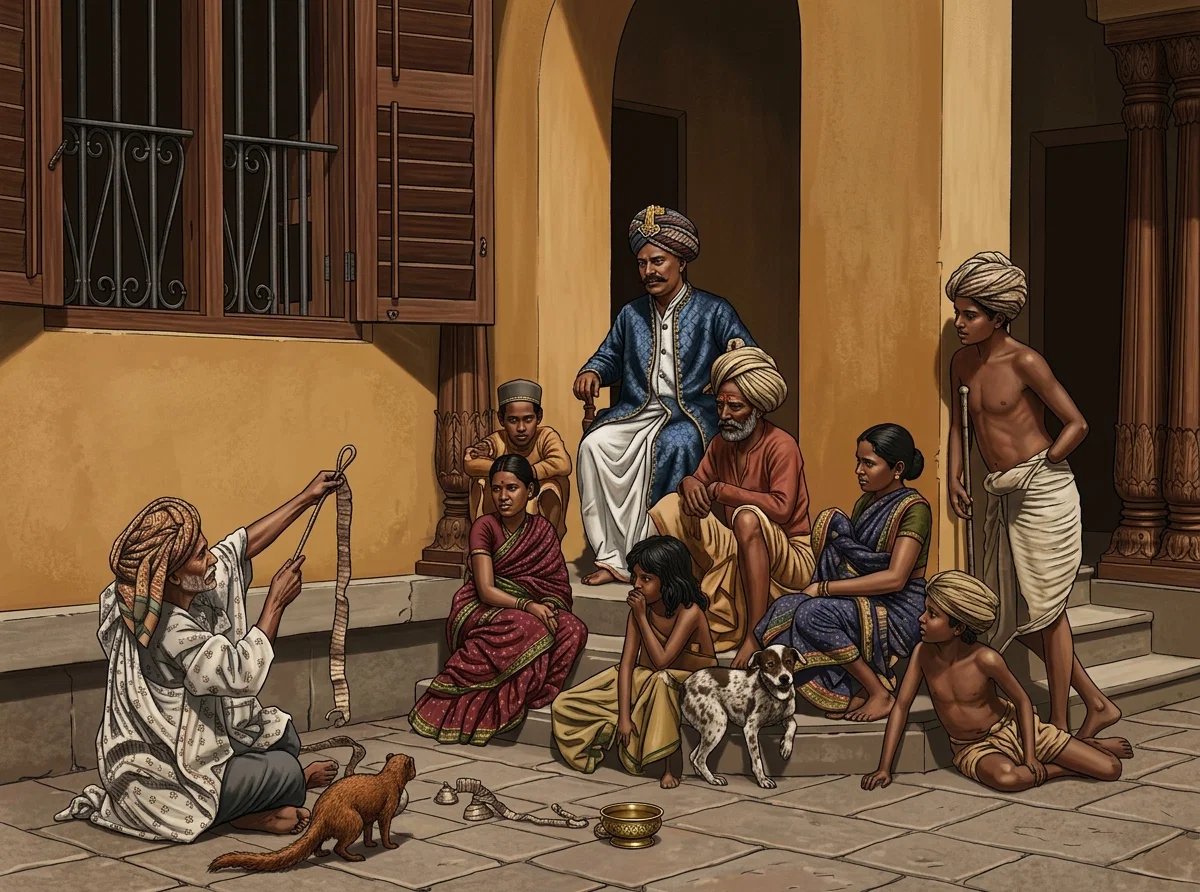
An East Indian Magician.
In the rainy season he has an umbrella made of the same material as his hat, with a bamboo stem. Seldom will you find a prosperous chasa; and no wonder, when he is a prey to the village money-lender or his own landlord who advances him money on interest; and so at harvest time he sells his grain much below market rates to those India Shylocks. Then again numbers are cheated in the weighments. Other chasas are employed as day laborers by planters, and these poor men are even worse off, I know for a positive fact, than in the Tirhoot District; he is paid at the rate of three cents a day, which is scarcely enough to give a man a square meal, to say nothing of supporting a family. A nephew of mine, who was in that region two years ago, said it was a pitiable sight to see these poor beings rubbing the paddy in their hands and eating it. They preferred taking the paddy to pice (coppers), everything that year being at famine prices.
The Bengal chasa lives on dal and rice, and occasionally vegetable or fish curry. The natives of Bengal are large consumers of fish, as it is plentiful and very cheap; they seldom taste meat except perhaps at some notable festival. They also indulge in palm toddy and liquor made from rice. Large numbers smoke the hemp drug, while others eat opium, and some smoke fiendish preparations made from opium, known as chundoo, muddock, etc. These last named are so injurious that the government inflicts a heavy fine with imprisonment on all men who keep these dens.
The chasa of the North West Province differs slightly in one or two respects. For instance, he smokes little but chews tobacco a great deal. His principal food is wheat flour chappaties (hard or unleavened bread) and dal. There are millions of these poor ignorant men and women who are enshrouded in the grossest darkness imaginable. Missionaries are laboring among these classes, but the ordinary run of native Christians one meets raised from their ranks are at their best nominal Christians. The declaration made at our home by an old Baptist missionary will show the quality of Christians I mean. He said “I baptize them, but I would not trust them farther than I could see.”
One of India’s greatest needs is an army of thoroughly trained native Christian workers, who would go out in the spirit and power of Elijah and turn the hearts of thousands of these erring ones from the power of darkness to light, and from the power of Satan unto God. These workers would be able to meet these poor classes, as it were, on their own ground, live among them, work with them, and preach to them; in this way much better results would be obtained. But from where are we to secure this quality of workers?—By the establishment of good training-schools for native children, where they could get a sound education and training that would fit them for such work.
If I may, I will here mention the Karmatar Orphanage, which was started by the late Pastor D. A. Robinson of our Mission. This little institution could be worked up and made into a first-rate training-school; funds, of course, would be needed for this work. We of India are sensible of the great love of our American brethren for us, and of their liberality in supplying our needs, and yet India still needs your help. GEORGE GWYTHER.
Calcutta, India.