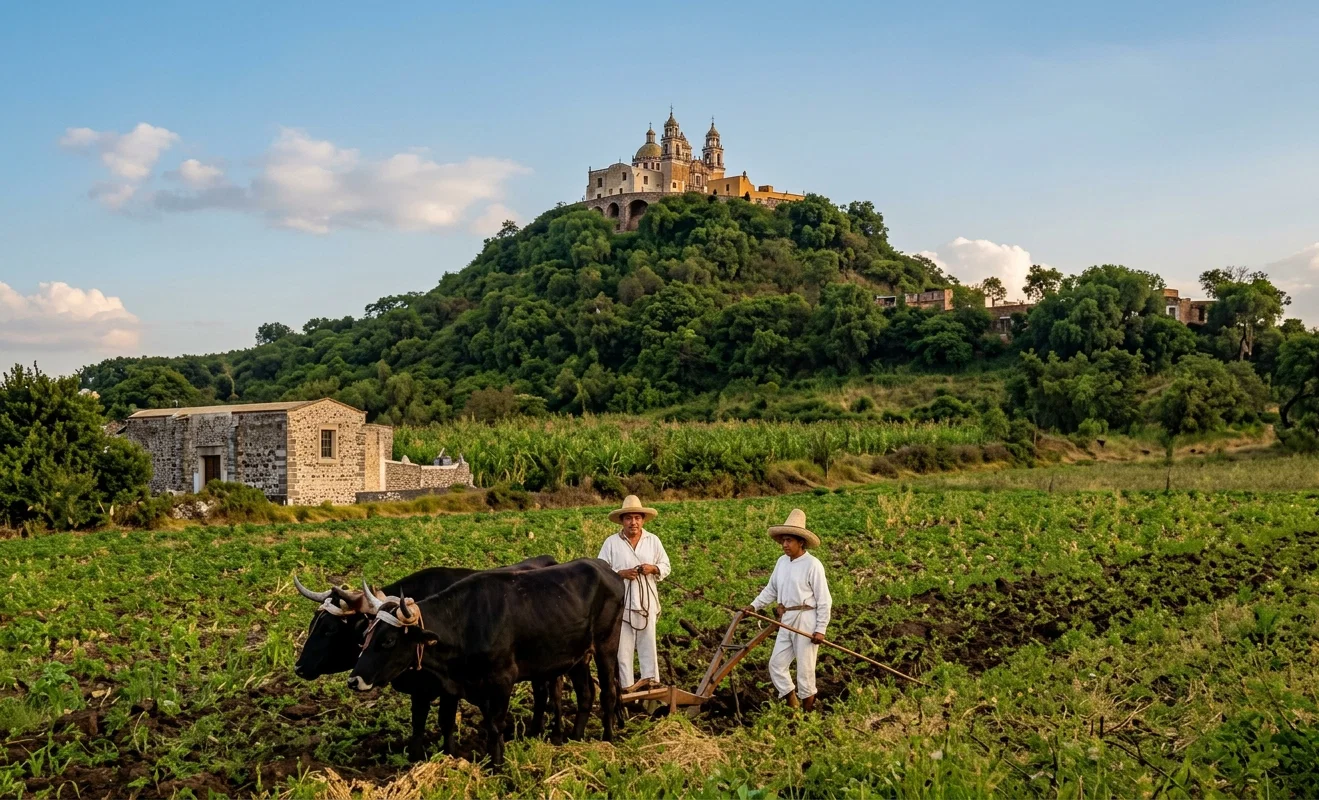
CHOLULA is a small village about nine miles from the city of Puebla, Mexico. The date of the building of the pyramid of Cholula is unknown. Even before the Aztecs came to the plain of Cholula, the great pyramid was there in the midst, and the people told them the legend of it, that it was built by a race of giants descended from two survivors of a great deluge that overspread the land, and whose intent it was to raise its heights to heaven; but they incurred the displeasure of the gods, who sent forth fires and destroyed them. This is the legend, and it is indeed coincident with the Chaldean and Hebrew accounts of the deluge and of the tower of Babel, of which there is much in the traditions of these people that is similar to the accounts of the Bible.
Pyramid of Cholula, near Puebla, Mexico.
On the summit stood the sumptuous temple of the mystic deity, Quetzalcoatl, “god of the air,” whose image was there, under its pinnacled towers, as the chronicler says, with ebon features, wearing on his head a miter waving with plumes of fire; a resplendent collar of gold was about the neck; pendants of mosaic turquoise in his ears; a jeweled scepter in one hand, and a curiously-painted shield, emblem of his reign over the winds, in the other. Cholula was, in those ancient days, what Rome is to-day. Pilgrims came from hundreds of miles, as do the Mohammedans to Mecca, to bow down before the temple of Quetzalcoatl, in the holy city of Anahuac. Cortez declared that he counted four hundred towers in the city of Cholula, yet no temple had more than two, and some only one. High above the rest rose the great temple of the pyramid, with its never-dying fires spreading their radiance over the capital, proclaiming the return of the deity to resume his rule over the land. Such was the pyramid and city as the Spaniards saw it at their coming, and the people they found there could tell little else of its history than is written here. The temple was promptly thrown down, as was the custom of the conquerors, and a Catholic church placed in its stead, that stands to this day.
This pyramid has the appearance of a natural hill, as its sides are overgrown with trees and bushes. This is but an evidence of its great antiquity, as the interior is composed of alternate layers of sun-dried brick, clay, and limestone. It covers twenty acres of ground, and rises to the height of 177 feet above the plain. A paved road leads up the steep west side, with steps of hewn stone to the arch and cross of the entrance way to the church of Nuestra Señora de los Remedios, on the very top. From the balconies the view of the valleys and surrounding mountains, the many churches, with their glazed tile towers, and the towns and villages of the plain, is superb.
The town of Cholula has dwindled from the great capital of a mighty nation to less than 5,000 people. But notwithstanding this, as I stood upon the top of the church, which is on the top of the pyramid, I counted forty-five Catholic churches in the town and near-by. As I viewed these many churches, my thoughts were carried to the condition of our work in this great republic. My heart was indeed sad to think that while the enemy has so many churches, where he is holding the people in darkness, we have not a single church building in the entire republic. On nearly every large farm they have one or more churches. They do this in order to keep the natives on the farm. For, if they have no church on the farm, the natives have an excuse to go to town to mass.
There are two other pyramids in Cholula, the Cerro de Acozac, and the Cerro de la Cruz. Acozac, about 1,300 feet southwest of the great pyramid, is forty-nine feet high, with base lines of fifty-five to 150 feet. The sides are vertical, and a ladder is necessary for the ascent. According to tradition, this mound was to the people that built it what the city of refuge was to the Israelites. The Cerro de la Cruz is about 350 feet west of the pyramid itself; it is forty-four feet high, and has a base 1,230 feet in circumference, and 460 feet at the top. Both these cerros are of adobe bricks. Tradition says that on the Cerro de la Cruz Cortez caused the first mass to be said in 1519. On the plains round about are numerous other cerros, or cerritos, as they are much smaller.
The day that I visited the town of Cholula, I had the privilege of selling fifty-seven copies of our Mexican paper, El Mensajero de la Verdad. I sold some as I was going up the steps to the church, and I left one with the woman that takes care of the church. All we can do is to sow beside all waters, and we know that in due time God will give the increase. Our hearts burn within us to see workers in all parts of the republic, giving the last message of mercy. And we believe that the day is not far distant when we shall see the message going with a loud cry in this darkened land. For the Lord has promised to cut His work short in righteousness. And from the many letters that we are receiving from our dear brethren and sisters in the States, whom the Lord is impressing by His Holy Spirit to come to this field, we can see how this work can be accomplished. A. G. BODWELL.