THERE are two phases to a woman’s life in Porto Rico as elsewhere, viz., the public or social phase, and the private or home life. I propose to tell our American sisters something about these, so that they may understand how the women live here.
Starting from infancy, a little girl’s life here is much the same as elsewhere; the same pleasures and the same baby sorrows enter it, and the same motherly love watches over it. The first change may be said to enter her life when she goes to school, if she is so fortunate as to enter one. She then enters, to a certain extent, into the social world, and has to be jealously watched and guarded from all suspicion or appearance of evil. She is not allowed out of doors alone, but must be chaperoned on all occasions. This, of course, refers to a family of what is called “la primera,” i. e., the first class of society. The lower in the social scale a family may be, the more lax are all these social rules.
Hitherto the education received by the women of Porto Rico has been very meager. They have learned reading, writing, and arithmetic fairly well, and then have been taught sewing, embroidery, crochet work, music, and painting. These last two arts were only attainable, however, by the rich. Our readers will wonder why the girls never received more education. The fact is that there were only three avenues open to them to self-maintenance,—marriage, school-teaching, or such work as dress-making, laundry work, or domestic service. Then what use was there in educating one’s daughters? The drudgery work was left to the poorer families, and the whole aim of the average girl’s life was to look pretty so as to capture some desirable young man as a husband.
Girls are carefully drilled in social etiquette and manners, the art of looking pretty, and all the various accomplishments that might aid in furthering this aim, such as dancing, singing, graceful carriage, etc., etc.
The liberties allowed to the girls in the United States never enter a girl’s life here. A young man can never take her out for a walk, drive, or to the theater, without a chaperon; nor can he ever interview or visit his “novia” (i. e. fiancée, or sweetheart) alone. To do so by stealth would be to ruin the young lady’s reputation. The young men here are the staunchest supporters of this idea. While they are as “wild” as their Northern brothers, they would not dream of asking for a girl in marriage whose reputation is questioned in the slightest degree because of any “escapades.” Of course, then, as the marriage state is most desirable, the girls do not demand such liberties as do their American sisters.
Do not imagine from this that a girl’s life is at all commonplace. Household work keeps her pretty well employed if she is poor, and direction of the servants, fancy needlework, and social duties if she is rich. All classes of society have their visits, dances, and church duties at very frequent intervals. These furnish her a chance to prove herself attractive and to captivate. The poor girl of good but poor family has to practise rigid self-sacrifice in order to keep pace with her wealthier associates. This self-sacrifice will often take the form of seamstress work, candy-making for street sales, or even of going without her meals, so as to be able to buy a new dress for the carnival ball, or for the casino, the “novenas” of the church, or other social events such as these.
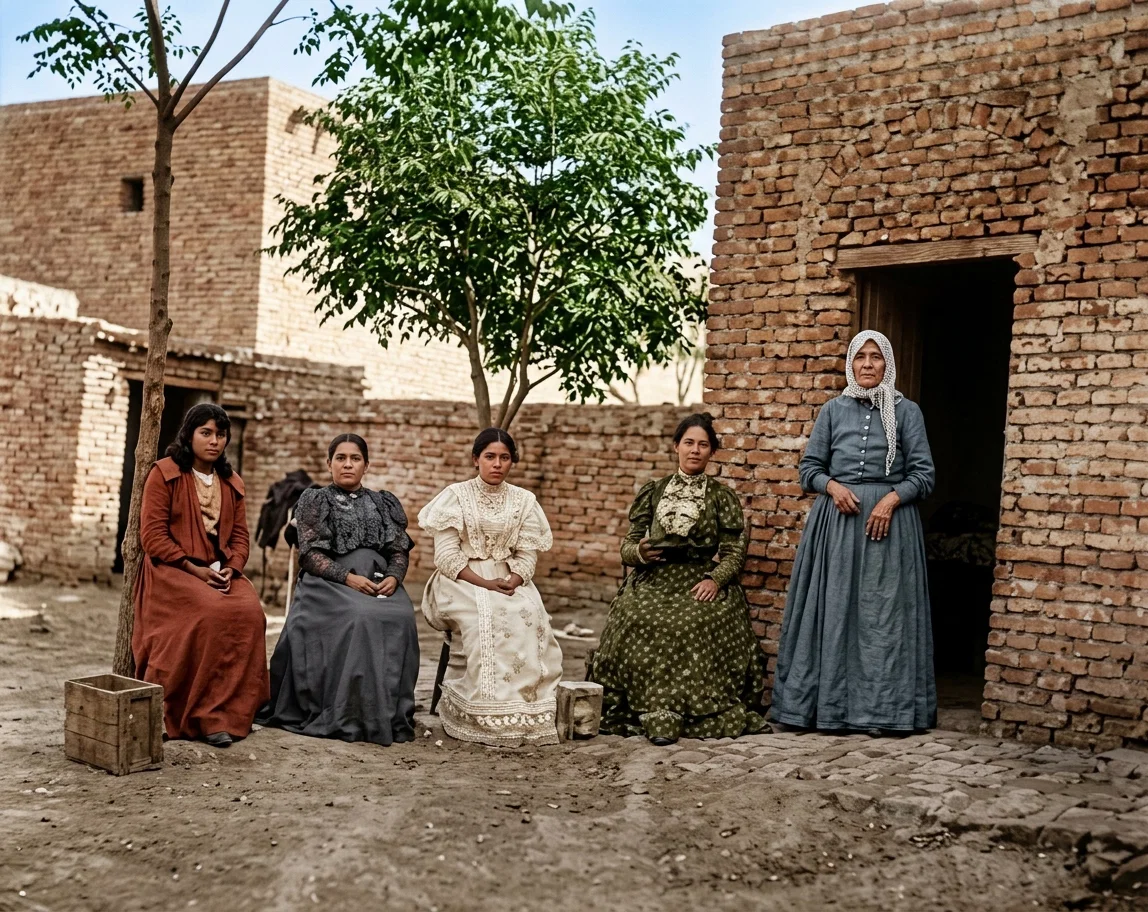
Group of Porto Rican Women.
As a rule the Porto Rican girl is decidedly pretty, of a somewhat pronounced brunette type. She is very tasty in her dresses and costumes. These are generally made from copies of Parisian “creations,” altho some of the prettier American patterns are being followed lately. The materials are of course light to suit the warm climate, such as muslins, batiste, silks, satins, lawns, etc., etc.
In towns such as San Juan, Ponce, and Mayaguez, one of the regular social functions is the open-air band concert on the plaza. All the “eligibles” are out for a promenade. They are all prettily gowned, and the hair prettily “fixed up.” This last is very necessary, as they go bareheaded. The “mantilla,” so common in other Spanish countries, is seldom used here, but a few flowers take its place to add to the wearer’s natural attractions.
Let us suppose now that the señorita has attracted some desirable young man. He generally tries to feel sure that his affection is reciprocated. This is at times very difficult to ascertain. The señorita fears he may be trying to trifle with her affections, and returns no signs of her feelings. The young man then gathers courage to tell her frankly of his love. She does not answer “yes” definitely; if she refers him to her parents, this is considered sufficient. To the parents he must go, then. If the parents consent, the engagement is announced.
Now begins another stage of the girl’s life. Her affections are whole-hearted and individual. She has plighted her troth; her fiancée’s slightest wish is law to her, and she obeys without question. He will not allow her to receive visits, or walk, or correspond with any other young man. She must not dance with any other than he, and she obeys. Often the lover will test his fiancée’s fidelity to him by putting her to the proof. If she stands the test, his love is deepened; but if not, the match is broken off. And she generally does stand the test, if for no other reason, because she knows that the young men will not look at a girl who has been engaged two or three times; for they say there must have been some cause for breaking off the match.
The engagements, as a rule, are of long duration, sometimes running for five or six years. Cases have been known of their lasting for ten and twelve years. This is, of course, a severe ordeal for any girl, knowing, as she does, that the young man may back out after all.
The saying here is, “that a father keeps his daughter under lock and key all the time she is single; and when she does marry, he simply turns the key over to the husband.” This explains the regime in a few words. It is true in most cases; but there are some husbands who are more enlightened, and give their wives a great deal of liberty.
Seldom indeed do the Porto Rican wives abuse their privileges or their position. Their great fault, if they have any, is that they are too docile and meek. There are few husbands who respect their marriage vows, but the Porto Rican women are model wives and mothers. They keep their homes above reproach. If they are poor, they will slave their lives away to economize for their husband’s and children’s benefit. If their husbands fail or prove unfaithful, they suffer with a patience and fortitude that is almost inexplicable.
Once married, the señora’s part in society life is merely passive. If wealthy, she figures as an entertainer and as a member of some charitable or religious organization. But her dances are past, unless it may be occasionally with her husband or a brother as a partner. She now enters the festivities only as chaperon to her sisters, daughters, or young lady friends. Most of her time is passed in housekeeping, entertaining, and looking after her husband and children. These duties she generally fulfils very well. She is a charming hostess, loyal friend, and loving companion.
In all stages of her life, the religious duties enter. A small proportion only in Porto Rico are unreservedly Catholics, and religion is only a form or social duty, necessary to society because it upholds law and order. They know nothing of Protestantism, and in their imaginations generally class Protestants among freethinkers and infidels. If Protestantism were fashionable here, thousands would join so as to be popular. Very few have ever seen or read a Bible in their native tongue. Long accustomed to a religion of appearances, they see no necessity for a doctrine that teaches a change of heart. They are whatever their husbands are. How, then, can they be reached?—By literature, by personal work, and by medical missionaries. If they do not want to come out to hear the Gospel, it must be taken to them. Now, since social etiquette here prohibits interviews with male workers even on religious topics, we can only work through our sisters.
Dear sisters in Christ, we appeal to you in the name of our Lord and Saviour to consider seriously your share in this work. It may be that He has other work for you either at home or in other lands. We then bid you God-speed, and wish you success in your work. But if you are still undecided as to where your duty lies, will you prayerfully consider the needs of your Porto Rican sisters? Will you take their needs to the Lord in a spirit of self-sacrifice, and ask Him to show you what you can and ought to do? When He shows you, pray, or come, or give, proving by your acts that you really believe the end to be near, and that He is personally leading you. The Lord has a rich harvest here. Who wants to work for Him? His burden is light and His yoke easy, and the reward is great,—a crown of righteousness. Will you not be willing to earn it?