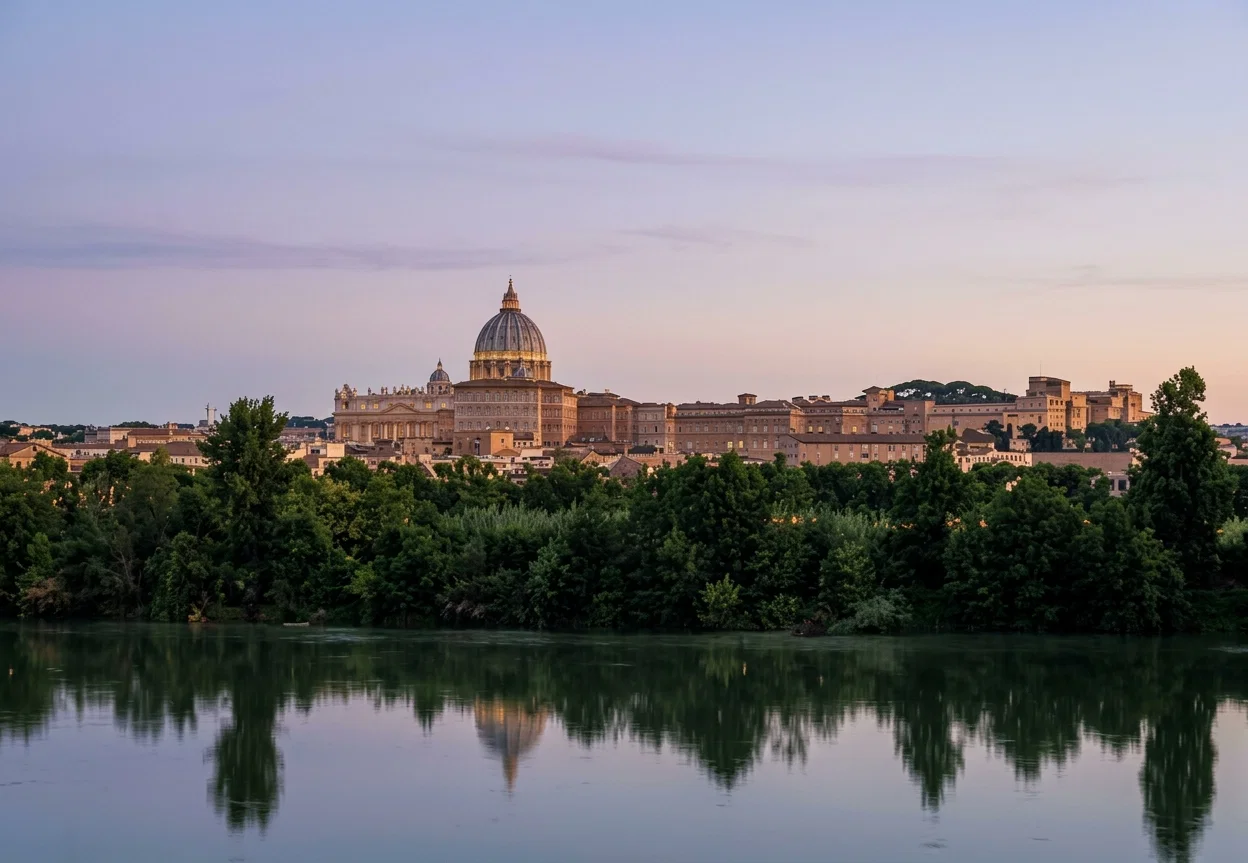
IN the accompanying illustration we have in the immediate foreground a glimpse of the historic Tiber. In the distance, on the left, is a view of the Basilica of St. Peter, and on the right, of the Vatican. Since the return of the papacy to Rome in 1376, after the seventy years' exile in France, the Vatican has been the official residence of the Roman pontiffs.
THE BASILICA OF ST. PETER AND THE VATICAN, FROM THE TIBER.
POPE NICHOLAS V. about the middle of the fifteenth century began the rebuilding of the old palace on a large scale. The work thus begun was carried forward by about a dozen other popes, and the building in its present form was not completed till the reign of Pius IX., in the third quarter of the nineteenth century. The entire mass of buildings, enclosing and fronting on twenty different courts, is computed to contain about eleven thousand rooms. It is especially noted for the splendor of its frescoes, many of which are by Michael Angelo, Raphael, and other great masters. Its museum contains the largest collection of classical statuary in Europe, and its library is famous for its magnificent collection of old manuscripts and rare and early printed books. There is also an immense collection of gems and small objects of value, presented to the different popes by sovereigns, princes, and others.
IN this splendid palace the pope styles himself a prisoner. Why? Not because he is not free to travel over the whole world, if he so wills. But he, the professed vicegerent and representative of the Christ who when on earth had not where to lay his head, asserts it his right, by virtue of his office, to be lord over all lands. Tho Jesus said, “My kingdom is not of this world; if My kingdom were of this world, then would My servants fight,” the pope claims that of right he is king over the kings and suzerain of the world; and so long as it was possible to maintain this high assumption by war and bloodshed, he did so. Now his authority, tho recognized by millions over the whole world, can be exercised up to his high ideal of absolutism only in the Vatican. So here he claims he is a prisoner, for beyond the boundaries of his absolute rule, he will not go.
THE Basilica of St. Peter is the largest church in Christendom. It is in the form of a Latin cross, 613 feet long and 450 feet across the transept. It is surmounted by a dome which rises 434 feet and 9 inches above the pavement, with a diameter of 195 feet and 6 inches. The present building was begun in 1450 A.D. by Pope Nicholas V., the same who began the rebuilding of the Vatican. The church was consecrated by Urban VIII., Nov. 18, 1626, the 1,300th anniversary of the day on which St. Sylvester consecrated the original basilica builded by Constantine the Great, and occupying the same site. Michael Angelo designed the dome of the present building, and nearly completed its erection. Architecture has seldom if ever produced a more magnificent object. The façade also, which is by Carlo Madrino, is grand and imposing. The dome and the façade, the most prominent features of the building, give the impression to visitors of the grandeur of St. Peter's. The Britannica says: “Few people ever seem to trouble themselves to look at any part of St. Peter's except the entrance front and the dome. If they would examine the rest of the exterior, they would find it to be a building without one other redeeming feature, or a single grace of outline or detail, and so absolutely unscientific in its construction and arrangements as to be2 (354)beneath contempt as a complete work of architecture.”
“INTERNALLY, the structure is open to similar praise and dispraise. Gorgeousness in matter, and meanness in manner, characterize the interior of St. Peter's.” “It is not too much to say that throughout the interior there is scarcely an ornament that is not offensive, while not one of them has the slightest natural connection with, or use in, a sacred building. Perhaps sculpture never reached so profound a bathos as in the hideous cherubs which are stuck, like petrified acrobats, against all the piers of St. Peter's.”—Encyclo. Britannica, art. Architecture. After reading from the Britannica this description of the architecture of St. Peter's, we can but feel that the basilica stands as a fitting symbol of the religion of Romanism.
VIEWED externally and casually, that is, considered as a human organization, the institution of Romanism rises like a magnificent dome overshadowing all lands. The entrance front to this structure is made enticingly beautiful by art and music. It appeals to the eye and the ear. Its sacred (?) mysteries, locked in, to them, an unknown tongue, appeal to the imagination of the multitude. It appeals also to the innate spiritual indolence of the human heart, by professing to take the full charge of the soul, and to insure its eternal felicity after the purgatorial fires are past. Then, too, it is hard to find any man or any organization that has always been wholly bad. In the age of anarchy and wickedness which succeeded the breaking up of the Roman empire, the church, bad as it was, was the source of many blessings to the people.
DRAFER, who has pictured the utter corruption of early Christianity in the Roman system, as perhaps no other man has, until it became, to use his words, an “adulterated, festering mass,” says: “But there is another very different aspect under which we must regard this church. Never in the world before was there such a system. From her central seat at Rome her all-seeing eye, like that of Providence itself, could equally take in a hemisphere at a glance, or examine the private life of an individual. Her boundless influence enveloped kings in their palaces, and relieved the beggar at the monastery gate. In all Europe there was not a man too obscure, too insignificant, or too desolate for her. Surrounded by her solemnities, every one received his name at her altar; her bells chimed at his marriage, her knell tolled at his funeral, when even to his friends his lifeless body had become an offense, in the name of God she received it into her consecrated ground, and under her shadow he rested till the great reckoning-day. From little better than a slave she raised his wife to be his equal. In ages of lawlessness and rapine, among people but a step above savages, she vindicated the inviolability of her precincts against the hand of power, and made her temple a refuge and a sanctuary for the despairing and the oppressed.”
SO MUCH for a glance at the externals of Rome, at the dome and façade of the building, so to speak; and in an age when the meanness of all other buildings makes this towering structure look splendid by contrast. But this same historian says: “If there is something grand and imposing about the history of the papacy, its biography is infamous.” He says, too: “No one can study the development of the Italian ecclesiastical power without discovering how completely it depended on human passion and intrigues; how completely it was wanting of any mark of divine construction and care.”
STILL more true is this when we come to examine the religious teachings and practises of the Roman Church. Almost every doctrine and every ceremony came either wholly or in part from paganism. The gods of ancient heathenism grin down upon you from every niche and every pillar of the vast edifice. We can apply the language of the Britannica concerning the ornamentation of the interior of St. Peter's almost word for word against the spiritual edifice of Romanism, and truly say that throughout the interior of the church there is scarcely a doctrine or a ceremony that is not offensive, and out of place in a truly Christian institution. Even the statue of St. Peter under the dome of the basilica, the stone toe of which has been nearly worn off by the kissing of the faithful, is only a statue of Jupiter taken from one of the pagan temples. The keys of St. Peter, the sacred symbols of the pope's office as divine interpreter, are the ancient symbols of Janus and Cybele.
SAYS Bower: “The Romans had, as they thought, till the year 1662, a pregnant proof, not only of Peter's erecting their chair, but of his sitting in it himself; for, till that year, the very chair on which they believed, or would make others believe, he had sat, was shown and exposed to public adoration on the 18th of January, the festival of the chair. But while it was cleansing in order to set it up in some conspicuous place in the Vatican, the twelve labors of Hercules unluckily appeared on it.” So they had to change this chair for another; but unfortunately they made small improvement. “If the former chair was borrowed from the pagans, the next was purloined from the Mussulmans; for when the French soldiers under General Bonaparte took possession of Rome in 1795, they found on the back of it in Arabic, this well-known sentence from the Koran: ‘There is no God but God, and Mahomet is his prophet.’”
THE Church of Rome has resisted all efforts to emancipate her from the Pagan corruptions of the Dark Ages. To-day she is the dark shadow which prevents millions of poor souls from seeing the Gospel light. She stands for spiritual tyranny and oppression instead of the liberty of the sons of God. She thrusts her mighty organic whole between each individual soul and God, ordering and prescribing its every belief and practise, and professing, in return for its support and its attendance on her confessional, to insure it against eternal fire. Thus the soul is defiled by the woman instead of following the Lamb whithersoever He goeth. See Rev. 14:4.
SADDEST of all! O, infinitely sad! she makes multitudes believe that they are saved and all right, thus silencing the voice of God in their souls, while they bear on their very faces, in the deepening, hardening lines of vice and sin, the evidence that they are lost and are being lost more and more. It is for this reason that we protest against Romanism, because the Romanist we love and long to see saved. We protest against it because it is the mighty last-day beast-power that shall so overshadow the earth that “all shall worship” it, “whose names are not written in the Book of Life of the Lamb slain from the foundation of the world.” We protest and warn all men against it, because the Scripture says: “If any man worship the beast and his image . . . the same shall drink of the wine of the wrath of God.” Dear reader, we beseech you, be warned.