THE KREMLIN

4%

Pacific Press Publishing Company · Oakland, California · May 21, 1902

FromSigns of the Times, Vol. 28, No. 21.

Read the full edition

THE KREMLIN.

Russia and Its Beginnings.
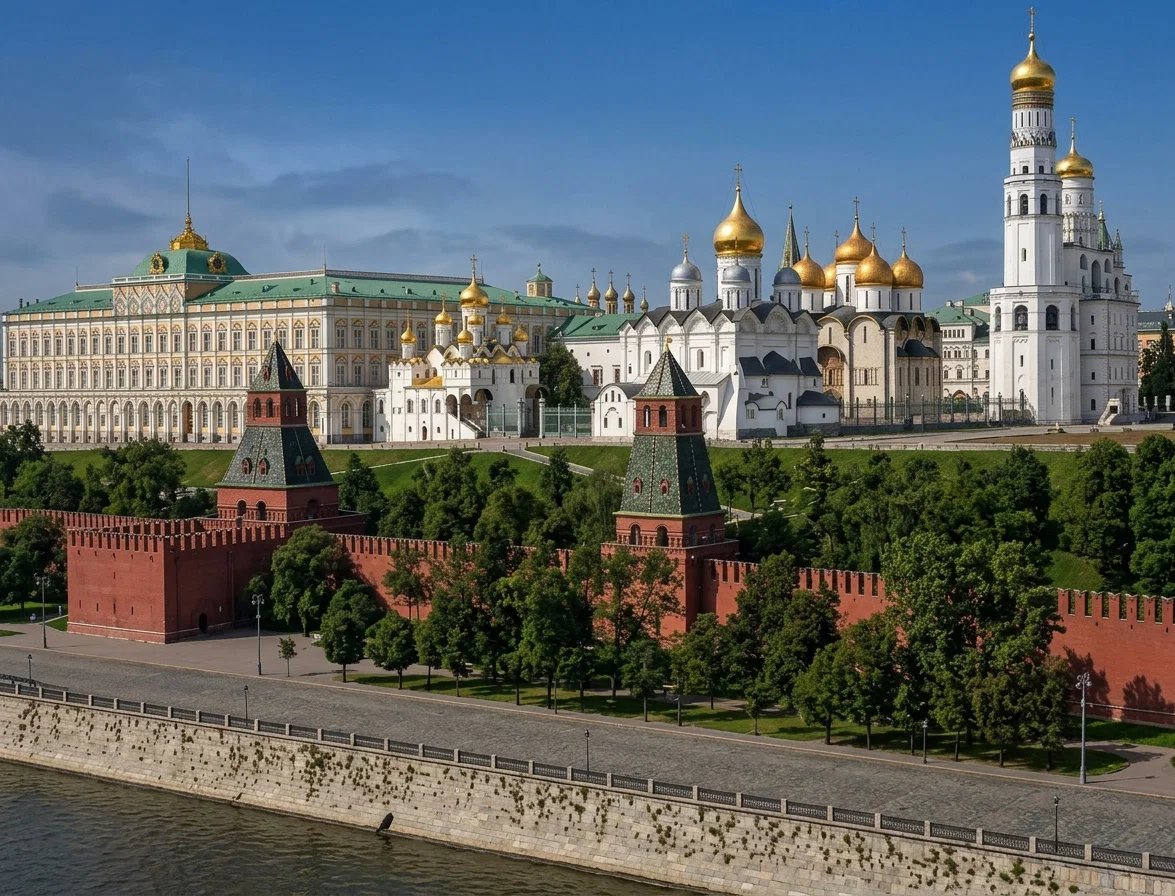
The empire of Russia extends over a seventh of the territorial surface of the globe, containing 8,082,970 square miles. It probably derived its name from Russalki, the supposed goddess of the waters and the woods. There is fitness in this name, as more than one-half of the empire is covered with forests and woodlands, oak, lime, maple, and ash trees predominating. The southern portion contains some of the richest grain land in the world. The population numbers about 90,000,000.
THE KREMLIN.
THE KREMLIN.
Church and State are united. Error and superstition reign on every hand, as in every land where men try to govern the consciences of other men, and dictate to them concerning matters which pertain alone to the worship of God. When man is left alone with God, the Lord guides him in his religion and worship, leading him into light and truth.
The empire was founded by Rurik, a Scandinavian, who settled at Novgorod about A. D. 862. The country had been inhabited for more than a thousand years by the Slavonians, from whom the present Russian people descended. They were savage and barbarous, and, in common with all savage nations, they regarded woman as the natural slave of man. Polygamy was allowed. When a husband died, his widow was usually put to death, that he might have his slave in the other world soon after his arrival. This naturally followed their faith in the continued conscious state in death.
Christianity alone gives to woman her true place. “There is neither male nor female; for ye are all one in Christ Jesus.” She is not the slave of a savage, nor a goddess for worship, as taught by infidel France in her “Reign of Terror.”
The Roman Catholic faith was early introduced into Russia, and the first church was built in A. D. 868 at Kieff. In this place Queen Olga reigned during the minority of her son. She became the first royal convert to the new faith, and went to Constantinople for baptism. Her life, both before and after baptism, was one of revenge and cruelty, showing little proof that the transforming power of God’s Spirit had ever been with her to the intent and purpose for which it is given. Nevertheless she is, by the church, still held to be a saint, the first native saint of all Russia. The native saints are regarded more highly than those who lived in other countries, as they are supposed to be more in sympathy with the wants of the people. Paul, Peter, James, John, and others are regarded as saints; but their portraits, or images, are seldom seen, while those of native saints abound.

How the State Religion was Adopted.

Choice of religion was made, for the empire, by Vladimir, the grandson of Olga. Judaism was rejected because it had no national temple or political status. Romanism involved the recognition of a pope who claimed civil as well as spiritual authority; therefore it was rejected. Mohammedanism was regarded with great favor, only that it prohibited wine. Said Vladimir, “Wine is the delight of the Russians; we can not do without it.” The Greek religion was then accepted, not because it wasthe truth, but because it best suited their desires and conveniences. How many others rest at least some portion of their faith on the same foundation,—desire and convenience.
Vladimir considered himself of too great importance to be baptized by any of the priests in his own kingdom, who were generally poor and ignorant. He was unwilling to acknowledge the necessity of going to some other kingdom for the baptismal rite. To help himself out of these difficulties, he made war on the Greek empire, that he might be able to take some prominent priests captive, carry them to his own city, and there be baptized by them.
Having taken the city of Cherson, he returned home with captive priests, and ordered all the people of Kieff, old and young, to be baptized.

Superstition.

Such superstition exists in Russia that the farmer does not consider the soil or weather with reference to plowing, but begins his work on St. George’s day. The cattle are turned to pasture on St. Stephen’s day without regard to the condition of the grass. The apples are not picked because they are ripe, but are gathered on the feast of Mary.
Every peasant has some hideous idol in his room; and the superstition is so great that, it is said, they sometimes cover the idol up, lest it see them do wrong.
Moscow, a city of 400,000 inhabitants, once the capital of the empire, contains the Kremlin, a massive pile of buildings, including the imperial palace, the archiepiscopal palace, the cathedrals of the Assumption and of Prorovskoi, and the churches of St. Michael and the Annunciation. Here is the belfry of Ivan Veliki, and the “great bell” of Moscow, which weighs 360,000 pounds. Tho it is broken, the people are not without a bell; for the city contains three thousand other church bells.
When Napoleon’s powder-wagons exploded near one of the gates of the Kremlin, the people claim that the picture of St. Nicholas, hanging on the wall, saved the place; that while the tower of the gate was shattered, the rent ceased as soon as it reached the saint’s picture. St. Nicholas is the patron saint of all Russia.
In the czar is vested the executive and legislative power in both civil and religious matters; he is the head of both Church and State. When he speaks, his word is law. When Vasilii in the 16th century lost half his army on the field of battle, the people were taught to maintain stoutly that not a man had been lost in battle.
The ignorance and superstition of the people were manifested when Ivan the Fourth reigned. One morning in the winter of 1565, the court of the Kremlin was full of sledges laden with furniture, crosses, images, and relics of saints. The people assembled, and gazed in wonder. Ivan and his family came from the palace, went to mass in the church of the Assumption, and, extending his hand as if to say farewell, drove away. The people were frantic, and wildly exclaimed, after this cruel tyrant, “The czar has forsaken us, and we are lost.” Having accomplished his purpose of frightening his ignorant subjects, he returned to the Kremlin.
This same Ivan, for the sake of plunder, made a charge against the people of Novgorod, and forged a letter to sustain it; and here put to death 60,000 men, women, and children, every one of whom he knew to be innocent of the charge made against them. In a moment of anger he smote and killed his son, and soon after died in misery and fear. And in the Kremlin, in the church of the Archangel Michael, lie side by side father and son, waiting that great, and to many, terrible day when Christ shall come and “render to every man according to his works.”
The blind slavish condition of the people may be seen by an inscription at the Kremlin which, after stating that Ivan died in 1584, the 19th day of March, calls him “the orthodox and Christ-loving lord.” Emperor Nicholas, who died in 1855, said, “Let there be no mind in Russia. I, Nicholas, the czar, so will it.”

Unrest and Conspiracy.

But with this despotic government, and the blind servitude of the people, there are continual intrigues, assassinations, and poorly planned rebellions, keeping the rulers in constant fear. And thousands of the people are marched across the wilds of Siberia, to work in the cold, damp mines, forever shut away from home and loved ones, because, perhaps, they have offended the czar, either in civil or in religious matters.
With all this blindness, how many hearts have yearned for just such truth and light as God is giving us. Who will be the light-bearers to carry the Word of God to this people? The law of the government does not permit one to teach any religion differing from that of the empire; but any one can hold his own views provided he does not teach them; therefore one can go and say, “What does the Bible say about images in Ex. 20:4-6? What does it say about the Sabbath in Ex. 20:8-11?” But it would not do to say, “Thou shalt not make unto thee any graven image,” or, “The seventh day is the Sabbath;” yet as a man reads for himself, he will soon see what the Lord requires.
Pray to the Lord of the harvest that He will “send forth more laborers into His harvest,” even into the Kremlin and to other parts of benighted Russia, that it may be said of the people there, “The people that sat in darkness saw great light.” W. M. HEALEY.