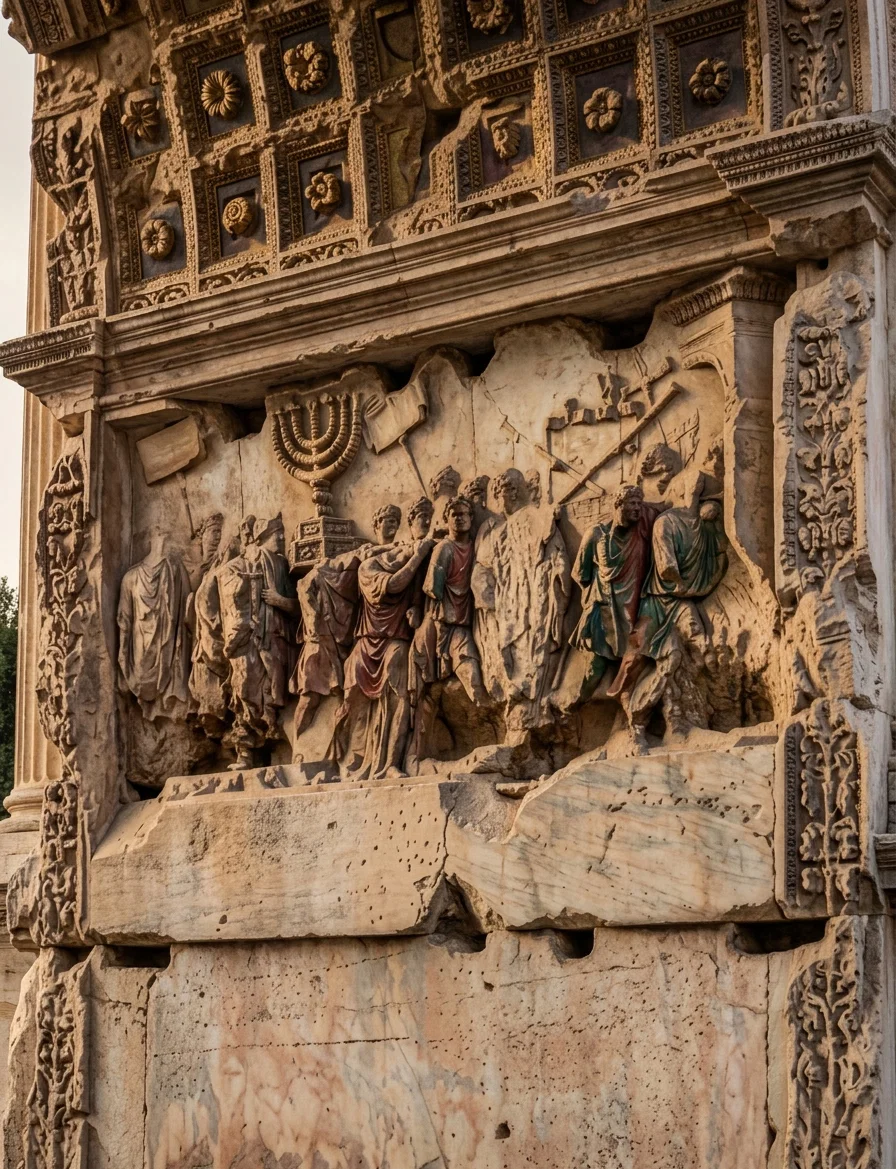
ARCH OF TITUS

4%

Pacific Press Publishing Company · Oakland, California · May 14, 1902

FromSigns of the Times, Vol. 28, No. 20.

Read the full edition

“ARCH OF TITUS.”

Illustrating Rome’s Victory; Israel’s Downfall.

Surety of God’s Word.

THE ARCH OF TITUS.
THE ARCH OF TITUS.
THE Bible tells us that “the Word of the Lord endureth forever.” Tho all flesh is grass, and all the goodliness of mankind as the flower of the field; tho all the works of men may appear and vanish,—the Word of God will certainly abide. Heaven and earth even may pass away, but the words of the Lord will surely remain. If God’s media, the human family, should fail to be true to the mission of calling the attention of the world to the truthfulness of His unerring and eternal Word, He would make the very stones to cry out. And the unspeaking, crumbling material would ring out in silent yet clear tones, the true, the sure, the never-failing, the immutable Word of the Lord. In this way the Lord would prove to men that His Word would accomplish its mission for Him.
Such has been the mission of the apparently impregnable and magnificent “Arch of Titus,” one side of which is represented in the illustration. Nearly nineteen centuries have come and gone since this structure was reared. Wind-storms, rain-storms, tornadoes, cyclones, earthquakes,—the combined forces of earth, sea, and sky,—have united their destructive elements to lay in ruins the many mighty achievements of the “men of renown” who were its builders; nevertheless the mighty power of God, who sees the end from the beginning, and in whose hands are the depths of the sea, has preserved this lofty work of man as a testimony to the world and for the benefit of the church—not to exhibit the greatness of man’s skill, but to impress people with the wonderful truth that the words of Christ will surely come to pass. At the same time it will condemn the world, if they believe not the faithful testimony of the words of the Spirit.

Rome’s Purpose in Building the “Arch.”

THE “Arch of Titus” was built by the Romans to commemorate and perpetuate their victory over the Jews, when they destroyed Jerusalem and all its sacred mementoes; making but desolation of all that was once grand, blessed, lofty, soul-inspiring, and glorious to the Jewish people. Many were the wars and strifes between the Cæsars and the Jews for over two centuries. Time and again did the Jewish people seek to free themselves from the slavery of the iron monarchy. But no! Israel wanted a king that they might be like the nations around them, and they finally preferred to have no other king but Cæsar. When their own blessed Lord and King came to rule over them, and through them herald the good news of salvation to the ends of the earth, they cried, “Away with this man, and release unto us Barabbas.” “Crucify Him.” We do not want Him; we want Cæsar. We will have Cæsar. “We have no king but Cæsar.” To which God replied, “As ye have spoken in Mine ears, so will I do to you.” When they sought repeatedly to liberate themselves from Cæsar, Heaven confirmed the choice made by the people on earth.
Cestius Gallus, procurator of Syria, determined to humble Israel in the dust, and forever to silence her haughtiness and pride. After besieging the city of Jerusalem, he was about to strike the fatal blow, when finally he raised the siege and suddenly beat a retreat. The Jews pursued their enemies quite a distance from the city, harassing and aggravating the Romans, and inflicting severe damage. Some months afterward Titus resumed the siege, and never left the city till he had laid it to the ground, and brought with him the victor’s spoils, which have been portrayed upon the wonderful arch that bears his name.

God’s Purpose Being Fulfilled.

GOD, however, had a purpose He was accomplishing in the apparent retreat of Cestius; and this was the fulfilment of the Saviour’s words to the disciples as recorded in Matt. 24:15–18; Mark 13:14–16; Luke 21:20–24.When the disciples saw the Roman armies gathering around the holy city, they knew that the time had come for them to flee and for Jerusalem to be destroyed. But how could they flee when surrounded by these hosts? Ah! God knew how, and He opened the way for them very plainly by the retreat of the Romans.

Representing the Spoils.

THE object at the left of the illustration represents “the book of the law,” tho this is greatly marred on the statue. Besides this there is a sign-board such as the Roman standard-bearers carried to inform the public what the object was, and whence the captives came. Toward the center of the picture is the seven-branched golden candlestick with its sign-board. Continuing to the right, we see the table of showbread, with two cups upon it and two trumpets in front, accompanied with another sign-board. Jewish writers tell us that there were many other precious spoils taken from the temple; but these were not sculptured on the arch. The reason evidently is that the things represented were taken from the holy place, and were therefore considered to be the most important and most sacred.

The Glory of the Second Temple.

IT is well known that in the second temple a number of objects were missing which had been in the first temple, built by Solomon. The ark was not there. The tables on which were the Ten Commandments were missing. The Urim and Thummim were gone. The spirit of prophecy was no more. The Shekinah was absent. Yet God had promised the people that the glory of the second temple should exceed the glory of the former. Was this true?—Most assuredly; God always fulfils His promises. Then why all this trouble upon the Jews?—Simply because they did not see the “veiled and unveiled” glory in the person of Jesus Christ, the blessed Messiah. He was the Glory of God that filled the temple with the Shekinah. His glorious presence and person adorned and beautified it. The Jews, instead of seeing in Him the beautifier of the temple, regarded the wealth that had been lavished upon it by Herod and others as the greater glory; this they supposed was the fulfilling of God’s promise. The gold and silver on the altar were to them more than the altar itself. The adornment of the beautiful building meant more to them than He meant, who was the Temple of God. Since they rejected Him, and simply saw the gold, the silver, the brass, the wood, the stone,—the outward material,—placing all their hopes on these perishing substances, what could God do but sweep them away in the great destruction of fire, and not leave one stone upon another that should not be thrown down? Neither Gerizim nor Jerusalem commended itself alone to God. God wanted people to worship Him in spirit and in truth. The service must be heart worship.

Results of Not Learning God’s Lessons.

ISRAEL did not learn this lesson, tho the Lord endeavored for centuries to teach it to them. He had the first temple destroyed that they might know that the worship of God does not consist in saying, “The temple of the Lord, the temple of the Lord, the temple of the Lord, are these.” When they returned from Babylonian captivity, they still refused to know God’s way of worship, and put man in His place. Later they failed to believe Him, the blessed and precious Temple in human flesh, in whom the Holy Ghost, the Shekinah of God, abode with all fulness. Through Him other lives were to be made temples for the same blessed Spirit. But Him they refused, while they continued to build temples and synagogues, lofty and grand. Therefore the Lord destroyed their temple, their city, their national and religious pride, so that to this day they are a byword, a reproach, a hissing, to all peoples of earth.

Lesson for the Church of To-day.

CAN not the church of to-day learn a precious lesson from this experience of the Jews? In fact, that is one reason why the Lord has permitted this arch to remain to this day. What great pride the Jews took in their candlestick, their table of showbread, their holy and sacred vessels, which were built at the command of God. But when the life became a mere sham, when the God-life was destitute in the soul, these objects ceased to have meaning, and of themselves were worthless. So the Lord removed them.
Even so it is at the present day. The professed church may build their lofty structures, may dedicate their modern temples, may lavishly adorn and decorate them; but if the truth as it is in Jesus does not abide in the soul; if the life of the Lord Jesus is not manifest in the believer, the day will come, and that soon, when another great conflagration shall take place, and all the temples and religious palaces shall be reduced to ashes, and the professed decorators of them likewise. For Jesus will have gone out and departed from the temple.
DEAR reader, where do you stand to-day? Are you setting your affections upon some outward, earthly, beautiful object, some beautiful church building? Do you feel proud that your name is enrolled upon the records of a magnificent building that it has cost thousands of dollars to erect? Or is the Christ of God, the Heavenly Temple, abiding in your soul, thus making of you a living temple for the Shekinah of God to dwell in? May God help you to let His light and life come into your soul, that when these outward buildings perish, you may have been cleansed, purified, and adorned to dwell with Him in that heavenly temple built without hands, the light of which is God Himself, the glory of which is the unsurpassed splendor of the Lamb.
F. C. GILBERT.