SETTLED in various parts of the most northern territory of the Scandinavian peninsula lives a singular people generally called Lapps, or Laplanders. In the mythical sagas of Scandinavia the Lapps are represented as an inferior race, distinguished only for craft and treachery, and addicted to practises of sorcery. They are regarded, in accordance with the same authorities, as the original occupiers of the whole of Scandinavia, from the fertile and more southern portions of which they were in ancient times driven forth by the superior, god-descended race of Odin, who banished them to the inhospitable regions in which they are now circumscribed.
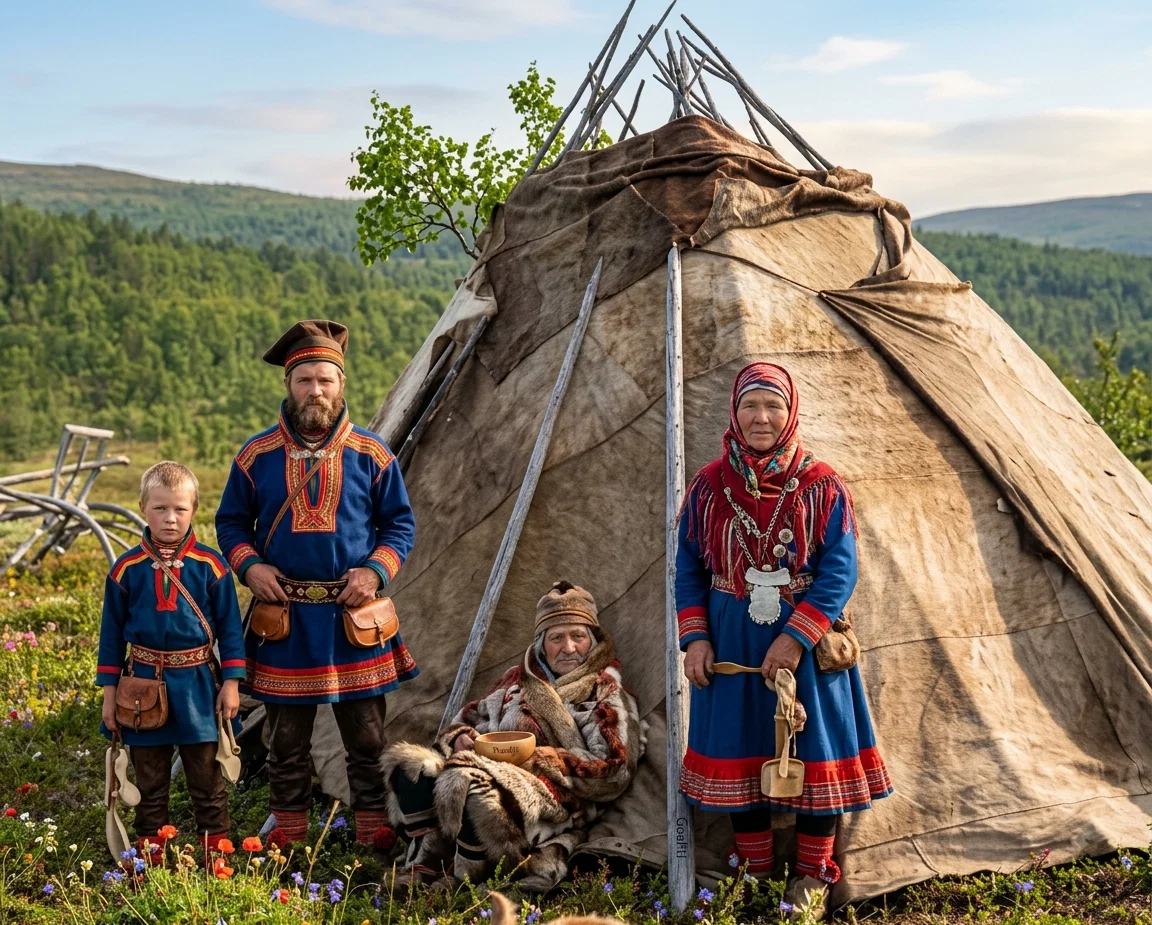
Typical Lapland Family and Summer Residence.
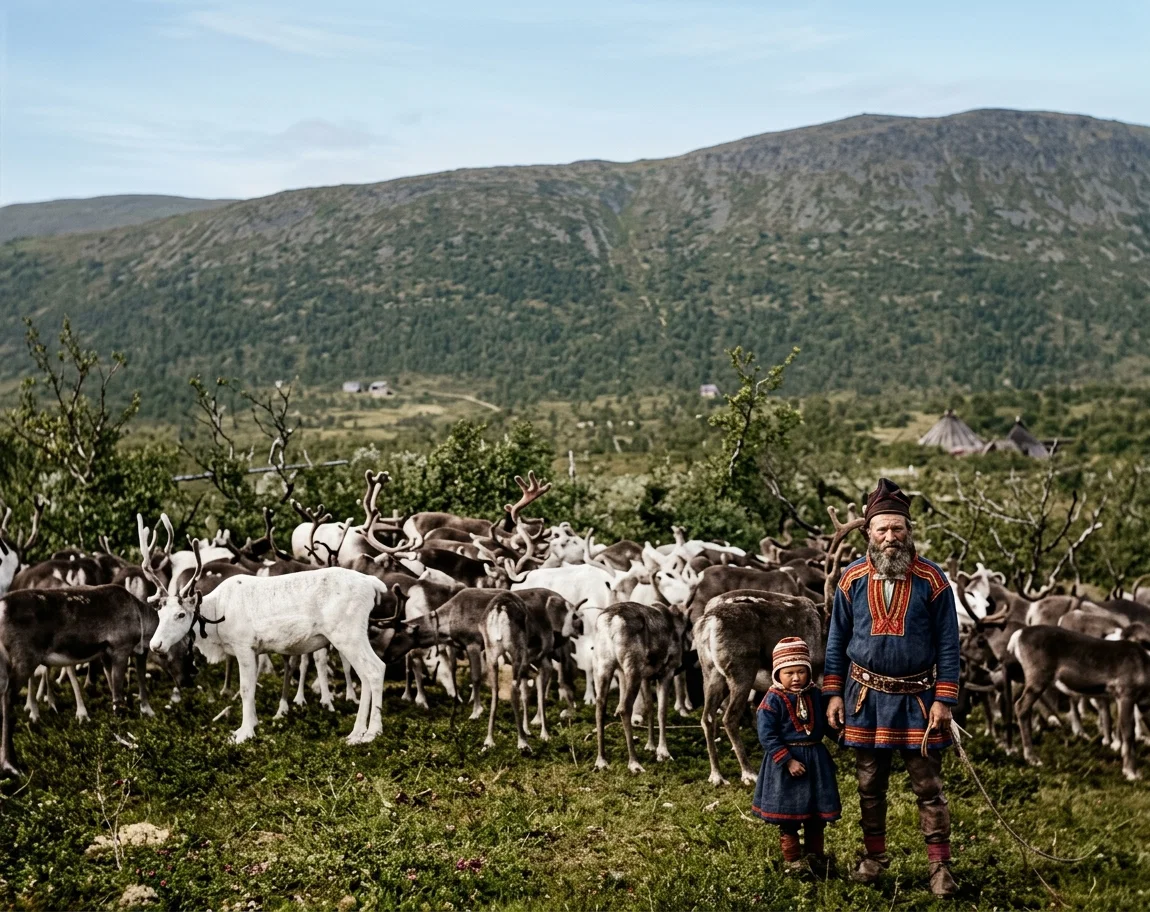
A Lapland Herd of Reindeer.
It is a wonderful country—this home of the Lapps. The ocean roars along its rock-bound coast, and during the long, dark winter the storms howl and rage, and hurl the waves in white showers of spray against the sky. Great swarms of sea-birds drift like snow over the waters, and circle, screaming, around the lonely cliffs. The aurora borealis flashes like a huge shining fan over the northern heavens, and the stars glitter with a keen frosty splendor through the long winter nights. But in the summer all this is changed, suddenly, as by a miracle. Then the sun shines warmly; innumerable wild flowers spring up; the swelling rivers dance, singing, to the sea; the birches mingle their light-green foliage with the darker needles of the pines; the ocean spreads like a great burnished mirror under the cloudless sky; the fishes leap, and the gulls and eider-ducks rock tranquilly upon the heaving bosom of the deep, shining through an endless day.
The Lapps, who are classed in the same family as the Finns, Esthonians, and Livonians, are distinguished in accordance with the nature of their pursuits, as Sölapper (Sea Lapps), Elvelapper (River Lapps), and Fjeldlapper (Mountain Lapps). They are a physically ill-developed, diminutive race, with small eyes, low forehead, high cheek-bones, pointed chin, black, coarse hair, and scanty beard. They are, however, wanting neither in mental capacity nor manual dexterity; and in the seminary for Lapp teachers at Trondenes, in the district of Senjen, Norway, several of the students have distinguished themselves by their extensive acquirements.
The tendency of the Lapps to deceit is probably in a great measure to be attributed to the inferior position in which they are kept by the Norwegians, Swedes, and Russians, near whom they live; for they are honest and attached to their own people and country; and altho they are still superstitious and credulous, they are not devoid of religious sentiment. The Bible has been translated into their own language, which is divided, like the languages of all nomadic tribes, into numerous dialects, whose many affinities and differences have of late years attracted much attention among philologists.
They were originally all nomadic, but the difficulty of finding sufficient food within the limited space to which the increasing civilization of the neighboring peoples had gradually restricted them, has compelled some of the tribes to settle near the large rivers and lakes, where they follow the pursuits of fishing and hunting with considerable success. The number of the Lapps probably falls below 30,000, of whom about half are included in the population of Norway and Sweden, and half within the Russian dominions.
The reindeer, somewhat similar to the American caribou, is the chief source of wealth, supplying the people with most of the articles of food, clothing, and tools which they use. This species of the deer is very inferior in gracefulness to the stag, being of a rather heavy appearance, with comparatively short and stout legs, the withers much elevated, as in the elk, and the neck carried almost straight forward. The tail is very short. There is little or no mane, but the hair on the lower parts of the neck is very long and shaggy. Both sexes have large horns, which are more or less branched. From the base spring one or two branches, comparatively short, in old animals much palmated, so that the armature of the head is of a very peculiar appearance.
The flesh of the reindeer is excellent, as is also the milk, which is much used. The skins are made into clothing, tents, and bedding, and the antlers are made into all sorts of domestic utensils and ornaments. The reindeer is also extremely valuable as a draft-animal, for which purpose it is harnessed to a sleigh (pulkha). It is capable of maintaining a speed of nine or ten miles an hour for a long time, and can easily draw a weight of nearly two hundred pounds besides the sleigh. With their large antlers the reindeers remove the snow from the lichens, which form a great part of their winter food; they also scrape away the snow with their feet, and turn it up with the nose. Many Laplanders possess herds of two thousand and upwards, which they feed chiefly in the mountainous tracts in summer, and in the lower lands in winter.
The dwellings of the Lapps consist either of conically shaped huts, raised on stakes (gammer), and almost impervious to light and air, or of hide-covered tents. Towns and villages are unknown among them. The contempt with which the Lapps are regarded by the tall, well-developed Norwegian and Swede prevents the amalgamation of the races, while their other peculiar habits, and the tenacity with which they cling to their own customs, tend still more to isolate them from neighboring peoples.