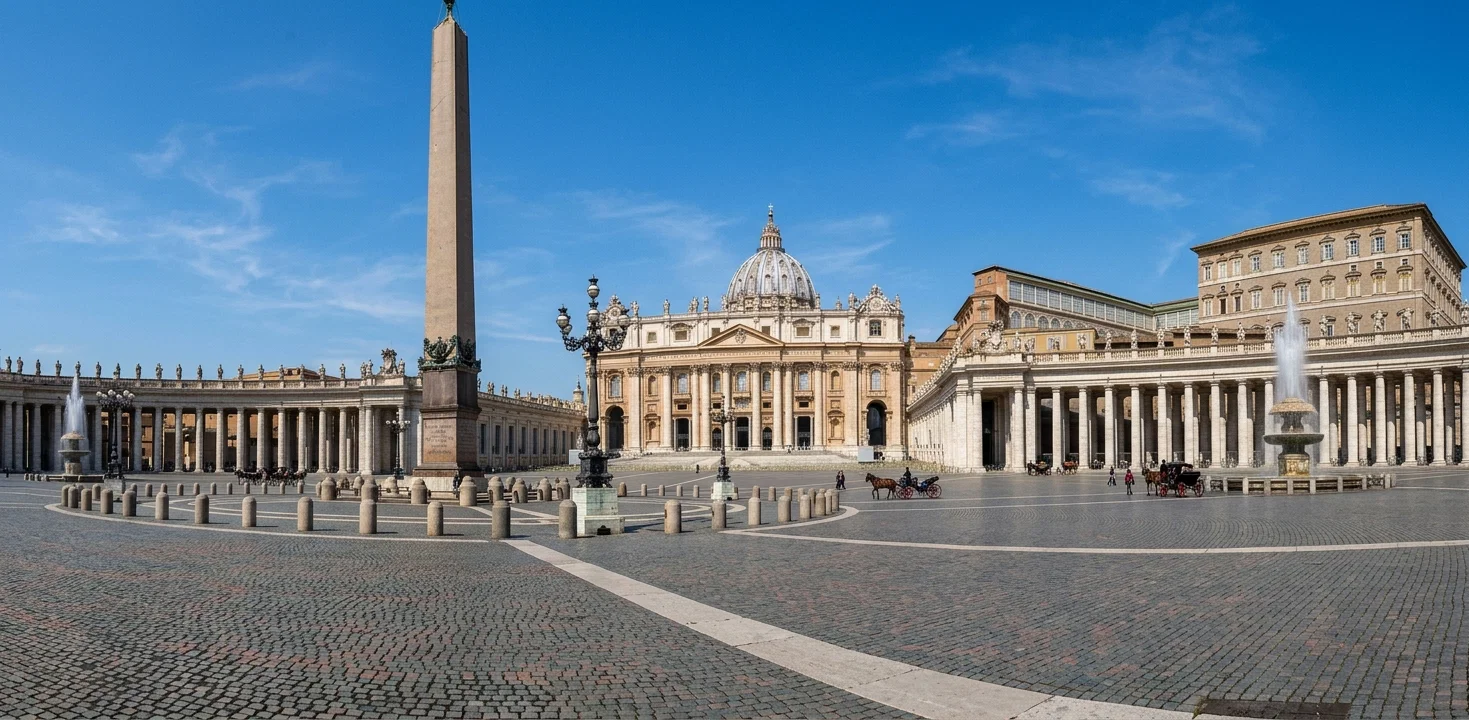
THE buildings shown in this picture are the Basilica of St. Peter and a portion of the Vatican palace, which one descriptive writer has styled “the noblest of princely palaces.”
ROME. Basilica of St. Peter and Vatican with Piazza and Colonnade.
“THE palace of the Vatican,” remarks the same writer, “is, indeed, not a palace, but a congress of palaces.” It is said to contain 16,000 apartments; but the “International Cyclopedia” thinks this an exaggeration. The same authority, however, credits the statement that the Vatican, with its gardens, etc., covers a space equal to the whole area of the city of Turin fifty years ago, at which time that city had a population of 130,000 souls.
THE history of the Vatican dates from the days of Constantine, who died A. D. 340; but the systematic scheme of improvement and embellishment to which is due its present magnificence, was not inaugurated until the time of Nicholas V., about the middle of the fifteenth century.
THE Vatican is the pope’s official residence, and headquarters of the Papacy for the entire world; it stands, therefore, for the whole papal system, the very soul of which is human instead of divine headship in the church.
THE Gospel teaches that “the head of every man is Christ.” 1 Cor. 11:3. It is an axiom that that which is true of every part is true of the whole; hence, being the head of every man, Christ is the head also of the church, as He is plainly declared to be in such texts as Eph. 4:15 and Col. 1:18, which, however, only put in other phrase the divine law of headship and brotherhood in the church: “One is your Master, even Christ; and all ye are brethren.” Matt. 23:8.
THE human poll is head of the body because it is the head of every member in the body; every part is responsive to its will. If any member were independent of the head, then were the body divided against itself, and there could be no real headship.
INSPIRATION has used this very figure of the human body to illustrate the relation not only of Christ to His church, but to each member of that church. “For as the body is one,” says the apostle, “and hath many members, and all the members of that one body, being many, are one body; so also is Christ.” 1 Cor. 12:12. And again, “Ye are the body of Christ, and severally members thereof.” Verse 27, R.V.
JUST as every member of the human body is responsive to the head, so every member of the true church, the body of Christ, is responsive to the great Head of the church. “Now there are diversities of gifts, but the same Spirit. And there are differences of administrations, but the same Lord. And there are diversities of operations, but it is the same God which worketh all in all.” 1 Cor. 12:4-6.
THUS the Gospel teaches that Christ is the head of the church because He is the head of each member of the church. In contradistinction to this the Papacy makes the pope the head of the church, and the head of every man because he is head of the church. Thus not only is the divine order reversed, but both the church and the individual are separated from Christ; first the church is put between the individual and Christ, and then the pope is put between the church and Christ; therefore the individual can come to Christ only by way of both church and pope.
NOR does this evil system of human versus divine headship in the church stop here. Indeed, this is but a small part of it. Not only are the church and the pope both put between Christ and the individual, but even then the Saviour must be approached not directly, but through saints who have been canonized by church and pope. Nor does it end here; for while the Scriptures teach that Christ “took not on Him the nature of angels; but He took on Him the seed of Abraham,” and was made “in all things” “like unto His brethren, that He might be a merciful and faithful High Priest in things pertaining to God,” the Papacy, by the doctrine of the immaculate conception of Mary herself, removes the Saviour so far from sinful men that the assurance of the Scriptures that “we have not an High Priest2which can not be touched with the feeling of our infirmities,” ceases to have any meaning to one who believes the papal doctrine, not only of the nature of Christ, but of His mother, and of her father and mother before her.
GOD is a person, but His personality is all-pervasive; He is everywhere present by His Spirit. Until the fall of angels and of man, the whole moral universe was as responsive and obedient to the divine influence, through the Spirit, as is the material universe to the laws of attraction and repulsion. As all the circling spheres in the universe are obedient to the law which we call gravitation because each particle of matter is responsive to that law, so the Creator would have the whole moral universe obedient to the moral law because each integral part of the whole is in harmony with that law.
SIN is separation from God. Salvation is union with God. Man was alienated from God in the mass because the race was yet in the loins of our common father, Adam, when he sinned; and it is impossible that a clean thing should come from that which is unclean. But men are redeemed as individuals. “I will take you one of a city, and two of a family, and I will bring you to Zion,” the Lord says. Moreover it is written that “God so loved the world, that He gave His only begotten Son, that whosoever believeth in Him should not perish, but have everlasting life.”
GOD wants human hearts to respond to divine spiritual influences, just as the forces of nature respond to the material influences of sunlight and rain. “For as the rain cometh down, and the snow from heaven, and returneth not thither, but watereth the earth, and maketh it bring forth and bud, that it may give seed to the sower, and bread to the eater: so shall My word be that goeth forth out of My mouth.” Isa. 55:10, 11.
IT is the work of the Gospel to bring men to God. “Now then we are ambassadors for Christ,” says the apostle, “as tho God did beseech you by us: we pray you in Christ’s stead, be ye reconciled to God.” 2 Cor. 5:20.
THE only hope of any man is oneness with God. The divine life must flow into the soul uncontaminated by any human influence. He who was made human flesh nineteen centuries ago, and who overcame sin in that flesh, must live His life in the flesh of every man who shall at last have a home in His eternal kingdom. “I am crucified with Christ,” the apostle says; “nevertheless I live; yet not I, but Christ liveth in me: and the life which I now live in the flesh I live by the faith of the Son of God, who loved me and gave Himself for me.” Gal. 2:20.
NOR is this an experience possible only to an apostle; like salvation,—for it is salvation,—it is for “whosoever will.” “Behold,” says the Saviour, “I stand at the door and knock; if any man hear My voice, and open the door, I will come in to him, and will sup with him, and he with Me.” Rev. 3:20.
HE partakes of our poor fare, and in turn gives us the rich viands of His grace. He partakes of our human nature, is touched with the feeling of our infirmities, and in turn transforms us into His likeness, clothes us with His character ; for by Him “are given unto us exceeding great and precious promises; that by these ye might be partakers of the divine nature.” 2 Peter 1:4. He became what we were, that He might make us what He is. “O the depth of the riches both of the wisdom and knowledge of God! how unsearchable are His judgments, and His ways past finding out! . . . For of Him, and through Him, and to Him, are all things; to whom be glory forever. Amen.” C. P. BOLLMAN.