REMINISCENCES OF JAPAN

8%

Pacific Press Publishing Company · Oakland, California · Apr 23, 1902

FromSigns of the Times, Vol. 28, No. 17.

Read the full edition

REMINISCENCES OF JAPAN.

I.

It was my privilege to live three years in Japan, and labor in connection with other missionaries for the advancement of the great principles of righteousness, of which Christ’s life on earth was a perfect exponent. Nine years have passed since my return to America, nine busy, eventful years, crowded full of absorbing experiences; yet the pleasant memories of my sojourn among the soft-voiced, kind-hearted, polite Japanese, still live. As I reflect upon those years, memories of unique experiences and pleasing scenes come racing through my mind like howling hounds, in hot haste giving chase to a fleeing fugitive. Come apart for a few moments, and let us glance at this remarkable people, and their beautiful island home, one of the most picturesque portions of the globe; for they are indeed a remarkable people, living in a remarkable country.

The People.

Laying aside all speculation as to their origin, and refraining from any attempt to draw the dividing line between the perplexing mazes of mythology and the chronicled events of their early history, we prefer to look at them just as they are, just as we met them in daily association,—real human beings, clothed with flesh and blood, exhibiting excellences and defects, and engaged in the serious business of struggling for existence. Among them we find the high-toned gentleman of real refinement and culture, clad in silk, and living a life of comparative freedom from vexatious care and fatiguing toil. There is also to be seen the rude boor of harsh, repulsive features, coarse character, and barbarous behavior. Between these extremes exist the usual gradations of intelligence, with their accompanying privileges and distinctions. But let us dismiss from our minds, once for all, the thought that they are a rude, uncivilized people. Heathen they are, it is true, but a race of barbarians they are not. Heathen, I say, in the sense that so many in America, the country whose boastful claims to superiority fill the world, are heathen. They know not Christ; therefore they love Him not, and hence do not obey Him. They are absorbed in selfish interests, and are assiduously seeking worldly promotion, material prosperity, earthly glory. In short, their lives are centered in self, and every self-centered life is essentially sinful, heathenish, abhorrent to the unselfish Christ, who gave Himself, not His means, to save others. Then we may say that self-giving for the benefit of others is the mark of a Christian, self-preserving for the benefit of self is the mark of a heathen. “He that loveth his life shall lose it; and he that hateth his life in this world shall keep it unto life eternal.” Judged by this Scriptural standard, we say the Japanese are heathen; but many who are not Japanese are, for the same reason, to be classed as heathen also.
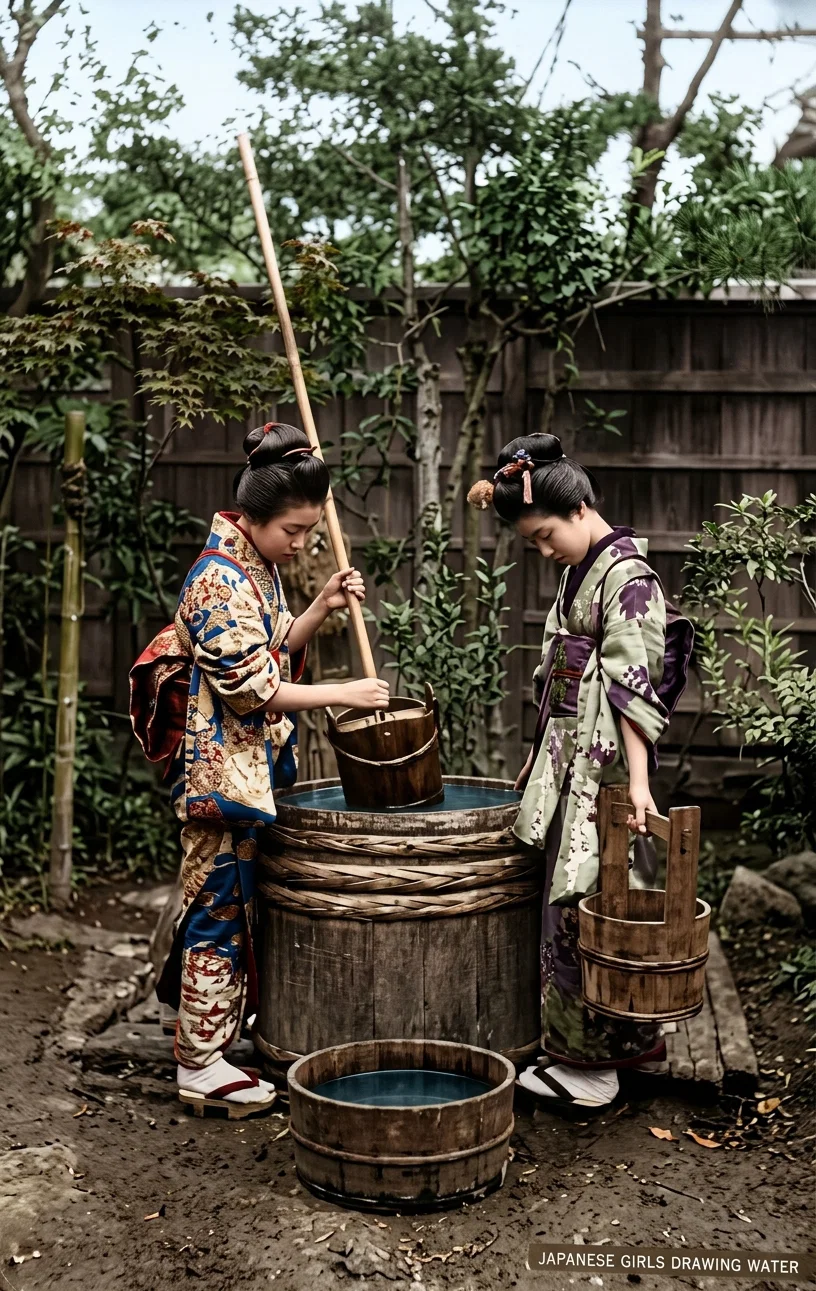
Japanese Girls Drawing Water.
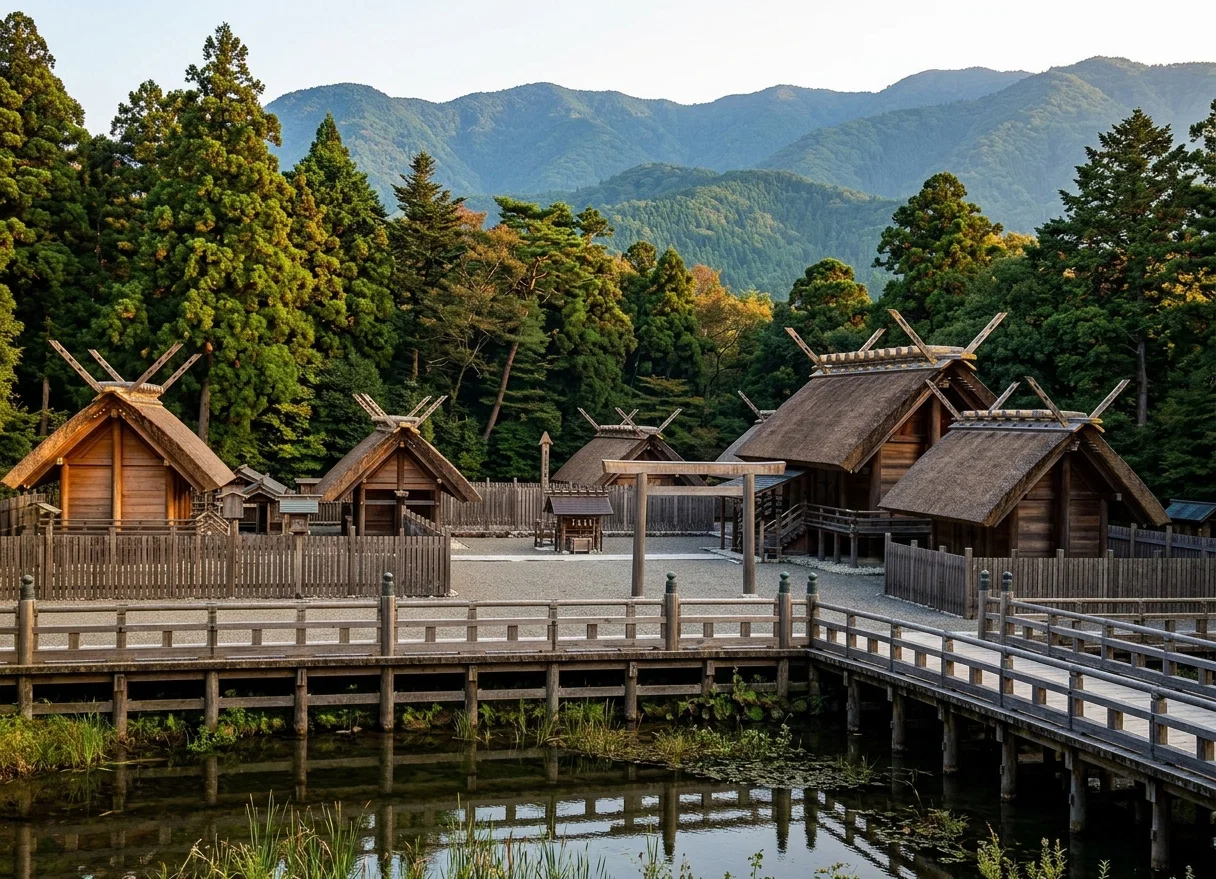
A Shinto Temple.
A Shinto Temple.
The Japanese are intelligent and progressive. They have a very well-ordered system of education, embracing the University of Tokyo, with its six faculties of Law, Literature, Science, Engineering, Medicine, and Agriculture, and matriculating annually more than a thousand students, on the one hand, and the modest primary school on the other. Between these extremes are schools and colleges of various grades. Text-books of Western authorship are frequently used; and the aspiring youth is inducted into the fields of scientific research by competent teachers, who have either studied abroad or have attained to a laudable degree of proficiency in their own schools. Consequently the amount of illiteracy, considering the great density of population and extreme poverty of thousands, is not so great as one would think. Many of the lower classes can read and write, and exhibit a good degree of intelligence. It is no uncommon thing to see a jinrikisha man draw from the folds of his scant clothing a daily newspaper, and utilize the unemployed moments in informing himself of current events.
They are kind and agreeable, and polite to a fault. They will often speak a lie rather than give offense. This fact makes them unreliable in business transactions. Indeed, their unbusiness-like habits are a source of vexation to the Westerner; and when the services of an Oriental are needed, the post of trust is given to a Chinaman in preference to a Japanese. The cashier, for instance, of the Kobe branch of the Hong Kong and Shanghai Bank, with which we did business while living in Kobe, was a Chinaman, who was both honest and accurate.
Cleanliness is another marked feature of Japanese life. In almost every village is found a public bath-house, where baths can be procured for a few cents. They are liberally patronized by the natives, but seldom by foreigners. Many of their tubs are quite expensive, and will accommodate several at once, and the bather has no assurance that he will be the sole occupant of the tub when he enters and begins his ablutions. Indeed, one of the opposite sex may come in, and with a gentle, “Gomen nasai” (excuse me, please), proceed to share with him the luxuries of the bath. But it must be remembered that exposure of person is not regarded as an act of indecency in Japan, as it is in America.
In point of morality the Japanese will compare favorably with other nations of higher professions. It is true, as Dr. Griffis observes, that chastity and temperance are not characteristic virtues, and yet it can truthfully be said that licentiousness is not so prevalent as the superficial observer would at first suppose.
JOHN A. BRUNSON.