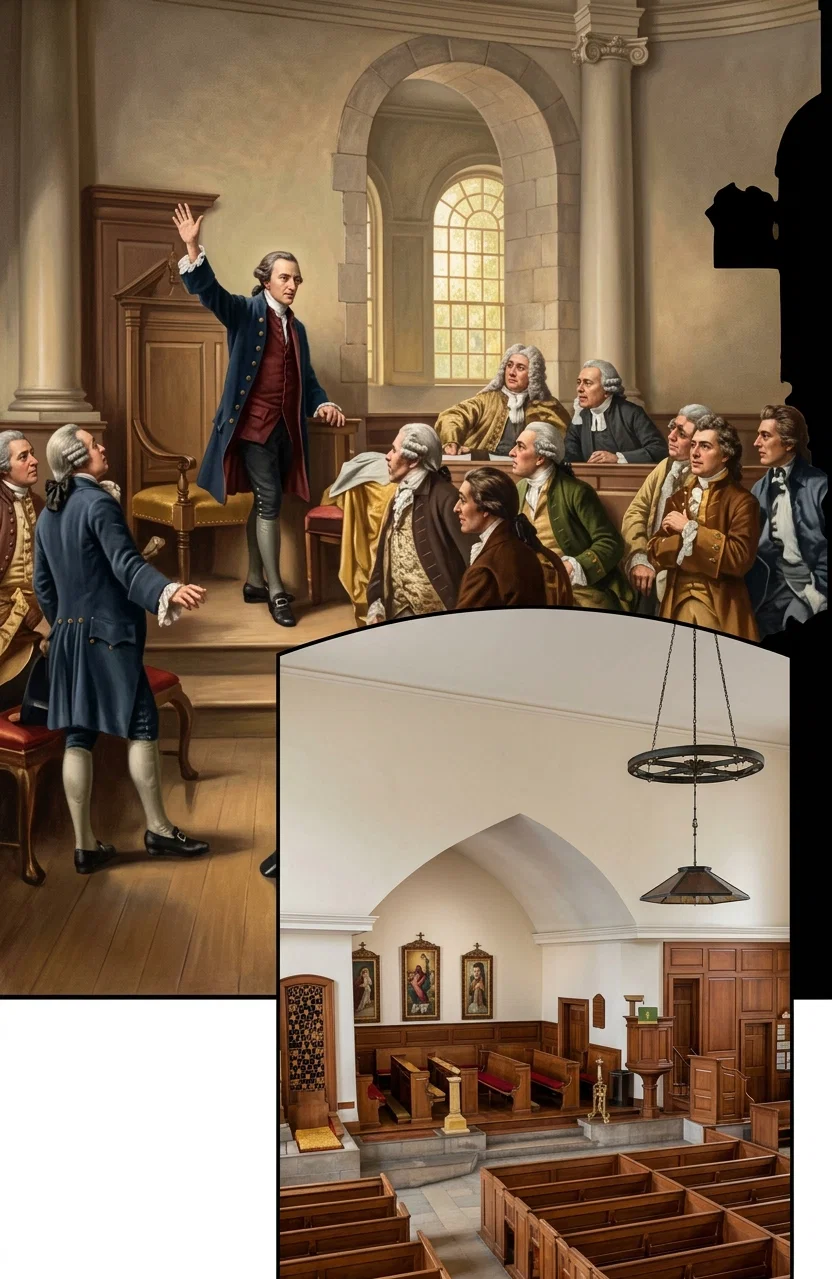
If there ever was a time in the world’s history when men tried to establish a free government and frame a fundamental law to secure and guarantee fullest liberty and “unalienable rights” to the citizens thereof, and forever leave behind religious legislation, and debar its recrudescence, it was at the time of the American Revolution. American statesmen of that time made them glorious living principles of the great Republic in basic charter and in fundamental law,—in the Declaration of Independence and in the Federal Constitution, which the Hon. William Ewart Gladstone declared to be “the most wonderful work ever struck off at a given time by the brain and purpose of man.”
1. The Constitution was “ordained” to “establish justice, insure domestic tranquillity, . . . to secure the blessings of liberty to ourselves and our posterity.”
2. “The citizens of each state shall be entitled to all privileges and immunities of citizens in the several states.”—Art. IV, Sec. 2, Clause 1.
3. “No religious test shall ever be required as a qualification to any office or public trust under the United States.”—Art. VI, Sec. 1, Clause 3.
4. “This Constitution, and the laws of the United States which shall be made in pursuance thereof; and all treaties made, or which shall be made, under the authority of the United States, shall be the supreme law of the land; and the judges in every state shall be bound thereby, anything in the Constitution or laws of any state to the contrary notwithstanding.”—Art. VI, Sec. 1, Clause 2.
5. “As the government of the United States of America is not, in any sense, founded on the Christian religion, . . . it is declared by the parties, that no pretext, arising from religious opinions, shall ever produce an interruption of the harmony existing between the two countries.”—Treaty with Tripoli, 1797. A part of “the supreme law of the land.” (Section from Article VI, Sec. 2, quoted above.)
MILTON C. WILCOX
6. These provisions, it was felt by some, securely guarded the sacred rights of every citizen. But after their adoption in 1787 many felt that something more specific and definite must be given to protect the religious rights of the people; therefore the Amendments. The First Amendment was adopted by most of the states before it was adopted by Congress in 1791: “Congress shall make no law respecting an establishment of religion, or prohibiting the free exercise thereof.”
INTERPRETED BY ITS FOUNDERS AND FRIENDS
Thus was the Federal ship of state launched for freedom. But it is held that because unrighteous inherited laws still existed in some of the individual states, the Constitution must be thereby interpreted. Let us see:
1. It is a principle of jurisprudence that “Constitutional provisions must be interpreted with reference to the times and circumstances under which the . . . Constitution was formed—the general spirit of the times and the sentiments prevailing among the people. Every constitution has a history of its own which is likely to be more or less peculiar; and unless interpreted in the light of this history, is liable to be made to express purposes which were never within the minds of the people in agreeing to it.”—Per Cooley, Chief Justice, in People versus Harding, Vol. 53, Michigan Reports, page 481.
Furthermore, the Constitution “is to be interpreted and effect given to it as the paramount law to which all other laws must yield. . . . It is not always necessary, in order to render a statute invalid, that it should contravene some express provision of the Constitution; if the act is inhibited by the general scope and purpose of the instrument, it is as much invalid as tho prohibited by the express letter of some of its provisions.”—Vol. 12, Corpus Juris, page 699.
Let us then look at the Federal Constitution in the spirit and sentiment of the times that gave it birth as shown in the expressed purpose of the very men who made it.
GEORGE WASHINGTON
We call for a witness George Washington, the “Father of Our Country,” its first President and the presiding officer in the Convention which gave form to the great document.
About twenty miles southwest from Reading, Pennsylvania, is the town of Ephrata, near which is the Ephrata Community, observers of the seventh-day Sabbath. In 1789, when the Constitution was in process of formation, these people feared that the new government might bring to them persecution, and they wrote to Washington, whom they knew personally. His reply, dated August 4, 1789, follows:
TO THE EPHRATA COMMUNITY
“If I had had the least idea of any difficulty resulting from the Constitution adopted by the Convention of which I had the honor to be president when it was formed, so as to endanger the rights of any religious denomination, then I never should have attached my name to that instrument. If I had any idea that the general government was so administered that the liberty of conscience was endangered, I pray you be assured that no man would be more willing than myself to revise and alter that part of it, so as to avoid all religiousPage Twelvepersecution. You can, without any doubt, remember that I have often expressed as my opinion, that every man who conducts himself as a good citizen is accountable alone to God for his religious faith, and should be protected in worshiping God according to the dictates of his conscience.”
This was Washington’s word to the Ephrata Community of Seventh-day Christians. He felt that the Constitution did or should secure their rights to worship God in their own way, doing their six days’ work in the week, and worshiping God on the seventh day. George Washington held to their right to do this. The first copies of the Declaration of Independence in foreign languages were printed on the Ephrata printing press.
JAMES MADISON
We call James Madison a lover of liberty, a stickler for human rights, a deeply educated man, a believer in Christianity, a Presbyterian, if we mistake not, by profession. He and Patrick Henry helped to frame Virginia’s “Declaration of Rights,” adopted June 12, 1776, twenty-two days before the Declaration of Independence was voted. Section 1 declares that “all men are by nature equally free and independent, and have certain inherent rights, of which, when they enter into a state of society, they can not, by any compact, deprive or divest their posterity,” among which are named life and liberty, etc. Section 16 reads:
REASON AND CONVICTION
“That religion, or the duty which we owe to our Creator, and the manner of discharging it, can be directed only by reason and conviction, not by force or violence; and therefore all men are equally entitled to the free exercise of religion, according to the dictates of conscience; and that it is the mutual duty of all to practice Christian forbearance, love, and charity toward each other.” Drawn up by Henry, modified by Madison. According to Appleton’s Cyclopedia of American Biography, Madison objected to the “fullest toleration in the exercise of religion, according to the dictates of conscience” proposed as a part of the Federal Constitution, and declared that “the free exercise of religion, according to the dictates of conscience, is something which every man may demand as a right, not something for which he must ask as a privilege.”
“In matters of religion no man’s right is abridged by the institution of civil society, and that religion is wholly exempt from its cognizance. . . . If religion be exempt from the authority of the society at large, still less can it be subject to that of the legislative body.”—“Memorial to the General Assembly of the Commonwealth of Virginia Against Paid Teachers of Religion.”
“We revere this lesson too much soon to forget it. Who does not see that the same authority which can establish Christianity, in exclusion of all other religions, may establish, with the same ease, any particular sect of Christians, in exclusion of all other sects? . . . What a melancholy mark is the bill, of sudden degeneracy! Instead of holding forth an asylum to the persecuted, it is itself a signal of persecution. It degrades from the equal rank of citizens all those whose opinions in religion do not bend to those of the legislative authority. Distant as it may be in its present form from the Inquisition, it differs from it only in degree. The one is the first step, the other the last in the career of intolerance.”—Id.
“It [the bill] is a contradiction to fact, for it is known that this religion both existed and flourished, not only without the support of human laws, but in spite of every opposition from them.”—Id.
Truly did Macaulay say:
“The whole history of the Christian religion shows that she is in far greater danger of being corrupted by the alliance of power, than of being crushed by its opposition. Those who thrust temporal sovereignty upon her, treat her as their prototypes treated her Author. They bow the knee, and spit upon her; they cry ‘Hail!’ and smite her on the cheek; they put a scepter in her hand, but it is a fragile reed; they crown her, but it is with thorns; they cover with purple the wounds which their own hands have inflicted on her; and inscribe magnificent titles over the cross on which they have fixed her to perish in ignominy and pain.”—Essay on “Southey’s Colloquies.”
THOMAS JEFFERSON
Thomas Jefferson, one of the greatest of American statesmen, the writer of the Declaration of Independence, and witness in the “Act for Establishing Religious Freedom” for Virginia, said:
“All men shall be free to profess, and by argument to maintain, their opinions in matters of religion; and the same shall in nowise diminish, enlarge, or affect their civil capacities.”
“Equal and exact justice to all men without regard to state or persuasion, religious or political.”—Jefferson.
Much more might be quoted from both Madison and Jefferson of the same import.
CHRISTIANS SPEAK—PRESBYTERIANS, BAPTISTS, QUAKERS
The Presbytery of Hanover, joined by the Baptists and Quakers, entered mighty protest against the bill to support teachers of Christianity in the public schools. Among many other good things they said is the following:
“In this enlightened age, and in a land where all of every denomination are united in the most strenuous efforts to be free, we hope and expect our representatives will cheerfully concur in removing every species of religious as well as civil bondage. Certain it is, that every argument for civil liberty gains additional strength when applied in the concerns of religion; and there is no argument in favor of establishing the Christian religion but that may be pleaded with equal propriety for establishing the tenets of Mohammed by those who believe in the Alkoran; or if this be not true, it is at least impossible for the magistrate to adjudge the right of preference among the various sects that profess the Christian faith, without erecting a chair of infallibility, which would lead us back to the Church of Rome.”
And there is much more from these witnesses and many others of that “time that tried men’s souls,” men and women who gave themselves to die, if need be, for the cause of religious as well as civil liberty.