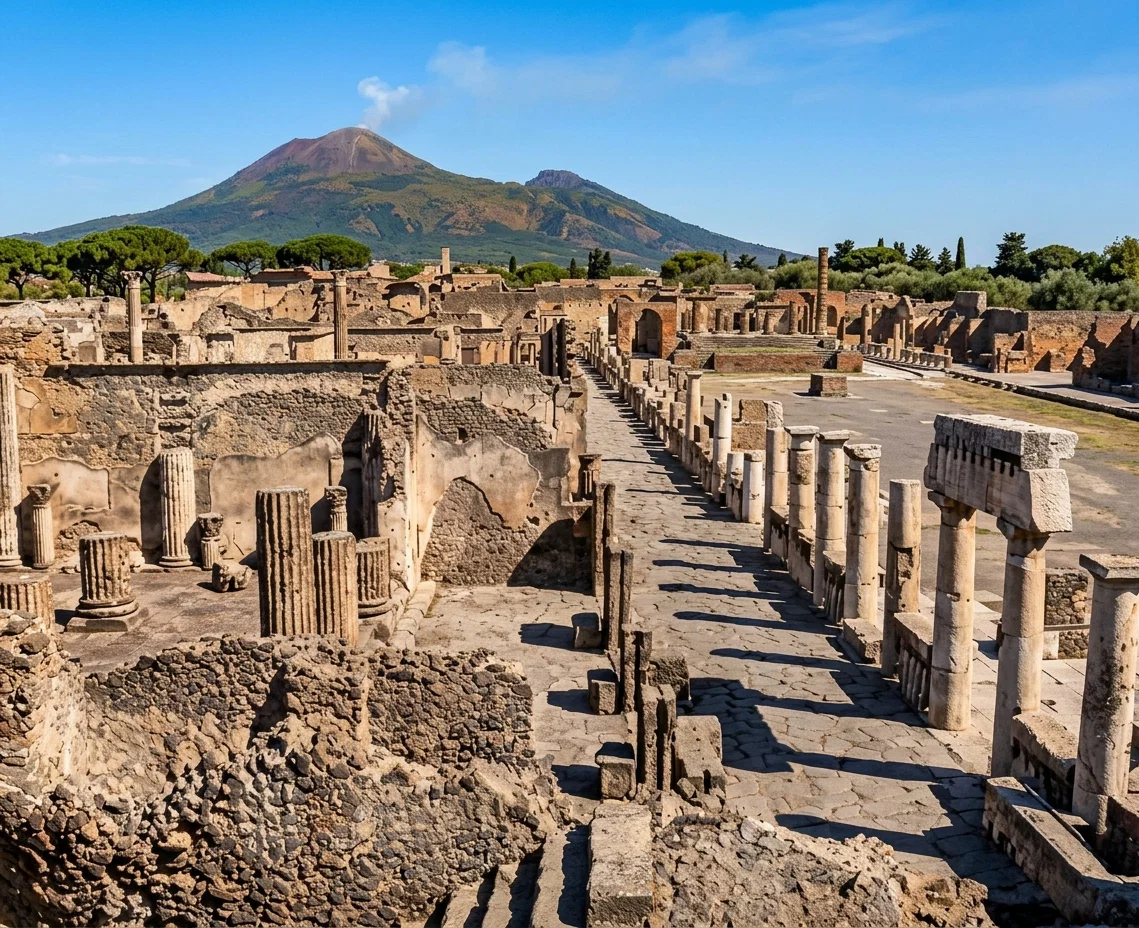
OUR illustrative cut is replete with melancholy, yet, withal, profitable suggestion. It puts under the eye a sad monument of the evanescence of merely human glory and achievement. Not only the poet’s “It might have been,” but also “It was and is not,” are among the saddest of all sad words of tongue or pen. Greece, Rome, Babylon—where are they?—In the dust. The proud architects and conquerors of empire—Alexander, Cæsar, Bonaparte—where are they?—They have long since become brothers to the cold clod.
POMPEII.
Forum and Mt. Vesuvius.
NINETEEN hundred years ago, under the soft, blue skies of southern Italy, hard by the limpid, lazy waters of the Sarnus, and nestling under the protecting (?) sweep of proud Vesuvius, lay Pompeii—splendid, opulent, festive. Perhaps fifty thousand souls lived, wrought, and hoped within her walls. Of the ancient world, Pompeii was one of the mistresses of architectural achievement. There was her amphitheater, with a seating capacity for twenty thousand persons; her temples of Mercury and Jupiter, adorned with magnificent Corinthian columns; her pantheon of Augustus, rich in frescoes and statuary; her Forum Triangulare, with an area enclosed by one hundred Doric columns; her marble temple of Venus; her luxurious thermæ, or baths;—all these attested her wealth, her culture, her splendor, her voluptuous luxuriousness. Not only these public edifices, but also many private dwellings were embellished with statues, statuettes, frescoes, vases, candelabras, and mosaics. Upon the outlying country nature had showered her benefits with unstinted hand. Her climate was balmy and salubrious. Everything seemed bursting into blossoms of promise. Naturally, then, the people were prosperous, happy, hopeful.
BUT her Nemesis was even then at her door. At the very hour when her votaries of fashion and luxury were assembled at a public festival, Mount Vesuvius, which had been inactive for centuries, suddenly, without a note of warning, shot forth clouds of smoke, and soon Pompeii was buried fathoms deep under volcanic ashes, sand, and scoriæ. All was over. Pompeii was no more.
HER temples, tho built of marble and adamant, were resting upon sand—the sand of idolatry and pride. And when “the floods came and the winds blew,” they fell, and the place thereof knew them no more forever. They were of the things that “may be shaken,” because they were not resting upon the Rock of Ages, Jesus the Christ, “by whom all things consist” (cohere), who upholds “all things by the word of His power.”
This one great, glorious truth, that there is a foundation Stone, a timeless Rock that can not be moved, and upon which every soul is invited to plant his feet, for time and for eternity—this, I say, is the star of hope that glows in the firmament of brass that spans our dark world.
HERE is the promise: “We have a building of God, an house not made with hands, ETERNAL in the heavens.” Verily there is a temple,2“a city which hath FOUNDATIONS, whose builder and maker is God.” It is the everlasting refuge, the eternal abode of all conquerors in the “strife of truth with falsehood.” We are living in a world of moral struggle, and to every struggler Jesus makes this inspiring promise: “Him that overcometh will I make a pillar in the temple of My God, and he shall go no more out; and I will write upon him the name of My God, and the name of the city of My God, . . . and My new name.” Rev. 3:12. We need to note that this promise is not to all strugglers. It is not to the many who are struggling for wealth, ease, fame, power. It is given to the few—the very few—who, in love of Christ, are struggling against sin—struggling for victory over the powers of evil. How superlative the incentive to press the battle for truth and righteousness to its eternally triumphant consummation!
THIS temple, in which our Lord proposes to make every overcomer in the cause of righteousness a pillar, is not composed of mere inert materials, not a temple of wood or stone. It is a living, spiritual temple. The materials that enter into it are redeemed souls, hearts cleansed and sanctified by the blood of the Lamb. It is the living church of the living God—the habitation of the Most High, of Him who “dwelleth not in temples made with hands.” It is a temple resting “upon the foundation of the apostles and prophets, Jesus Christ Himself being the chief corner-stone: in whom all the building fitly framed together groweth unto an holy temple in the Lord. In whom ye also are builded together for an habitation of God through the Spirit.” Eph. 2:20–22. Ah! it is God’s peculiar dwelling-place. It is His home, His house, where He rests in His love; where He finds solace in His ransomed, blood-bought children. It is here, in His home, that He manifests Himself unto His children—the apple of His eye—as He does not unto the world. It is here that He bends over each confiding child with the sweet assuring words: “I have loved thee with an everlasting love; therefore with loving-kindness have I drawn thee.” It is here in His temple, glorious in the beauty of holiness, that He takes His children to His bosom, that they may know that He is “the Lord, the Lord God, merciful and gracious!”
HOW wondrously unique this temple—every part of it instinct with life! He who stretched out the heavens, and laid the foundations of the earth, is its Architect, its Builder. Of old He devised it. Before the worlds were made, He ordained its length and breadth, appointed its doors and gates, determined the size and shape of every stone, and the place it should occupy in the completed structure. Through the eye of faith and reason I see Him choosing the corner-stone. He looks first at those glittering stones, the angels, from Gabriel down. Tho glorious in power and resplendent in light, not one of them is adequate, not one will suffice. This temple of matchless proportions, this temple all-glorious for beauty, this temple meet for the indwelling of Jehovah—such a temple must needs rest upon a corner-stone of the same material as the other living stones of the structure, and yet have the strength, the might, the infinity of God.
MARK how Infinite Wisdom solved the difficulty. My Son shall become man, very man, and so shall be of the same substance as the other stones of the temple; yet shall He be God, and therefore abundantly able to bear the weight of a structure the top whereof shall reach to heaven. Do you see that foundation Stone laid? That Stone must be laid in the crimson cement drawn from its own veins; it is imbedded in blood. Through the awful ordeal of self-immolation it is eternally fastened to the living stones which it forever bears aloft.
AND now out of the hillsides of crucified pride; deep in the darkness of conquered despair; in the fretting, dusty atmosphere of petty cares; wherever souls are being tried and ripened—there are the strange quarries where God is hewing out and chiseling and polishing and quickening the stones for His temple. Each soul, as it becomes truly obedient to the Master-Builder, loving and hating in truest unison of sympathy with Him, with no purpose but His purpose, takes its place in the slowly-rising temple of God’s eternal purpose, which He purposed in Christ Jesus our Lord. Wherever a soul in this world, by repentance and faith, catches the fire of God’s likeness, it is placed a pillar in the temple of Zion, and it “shall go no more out.”
AND now mark how these living, holy stones rest one upon another, and all upon the “elect, precious” Corner Stone! How they bear one another’s burdens; and how the “sure Foundation” bears the burdens of all. Each stone binds and secures the others. The Corner Stone secures and binds them all. “How glorious is Zion!” Note her impregnable strength. God is in her midst, and she can never be moved. The kings of the earth stood up, and the rulers took counsel together,—they came against her, every one with mighty men of war, each man with his sword drawn,—but the Almighty scattered kings in Hermon like snow in Salmon. Ah! that temple is SAFE. The shafts of her enemies can never touch her. Let her foes come on and break themselves in pieces. Let them dash themselves against walls of rock. They shall be ground to powder. “He that sitteth in the heavens shall laugh; the Lord shall have them in derision.” They shall “perish from the way when His wrath is kindled but a little.”
“A PILLAR in the temple of My God”! O what a promise is this! I, a shining pillar in Zion—in Zion “glorious for situation”? O, how shall I not “praise the Lord for His goodness, and for His wonderful works to the children of men”?
THE life that we now live—how unreal, how illusory, evanescent, short. To the question of the apostle James, “What is your life?” Inspiration gives not fewer than eighteen answers. All these answers metaphorically declare that life is short, uncertain, shadowy. Your life is “even a vapor;” “a tale that is told;” “a swift post;” “a handbreadth;” “water spilt on the ground;” “a dream;” “wind;” “a shadow;” “a swift ship;” “a thread cut by a weaver;” etc. These are a few of God’s answers to the apostle’s, “What is your life?” Note the last answer here given,—the grim image of the weaver’s thread suspended in the air, and the keen blade of the lifted knife touching it with its edge. It means that I may die at any moment. The thread of my life may be cut to-morrow, to-day, even now. One pressure of the hand of Fate, and my life is done. When Pompeii dreamed that “it is yet three months till the harvest,” at that very hour the “Weaver’s” knife descended upon her “thread” of security.
BUT there is another life—a long life—with which God has promised to satisfy His children. In His temple He will make you and me a pillar, and we shall go no more out. There is everlasting safety, endless security. For God is there, and “that syllable is central.” He is our habitation, and He inhabiteth eternity. With Him there “is no parallax or eclipse.”
O CHURCH of the living God, temple of the Holy One! remember that thy Redeemer “in the midst of thee is mighty; He will save, He will rejoice over thee with joy; He will rest in His love, He will joy over thee with singing.”