The climatic conditions of Japan vary of course with latitude and altitude. Yet in general it may be said that the summers are warm and moist, and the winters comparatively cold. Snow and ice are frequently seen; but the former, falling upon a damp ground, quickly disappears, while the latter rarely attains to any great thickness. However, let not the prospective visitor in winter imagine that he is going to a subtropical climate, where wraps are burdens and fires unnecessary. He will find flannel underwear a great protection, and heavy coats by no means unacceptable. I have seen people from our Northern States shiver in the cold, raw air of Japan more than in the dry bracing cold of their native clime. The heat of summer is rather enervating, but heat prostrations are rare. With a little care and foresight, one need not suffer any extreme discomfort.
The best season is autumn. From the latter part of October to the first of January, the sky is clear and the atmosphere still, and out-of-door exercise becomes a positive delight. The frequent rains and high winds render the spring rather trying. But taking it all together, the climate of Japan is very good.
Proper attention to the rules of hygiene will enable one to enjoy good health. He needs to be careful about his drinking water. As a rule, unboiled water is not safe for drinking, unless one is in the mountains, or the bottom of his well is above the level of the rice-fields. The Japanese themselves drink very little cold water. For the most part, they quench their thirst with tea, sipped hot, without milk or sugar.
Fruits.
Among the fruits most commonly seen on the Japanese market are peaches, apricots, melons, persimmons, and oranges. The persimmons are exceptionally fine, far superior to the American persimmon that abounds in the South. They grow in comparative abundance, and are much used both by foreigners and natives. The latter often dry them in the sun, and store them for winter use.
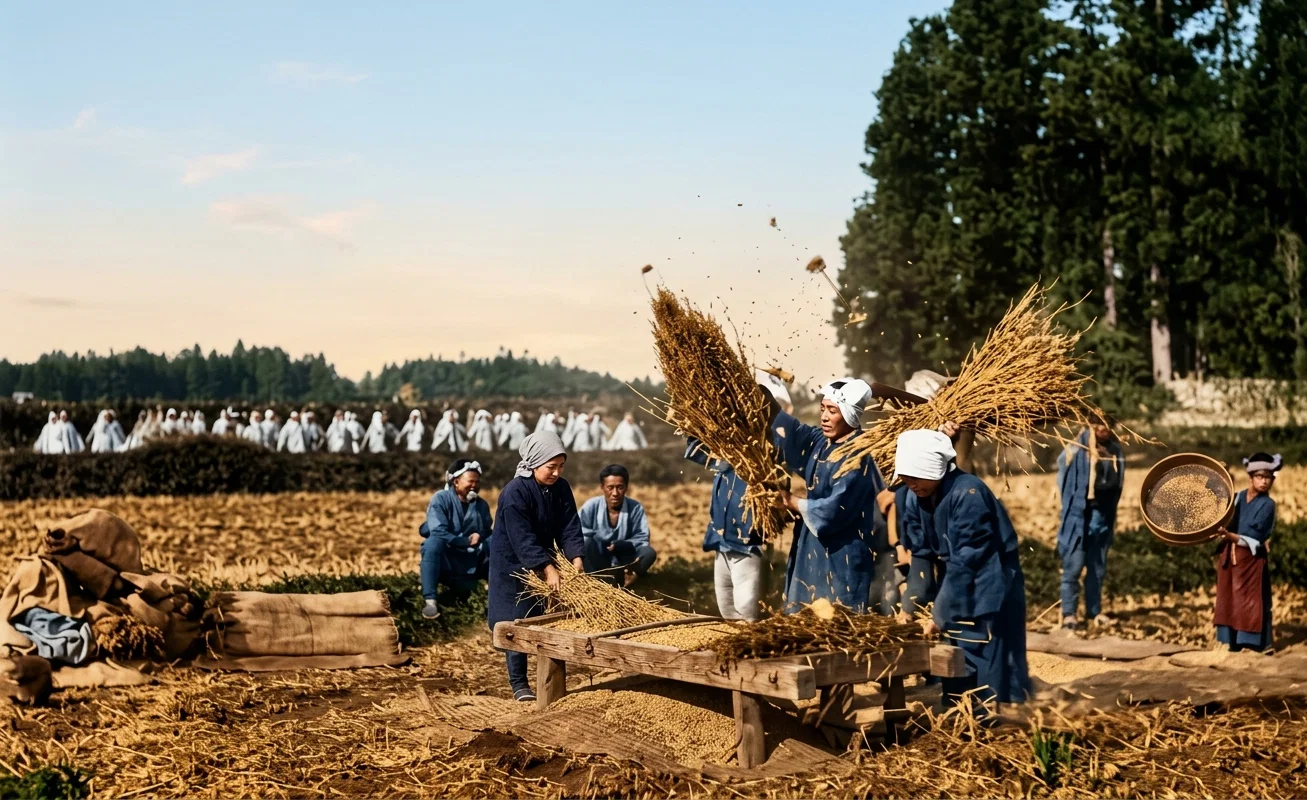
Mode of Threshing Rape, Sesame, and other Grains.
The oranges are of the so-called “kid glove” variety, because the peel does not adhere tightly to the pulp, and can be easily removed without soiling even a pair of kid gloves. They are neither so large nor so sweet as the Florida orange, yet they are palatable and wholesome. Small ones can be purchased for a half cent each, and the larger ones for a cent. But the peaches are decidedly inferior. Well do I remember the gustatory pleasure I anticipated, and the sudden disappointment that followed, when, in passing along the market street one day I was beguiled by the delightfully appetizing aroma of peaches into the purchasing of a few, I found them almost destitute of flavor.
Peaches are usually gathered before they are ripe, and put on the market. That in part accounts for their insipidity. The natives say that if they are allowed to remain on the tree, they will rot before they will ripen, and so they pick them while green in order to save them.
A story comes to my mind which illustrates the point. A Western man went out into the country, and discovered on the premises of a farmer a peach tree well laden with fruit. He purchased the fruit just as it hung on the tree, and paid for it. After the transaction was completed, he said to the Japanese farmer, “You understand now, that these peaches are mine, and are subject to my orders?” “Yes, sir,” was the reply. The Westerner continued, “Let them remain on the tree till I give orders to have them plucked. If they rot, it will be my loss; for I have already paid for them. You will not lose anything. Do you understand?” “Yes, sir,” was again the reply. The Westerner returned to the city, congratulating himself upon the prospect of enjoying some fruit that had been allowed to mature and ripen on the tree. But to his astonishment and disgust, in a few days the little Japanese farmer halted at his door, and informed him that he had plucked all the peaches and brought them to him, explaining that they would have rotted had he allowed them to remain longer.
The melons are a disappointment also. But after one has forgotten the fine flavor of the large luscious melons of our Southern States, he comes to enjoy them. They are good thirst-quenchers, and are eaten with a relish on a warm summer day.
Housekeeping.
Japan may be called the housekeeper’s paradise. As servants, the Japanese are faithful and painstaking. Our first cook was one who had been well trained in an English family, and knew how to prepare Western dishes. He went regularly, morning by morning, without any instructions, to the market, and bought the day’s supplies. At the end of the week he would always come and present his account, giving each day’s expenditures item by item. I would then refund to him as much money as he had spent during the week. This relieved me entirely of the burdensome task of marketing. In the kitchen he was equally as thoughtful and efficient as he was in the market. He soon discovered our favorite dishes, and without conference or instruction would prepare our meals, taking care to provide what was best liked. When the meal was ready and on the table, he would politely announce the fact, and then proceed to wait on the table.
But of all the servants we employed, the last one was in many respects the most satisfactory. He was an unusually large fine-looking man, with a great shock of black curly hair, something very unusual for a Japanese,—a great bundle of good nature and thoughtfulness. His name was Goto Shinaguchi, but we called him “Shin.” A single instance of his faithfulness will suffice. Our little girl became extremely ill. The nearest foreign physician was 350 miles away. We did all we knew for the little sufferer, but could not succeed in giving any relief. In the town was a Japanese physician who had graduated from the university of Tokyo. He was called. He came, diagnosed the case, and proceeded to treat it. After five visits we considered the child out of danger, and the physician discontinued his visits. I then wrote him a note, and asked him to send me his bill. He sent in a bill for $5.00, one dollar a visit. I cheerfully paid it, and dismissed the matter from my mind, thankful that our child was relieved. But “Shin” heard that the amount charged was $5.00. So he came to me one day shortly afterward, and said, “Danna san [lord], did the doctor charge you $5.00?” “Yes,” I replied. With ill-concealed indignation he said, “Danna san, that is an outrage. Please let me go to see him, and I will force him to refund some of that money.” I remonstrated, explaining that it was all right. “Shin” left me and walked away rather crestfallen. In about two or three hours he returned, and in great glee put a dollar bill in my hand, saying, “Danna san, you refused to let me go to see the doctor, but I went anyhow, and I made him give me one dollar back. Here it is.”
When we came back to America, I left faithful “Shin” behind with deep reluctance.
From these rambling remarks it can be seen that the Japanese are an interesting and promising people. They are ready for the Gospel of the coming kingdom. They must be warned, “And this Gospel of the kingdom shall be preached in all the inhabited earth for a testimony unto all the nations; and then shall the end come.” May the God of the harvest send forth laborers into His harvest, and in His distribution of workers may the little Island Empire receive her full quota.