ANGLO-INDIANS IN INDIA

7%

Pacific Press Publishing Company · Oakland, California · Apr 9, 1902

FromSigns of the Times, Vol. 28, No. 15.

Read the full edition

ANGLO-INDIANS IN INDIA.

Of late I have seen a number of articles in the SIGNS OF THE TIMES regarding India’s great need of competent Christian workers among the heathen millions of natives. Perhaps it would be as well for some one to say a few words in behalf of the Anglo-Indian and Eurasian community in this respect. They are a body of people who number some hundreds of thousands, of European parentage. The majority are at best but nominal Christians, who have the form without the power, and who search the Scriptures but very little.
This sad state of things is due to the utter indifference displayed by parents in general with regard to the early religious education of their children. Few of our boys and girls know anything of family prayers or daily Bible reading, their spiritual training being left to day-school and Sunday-school teachers, the former of whom teach Scripture in a way which awakens no love for the Word in the hearts of the pupils. It is very generally a case of the blind leading the blind. As to the latter, whatever his or her capabilities may be, it is certain the teachers can not do much in the way of instruction when they have only an hour a week with their scholars. This neglect of spiritual training of the Anglo-Indian and Eurasian youth results in producing callous, nominal Christians.
Very likely many of your readers do not know who the Anglo-Indians and Eurasians are. Well, let me tell about them as briefly as possible. An Anglo-Indian is a domiciled European who has not mixed his blood in any way, while the Eurasian is one who has a tinge of Indian blood flowing through his veins.
The former term applied to both classes until one of the late governor-generals thought it necessary to make a distinction between the two classes.
The writer belongs to the latter class. Our customs, habits, etc., are English, but the mode of living is very different from that of Europe. Here we have everything done for us; even those in the most ordinary circumstances keep three servants, a home servant, a washerman, and a sweeper. These cost in all from $6 to $8 per month. Others keep five servants, and those of us who are well off employ from eight to thirteen. A full complement of Indian domestics, twelve in number, costs in all about $36. Thus our mothers have very little to do except to superintend a little housework, such as giving out stores, etc., doing a little mending, and looking after baby when the nurse is taking her meals. Dress and suit making are done by Mohammedan tailors. To cut and sew a lady’s dress costs $2, and a gent’s warm suit $1.66; drill suits for the hot season are cut and sewed for 50 cents each.
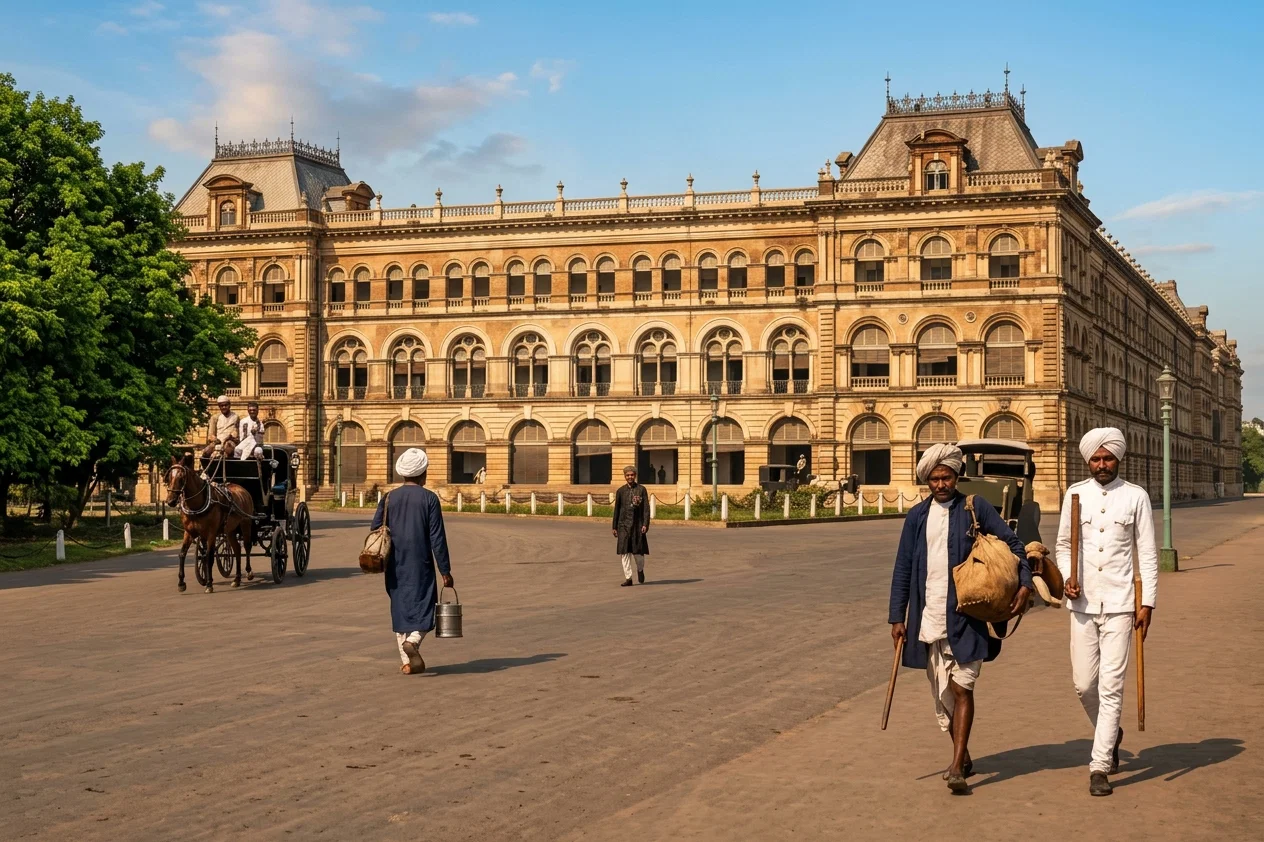
GOVERNMENT OFFICES OF FINANCE, CALCUTTA.
The staple food of India is rice, and, as in the case of the natives, the first solid food our infants touch is dal, or lentils and rice, when they are a year old. Naturally few of us can do without our kari-bhat (curry and rice). It is also a very strange fact that all our little ones talk the Hindustani language before their mother tongue. It is, of course, because of association with the native nurses.
Meat is the principal diet among us. Perhaps this is due largely to its cheapness; for the very best beef procurable in our municipal market here can be had at 4 cts. a lb., mutton at 6 cts. a lb., fowls from 6 to 12 cts. each, ducks at 16 cts., geese at 66 cents. Fish, fruit, and vegetables are also very cheap and very plentiful. Things in the country are just about half the above prices.
The cigarette is a great curse among our boys, the majority of whom learn to smoke at the early age of twelve to thirteen, and even before that. This is easily accounted for, as there is no duty on imported tobacco in this country. American and English tobacco manufacturers are able to sell their goods at ridiculously low prices, so that a few coppers will purchase a packet of ten good brand cigarettes. Of recent years, since times have been getting hard, our girls have taken more generally to working for themselves.
Our men are employed in all the subordinate grades of government service, public work’s department, accounts, railway, telegraph, medical, etc. A large number are engineers, and a few are employed as tradesmen’s assistants. The salaries range from $15 to $250 per month. There are others who have influence and means who pass into the superior grades, from Roorkee College and England, and a small number have flourishing businesses of their own.
Now, dear reader, here are hundreds of thousands of professing Christians, who do not know where they are, or how near the great consummation is, when the Lord Jesus will appear the second time, without sin unto salvation, to take unto Him His own. The glad tidings must reach them; but how can they hear without preachers? So do come over and help us. India’s need is great. May the Lord touch the hearts of our American brethren, and wake them up to seeing and supplying this great need, not only in the shape of workers, but funds also. Respond to this call by giving bountifully, and thus not only lay up treasure for yourself in heaven, but do your part in the great work of announcing the Lord’s soon coming, and inviting India’s thousands to take a firm stand on the commandments of God and the faith of Jesus.
GEO. GYTHER.
Calcutta, India.