TWO MANNER OF PEOPLE

5%

Pacific Press Publishing Company · Oakland, California · Apr 9, 1902

FromSigns of the Times, Vol. 28, No. 15.

Read the full edition

“TWO MANNER OF PEOPLE.”

“IT is written, that Abraham had two sons, the one by a bondmaid, the other by a freewoman. . . . Which things are an allegory.” Gal. 4:22-24.
ISHMAEL, Abraham’s first-born, was the child, not of promise, but of doubt, and of impatience that the promise was so long delayed. Isaac was the child of promise, the pledge of Abraham’s faith and loyalty.
THE angel said of Ishmael, “He will be a wild man; his hand will be against every man, and every man’s hand against him.” This has been fulfilled in him and in his descendants.
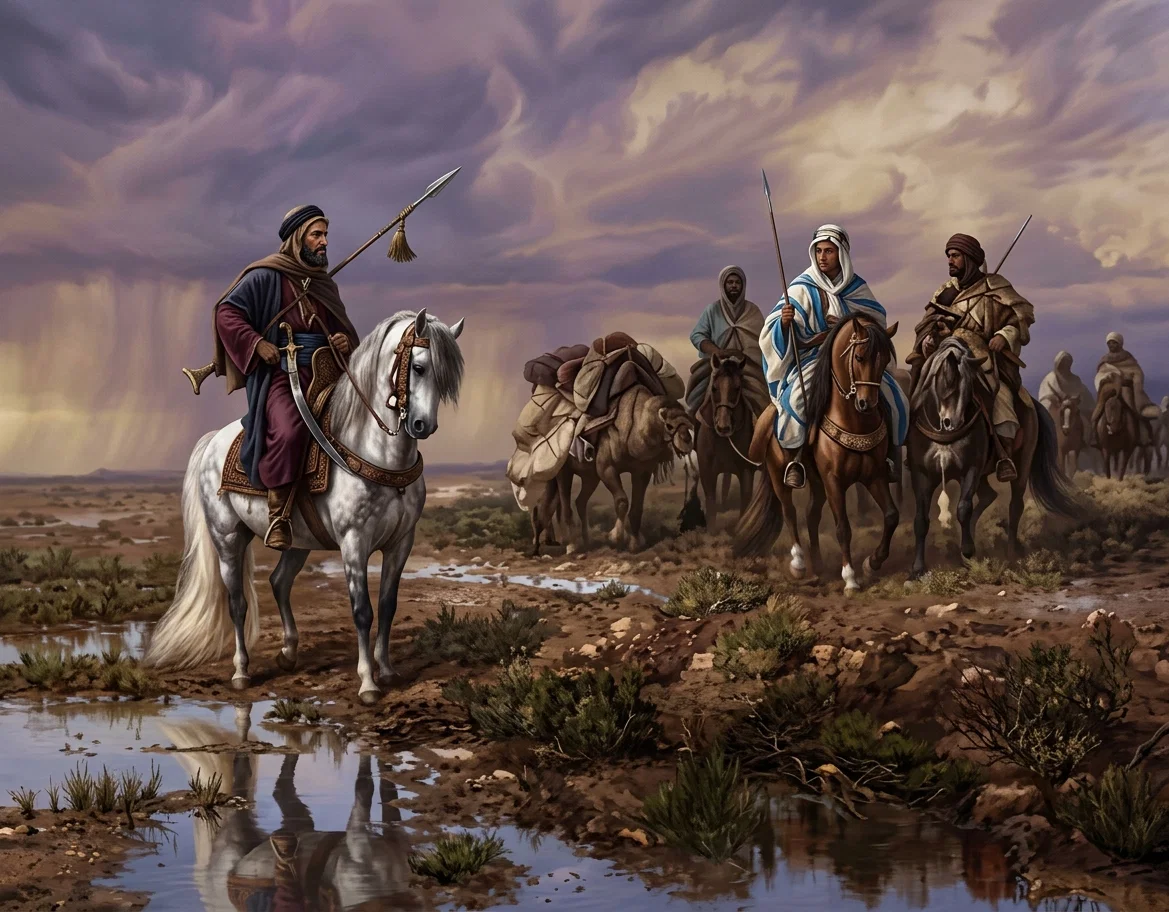
Arab Sheik Traveling: an Ishmaelite of To-day.
WE read: “And God was with the lad; and he grew, and dwelt in the wilderness, and became an archer. And he dwelt in the wilderness of Paran; and his mother took him a wife” out of Egypt. Ishmael joined the mixed races of Arabia, as did the sons of Keturah, and later, no doubt, the sons of Esau. He is reputed to have become very early a leader among these peoples. When Abraham was buried, Ishmael was nearly ninety, and no doubt in the height of his prosperity. As he stood with Isaac at his father’s tomb, with his armed retainers around him, there is no reason to suppose that the bold, adventurous desert prince felt any need to envy Isaac, the peaceful shepherd, even tho Isaac was heir to his father’s wealth, and head of the hundreds of “trained servants, born in his own house.”
EACH of Ishmael’s twelve sons became the head of a tribe. Descendants of his oldest son united with the Edomites in building up the Idumean kingdom and in making its capital city, the marvelous rock-hewn Petra. Other Ishmaelites also lived a settled life; but the great majority were nomads. Their encampments, or “movable villages of tents,” were found in all the desert region from the Euphrates westward. A large carrying trade across the desert was done by them, and their roving bands ravaged and plundered whenever an opportunity presented itself.
To THIS day the descendants of Ishmael roam the desert, “tribes of the wandering foot,” each under its own sheik. As of old, their bands are ready for commerce or for plunder. Would a caravan be complete without its Arabs? Would the traveler be safe in the territory of a sheik without an escort of his Arab lancers?
IN the family of Ishmael has originated a religion which is the embodiment of their own character. For the tribe of the Koreish, from which Mohammed sprang, is conceded to have descended from Ishmael, tho they were not of unmixed blood. Mohammedanism makes ample provision for “the works of the flesh,” and promises to the “faithful” a heaven in every way suited to the desires of the carnal heart. Among its votaries “the most scrupulous observance of outward duties is not unfrequently united with the grossest habitual immorality and crime.”
AND what a record this false religion of a great impostor has made in the social and political world. Bearing the standard of the “prophet,” the Saracenic hosts went forth on their career of conquest. They overran country after country, until nearly all of Southwestern Asia and Northern Africa and part of Southern Europe owned the sway of Islam. And to-day there are from 176,000,000 to 185,000,000 adherents of this faith which deadens the conscience, feeds a false hope, and paralyzes enterprise and progress. Like a mighty poisonous river has the tide of this worldly religion rolled on, carrying with it ruin to body and soul.

The Other People.

VERY different was the life of Isaac. He and his son Jacob served the true God, if not perfectly, yet sincerely, and God accepted them. The descendants of Jacob, the people of Israel, stumbled in the way of righteousness, and sometimes seemed to quit it altogether; and because they would not receive Christ, they are now rejected and dispersed; yet they have never reached the low level of the sons of Ishmael. And while they remained the people of God, the nation produced an army of holy men, among whom were prophets, priests, and kings. Through them God wrought in blessing, not for themselves alone, but for the world. Through them He has given us the Saviour and through them His Holy Word, for “salvation is of the Jews;” and these treasures of divine grace have brought untold blessings, both temporal and spiritual, to untold millions of the human race.
WHAT a mighty river of life and healing has thus rolled over the world, fraught with blessing “because their waters they issued out of the sanctuary.” The waters may be carried to earth’s thirsting millions by imperfect human agents; but their origin is heavenly. They proceed “out of the throne of God and of the Lamb.”
IS GOD, then, partial? Does He give blessings to some, and withhold them from others?—O, no! All in the families of Abraham and Isaac were taught the worship of the true God. For God said of Abraham, “I know him, that he will command his children and his household after him, and they shall keep the way of the Lord.” Note, too, how earnestly the patriarch pleaded, “O that Ishmael might live before Thee!” When Ishmael went out from the family of Abraham, we can well believe that he was followed by the prayers and counsels of his wise and loving father, as he certainly was by divine care and protection,for we read that “God was with the lad.”
ISHMAEL and Esau could have shared the favor of God as freely as did Isaac and Jacob, had they chosen so to do. They as well as Israel might have had a part in giving the Gospel message, if they would. But they loved this present world. Their hearts and hopes were centered on the things of time and sense, and they did not by faith grasp unseen realities. More than all, they loved sin, and hated righteousness. So they chose their portion in this world, and God gave them their choice,—a choice which left them in the bondage of sin and in the shadow of death.
“WHICH things are an allegory,” Paul says; and “they are written for our admonition, upon whom the ends of the world are come.” What use will we make of the lesson? Which of the “two manner of people” will we choose to be like?
“Why choose the evil, when the good, More lovely, more divinely fair, With heavenly graces aye imbued, Awaits the searcher everywhere? Why go the downward ways of sin ’Mid vain regrets and wild despair? Why quell the good each soul may win, Why lose all hopes of heaven here?”
E. J. BURNHAM.