To whom then will ye liken Me, or shall I be equal? saith the Holy One. Lift up your eyes on high, and behold who hath created these things, that bringeth out their host by number; He calleth them all by names by the greatness of His might, for that He is strong in power; not one faileth.” There is, perhaps, no other branch of science which reveals so clearly God’s greatness and majesty as do the heavens. The microscope reveals God’s exquisite finish of nature even in its very minutest parts. We may carry the analysis as far as we wish, and we yet have the most wonderful refinement of workmanship, none of which is too rude to bear the closest inspection. The telescope reveals the same minuteness and accuracy of workmanship, but on an infinitely more magnificent scale—great bodies hanging upon absolutely nothing and passing through various motions at the same time with the greatest precision.
I have spoken previously of our solar system, with its eight large planets, besides hundreds of smaller ones, revolving about the sun. These are held in space and confined to their regular orbit by that great law of God which we call gravitation. What a wonderful sight this solar system would present could we see it whirling through the heavens as a whole—the sun dashing on in its orbit, taking with it all of these planets at a rate of about three hundred miles per minute. “Could we plant ourselves immovably at a certain point in the celestial spaces, and see our sun go sailing by with all its glorious squadrons of planets and moons,—sailing down the abyss as if driven by ten thousand hurricanes,—would not the sight of such celerity almost irrecoverably daze both senses and spirit?” But this is but a small fraction of heaven’s grandeur. The magnificent distances and glories of heaven are an ocean compared to which our solar system is but a drop—a taper ’neath the noonday sun.
It has been clearly shown that our solar system is but one of a vast number of similar systems. Let us imagine ourselves sitting in space, with the power to see all of the planets as we would see individuals. Here is our system whirling along at such a terrific rate. Where is it going? We see another moving in a similar direction, and we find that all these systems are moving in an orderly arrangement. As we look at them, we discover that our earth, which we think is so large, is but a very small planet traveling around a small star, or sun, and that the suns of many of the other systems are far larger and more beautiful than ours.
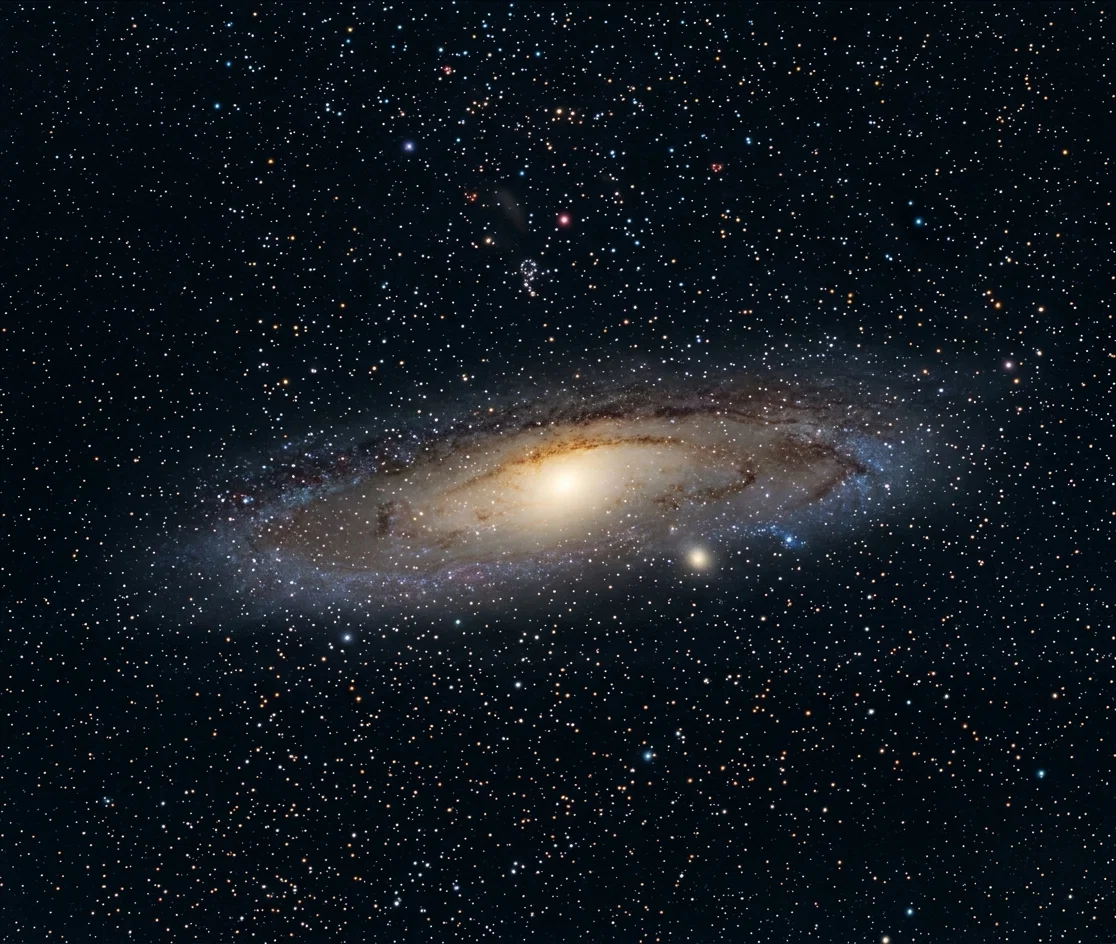
NEBULA OF ANDROMEDA.
The distance between these systems is most stupendous. The nearest solar system is distant from the earth more “than one hundred thousand times one hundred ninety millions of miles. A most bewildering distance! According to the most recent authorities, it would take light itself, that fleetest of known travelers, that Mercury of science, whose pace is 186,000 miles a second, more than four years to sweep across it.” All the fixed stars that we can see are the suns of other solar systems. The more distant of the stars are so far away from the earth that it takes thousands of years for their light to reach us. This great distance can not be comprehended; for light will travel from California to England and back quicker than we can wink our eye. There are many thousands of these systems. I said a moment ago that our sun was one of the smallest known. Sirius has a light said to be equal to that of forty of our suns, and the polar star gives a light to its solar system much greater than that of Sirius to its system; and there are many other stars whose light is far greater than that of Polaris—even to several hundred times. “As we have seen, our sun is no trifle. Its astonishing orb . . . would weight down, eight hundred times over, its whole ponderous cortège of satellites, planets, and comets. And yet it is only one of the lesser lights of space; not the smallest indeed,—forbid it, little sixty-one Cygni,—but still a mere rushlight and glowworm as compared with many of the huge luminaries which pour their glories adown the immensity of nature. It could not remain visible a moment in the presence of such golden-haired and majestic day-kings as even Sirius and Polaris, to say nothing of those huge monarchs whose effulgence floods the celestial spaces.”
But this is not the end of this marvelous “wheel within a wheel” order of the heavens—the solar systems increase, forming new systems, circling around larger central suns, and in turn forming still larger systems, until we arrive at the nebula systems, of which our Milky Way is one, and to which system our own sun and its attendant satellites belong. And this nebula system forms a part of a still larger system, revolving around a still greater and perhaps the greatest of all centers, which may be the throne of God.
“Eighteen million suns belong to our firmament. More than four thousand such firmaments are visible; every increase of telescopic power adds to the number. Where are the frontiers—the last astronomical system, that remote spot beyond which no nebula, no world, glitters on the black bosom of eternal nothingness?”
“What right have we to stop just where the power of our instrument happens for the moment to have stopped, and say, ‘This is the end—these are the pillars of Hercules! Turn back, O adventurous explorer—nothing but night and void in this direction; thou hast reached the last outpost of the kingdom of the Eternal!’ No; thrice no. On still through peopled infinitude, through raining galaxies and tornado nebulae; and while thou goest outward still through the charging, storming hosts of suns, as long as thought can fly, or angels live, say ever to thyself, ‘Lo, these are parts of His ways; but how little a portion is heard of Him!’”