THE STUDY OF CHEMISTRY

8%

Pacific Press Publishing Company · Oakland, California · Mar 5, 1902

FromSigns of the Times, Vol. 28, No. 10.

Read the full edition
THE STUDY OF CHEMISTRY.

THERE is but one source of force or power in the world, and that is God. Force, however, manifests itself in many different ways, but all these may be grouped into two; namely, physical and chemical, each force producing its corresponding change. In physical changes no new thing is formed. When chemical changes take place, however, some new substance is the result. Take, for instance, the formation of alcohol. Now there is no alcohol in an apple; but reduce it to pulp, press the juice through a muslin or cheese-cloth, and bottle it. In a little while we have what is termed “hard cider.” This is due to the fact that fermentation has set up, and alcohol is the result. Here is a new substance. Through the process of distillation, this alcohol can be drawn off and separated entirely from the cider. After alcoholic fermentation has taken place in the cider, there is a souring or changing of the cider to vinegar. This is due to the formation of still another substance called acetic acid. Now the force which is at work producing these chemical changes from the sweet juice of the apple to the alcohol, and then to acetic acid, is chemical force, or chemism, but it is simply the direct result of a wonderful law which God is manifesting in nature. It may be very rightfully doubted as to whether God originally designed that this fermentation resulting in alcohol and acetic acid should ever take place. They are certainly unnecessary substances for a healthy individual to use in any way; and it is just such individuals that the Lord designs His children to be. It is quite safe to say also that many chemical laws and changes which men consider so valuable at the present time, and which indeed are valuable, would be of no benefit to man, were it not for the present conditions resulting from sin.
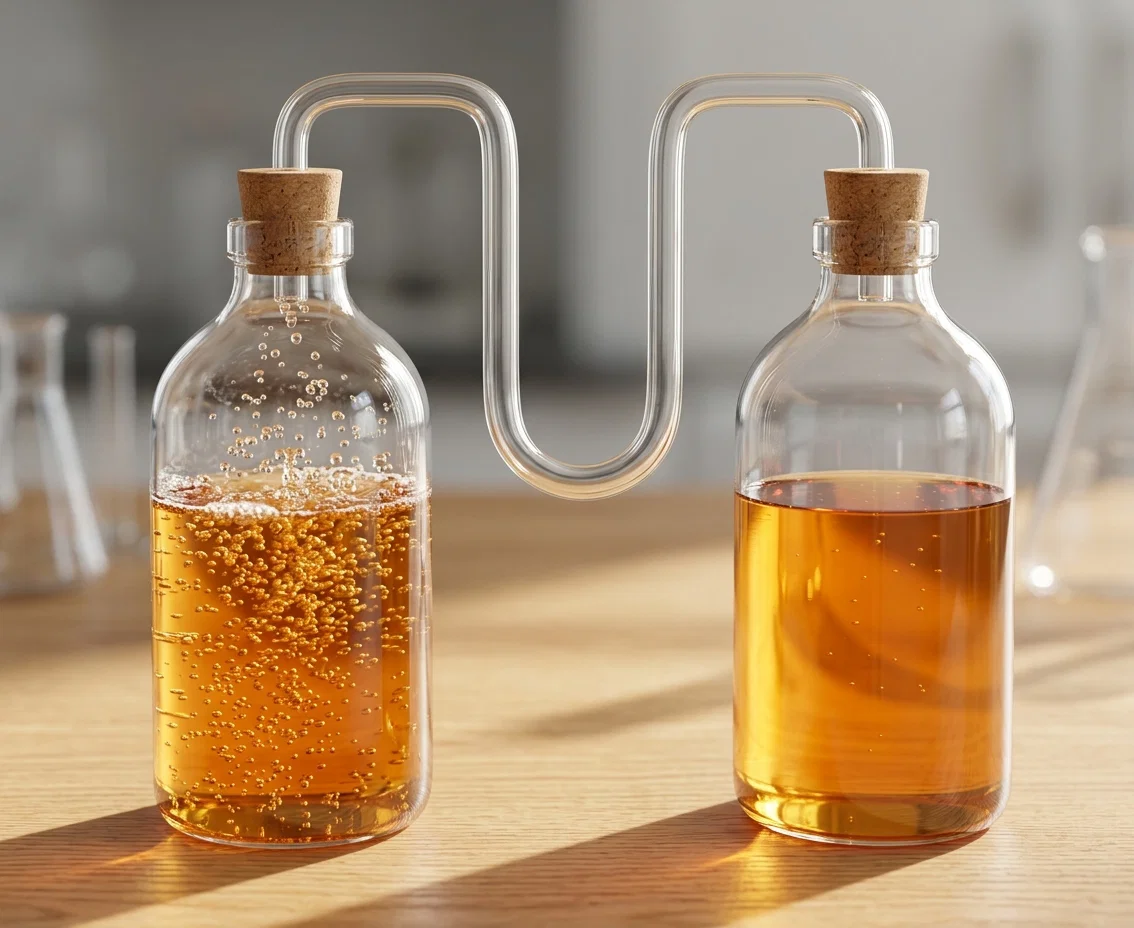
There is another change which may be noted quite easily as having taken place in the juice of the apple. Into a jar half full of this fermented juice lower a match or a taper. It will be noted that it behaves very differently from what it does in pure air. Now take two bottles. Partly fill one with hard cider, and the other with lime-water. Cork each. Connect these bottles with a bent glass tube, passing through the corks of each. Thus there will be forced some of the gas arising from the hard cider into the bottle of lime-water. Note the changes in the lime-water. The tests with the flame and the lime-water indicate clearly that carbonic acid gas has been formed as the result of the decomposition or change in the juice of the apple.
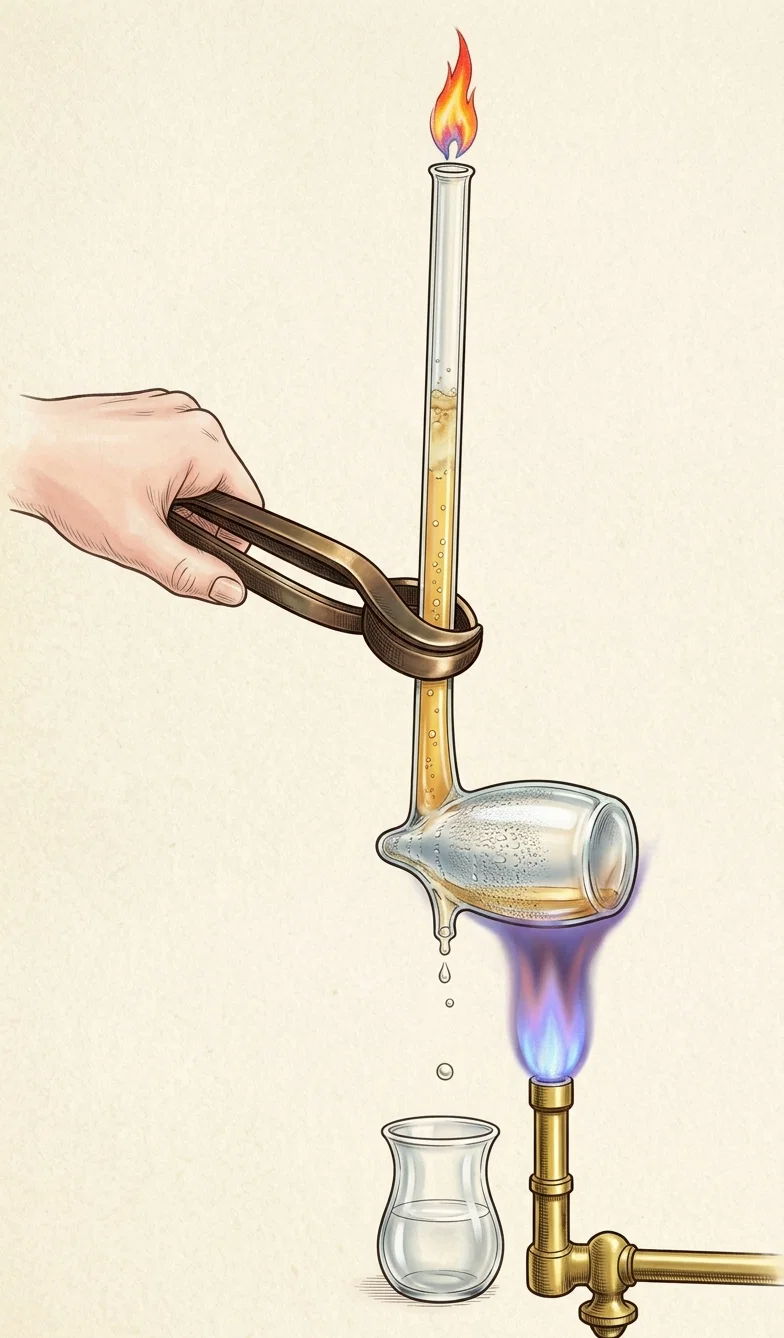
I want to suggest still another chemical change which can be easily shown. Coarsely powder a lump of soft coal, and half fill a common clay pipe. Cover the mouth of the bowl with plaster of Paris or soft clay, and place on some support over a lamp with the stem projecting upward. Note the odor which comes from the stem of the pipe, and from time to time apply a lighted match. After a time it will be noted that there is an odor arising, and a gas is sent forth which can be lighted. When the flame has died out, remove the pipe from the lamp and allow it to cool. Then remove the clay from the mouth of the pipe and examine the contents. It will be noted that a change has taken place in the coal. It is a chemical change. It is in a very similar manner to this that coke is manufactured on a very large scale, and that gas, which is used in our houses and our cities, is obtained. Very large ovens are constructed, lined with fire-brick. There is one opening in the top through which the oven is filled, and another at the side through which the coke is withdrawn. After the coal has burned for several hours, both openings are closed, and the burning is completed without contact with the air. The heat of the oven is now sufficient to start the burning without resorting to any other means. The gas thus set free passes through pipes into a large retort. A country blacksmith often makes his own coke on the open forge, but it is neither so easily done nor so well made as in a closed oven. Not only is the gas thus drawn off from the coal, but by different processes many other chemical changes take place, and many valuable substances can thus be obtained from the coal.
Now, as I have said above, all these changes are chemical changes. This matter undergoing these changes forms new compounds or substances. These changes are indeed very wonderful and oftentimes quite inexplicable. Everything in the world is composed of about 70 elements. By an element we mean a substance that can not undergo any further change by any chemical process now known. There is little doubt but that some substances that are now called elements may yet be further changed, and found to be divisible into other elements; but the science of chemistry has developed but this number. Some of these elements may be mentioned, such as carbon, gold, iodine, iron, lead, silicon, silver, arsenic, oxygen, and nitrogen. These are common elements with which nearly all are more or less acquainted.
The ancients were acquainted with only seven elements,—gold, silver, copper, iron, mercury, lead, and tin. They dedicated these to the heavenly bodies. That is, silver was dedicated to the moon, or Luna. It is in this way that some names of chemical compounds which we now have originated. For instance, nitrate of silver is still called lunar caustic.
One of the most wonderful laws of chemical action is the law of definite proportion. When we examine any chemical compound such as water, which consists of hydrogen and oxygen, or common salt, which consists of the elements of sodium and chlorine, we find that the compound always contains the same elements in exactly the same proportions. Water always contains 88.89% of oxygen and 11.11% of hydrogen, never changing. Common salt always contains 39.32% sodium and 60.68% chlorine.
Not only is this law wonderful, but another law quite as marked is that by which the same elements may enter into composition, but in very slightly different proportions, and form entirely different substances. For instance, grape sugar contains carbon, hydrogen, and oxygen in definite proportions; but when we change the quantity of these elements only a slight amount, starch is produced. How it can be that exactly the same elements varied in the slightest degree, or stranger still, how the same elements in exactly the same proportions, can produce entirely different substances, can be known only to the Creator of all things.
The last fifty years has revealed more to mankind of the wonderful laws of chemistry than perhaps all time past so far as we now know. In this there is another evidence of the wonderful love of our Heavenly Father. Chemical laws have revealed many valuable things in medical science. If it were not for the remedial assistance which can be rendered to the human race, it would very quickly perish from the earth, so weakened has it become. But as the race have been growing weaker through sin, God has provided them some way of still existing. Thus is shown His marvelous forbearance and love to His erring children.
FREDERICK GRIGGS.
So. Lancaster, Mass.