THE RUSSIAN CHURCH

6%

Pacific Press Publishing Company · Oakland, California · Apr 2, 1902

FromSigns of the Times, Vol. 28, No. 14.

Read the full edition

THE RUSSIAN CHURCH.

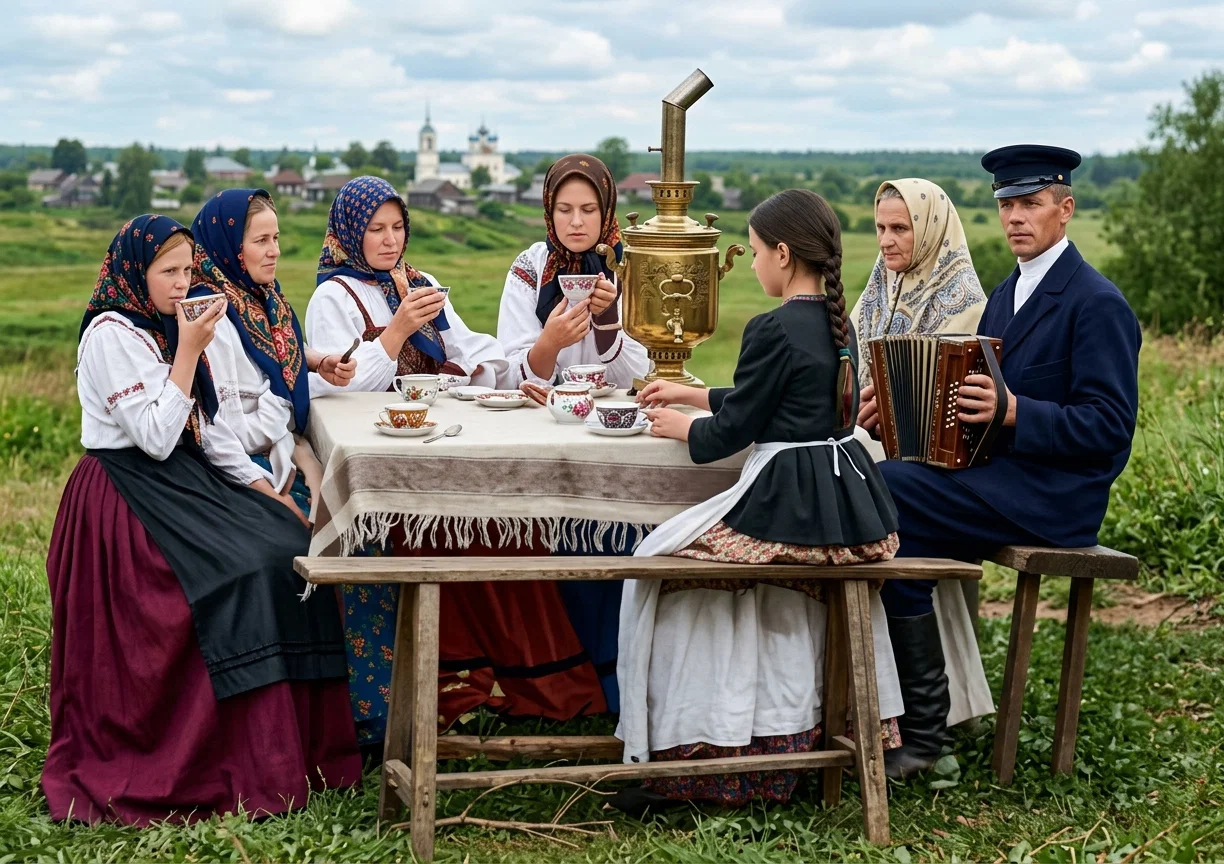
A Russian Tea Party.
The Russian State Church is an offspring of the Greek Church. Sometime in the ninth century the Greek Church sent missionaries into what is now Russian territory, but no permanent results seem to have followed. In the succeeding century, in 955, the Princess Olga, at that time regent of Russia, went to Constantinople, and was baptized into the Greek faith; but the wild tribes of the Russian steppes still worshiped their idols.
Princess Olga’s grandson, Vladimir I., having united under his rule the provinces that formed the nucleus of the present Russian Empire, decided to choose a religion, not only for himself, but for his subjects as well. He investigated the claims of the Catholic, Greek, Mohammedan, and Jewish faiths; and it is said that he was led to choose the Greek Church from the “enthusiastic accounts” given by his ambassadors of the splendor of the services in the church of St. Sophia at Constantinople. Vladimir went to Constantinople. The grand and imposing Greek ritual seemed all that could be desired, and his choice was made.
The royal convert demanded in marriage the hand of the Princess Anna, sister of the emperors Basil and Constantine. Vladimir was already well supplied with wives. He had a “great number,” we are told. But that was no bar to his marriage with a Byzantine princess. If she objected to being one of many, it was easy to dispose of the others. They could be banished from court, or even killed if it was necessary. Emperor Basil was not a little embarrassed by the proposed alliance. He was unwilling to send his delicately reared sister, who had all her life been accustomed to the refinement and luxury of the brilliant court at Constantinople, to a country of barbarians, even tho it was to share a grand ducal throne. But Anna was quite willing to become a royal missionary, with a good prospect of bringing a nation to her faith.
When Vladimir returned to his court at Kief on the Dnieper, he had the images of Peroun and other national gods of the Russians thrown into the river. It is said that the people cried a little over the loss of their gods; but they were baptized at the command of their prince, and lo!—
“The whole land became a Christian land, In the old gods no more trusting and believing.”
Thus was Russia Christianized. Since that time through all the changes of Mongol invasions and of the conquests by which Russia has grown into the mighty empire of the north, the Greek Church has remained the established Church of Russia.
The Russian Church long acknowledged the primacy of the Greek Church, and with more or less loyalty the authority of the patriarch at Constantinople. The fall of Constantinople in 1453, and the growing power of Russia, prepared the way for a complete separation, which, however, was accomplished gradually.
During the reign of Peter the Great (1689-1725), the patriarchate was abolished, and the czar has since been the head of the church; but its government is in the hands of the Holy Synod, the members of which are appointed by the czar and are partly priests and partly laymen. The members of the synod must take an oath to “be loyal to the czar and his successors, and to recognize the czar as the highest judge in the synod.” It follows without saying that “the synod is subject to the czar and receives his orders.”
The presiding officer of the synod is the oldest metropolitan; but the procurator-general represents the czar, and has the right of veto. Thus “the constitution of the synod and of the Russian Church in general is such that it places the clergy under the authority and supervision of the government, and makes it subservient to the interests of the powers that be.”
It is a rule that political religions are intolerant, and the Russian Church is no exception to the rule. When, in the latter part of the eighteenth century, the ancient kingdom of Poland was divided, several provinces fell to the share of Russia. Many people of these provinces were United Greeks; that is, they were of the Greek faith, but united to Rome. Catherine II. was on the throne at the time, and so good a proselyter was she that during her reign about 7,000,000 of these “schismatics” were gathered into the “true fold;” and so consistently has the policy then entered upon been carried out, that in 1879 the United Greek Church was declared to be nearly extinct.
In the reign of Alexander I. a very earnest attempt was made to convert the Mohammedans and pagans in his dominions; and it is said that it was made worth their while to be converted. Under Alexander’s son and successor, Nicholas I. (1825-55), “schemes were formed and extensively supported for the consolidation of all the tribes of the vast empire into one language and one religion.” They have not succeeded, however.
According to the “World Almanac” for 1901, there are in Russia 73,000,000 adherents of the Orthodox or Russian Church. There are also 19,000,000 non-adherents, including Roman Catholics, Protestants, Jews, and Mohammedans. Of these the Jews and Protestants have been more than once the victims of cruel persecution. For the czar is quite too likely to act on the advice Augustus is said to have received from Maecenas: “By all means and in every way yourself reverence the divinity after your country’s manner, and compel others to do so; and all who follow strange customs in this matter, both hate and punish.”
As in Russia it is a crime to propagate any but the established religion, that country is one of the hardest in the world for the Gospel message to enter. But even in that unpromising soil, the seeds of Bible truth have found lodgment, and are bearing fruit that in the great day of days will appear to the glory of God.
E. J. BURNHAM.