THE SUN

8%

Pacific Press Publishing Company · Oakland, California · Mar 12, 1902

FromSigns of the Times, Vol. 28, No. 11.

Read the full edition

THE SUN.

Our Heavenly Father has bound up His lessons of love and truth in all His works, from the little mote that floats in the sunbeam to the mighty leviathan of the waters; from the tiny flower by the wayside to the immense planets whirling through space. Everywhere there is seen His power, wisdom, and delicate touch. Over and again in His Holy Word, when speaking to His children, He has called attention to the planets, all moving in orderly procession, as an evidence of His love and care for His children, for those who are discouraged, for those who feel that their ways are hidden from the sight of the Lord. I say that the heavens speak of His love and care for even the minute. How do these immense bodies show this love and care? In one way they show it by the absolutely accurate and precise revolutions through which they pass in completing their orbits.
When we look at a photograph of the heavens, and see nearly every particle of its space covered with the pictures of stars, we are lost in amazement at the great host of celestial bodies for which our Heavenly Father has a care. Amid these has He set a tabernacle for our sun, which goes forth on his daily march as a bridegroom coming out of his chamber, clothed with strength as a strong man able to run a race. Day after day throughout all time he has taken his journey across the heavens, and nothing has been hidden from his heat.
A marvelous body indeed is this sun. Look at its size. Our earth is 8,000 miles in diameter, but the sun has a diameter of 866,000 miles and a consequent mass of matter equal to about 1,300,000 globes of the size of our earth. The world to us is a synonym for bigness. But traveling at the rate of 900 miles a day, which is about the average rate of the fastest express trains, it would take eight years to pass once around the circumference of the sun. Were the sun a hollow sphere, and were there several hundred holes in the shell of this sphere, and a luminous atmosphere outside, and were the earth placed in the center and the moon at the distance from it which it is now, it would be quite as far from the moon to the shell of the sun as it is from the earth to the moon, and the view presented to us on the earth because of the openings in the shell would be similar to our present view of the universe.
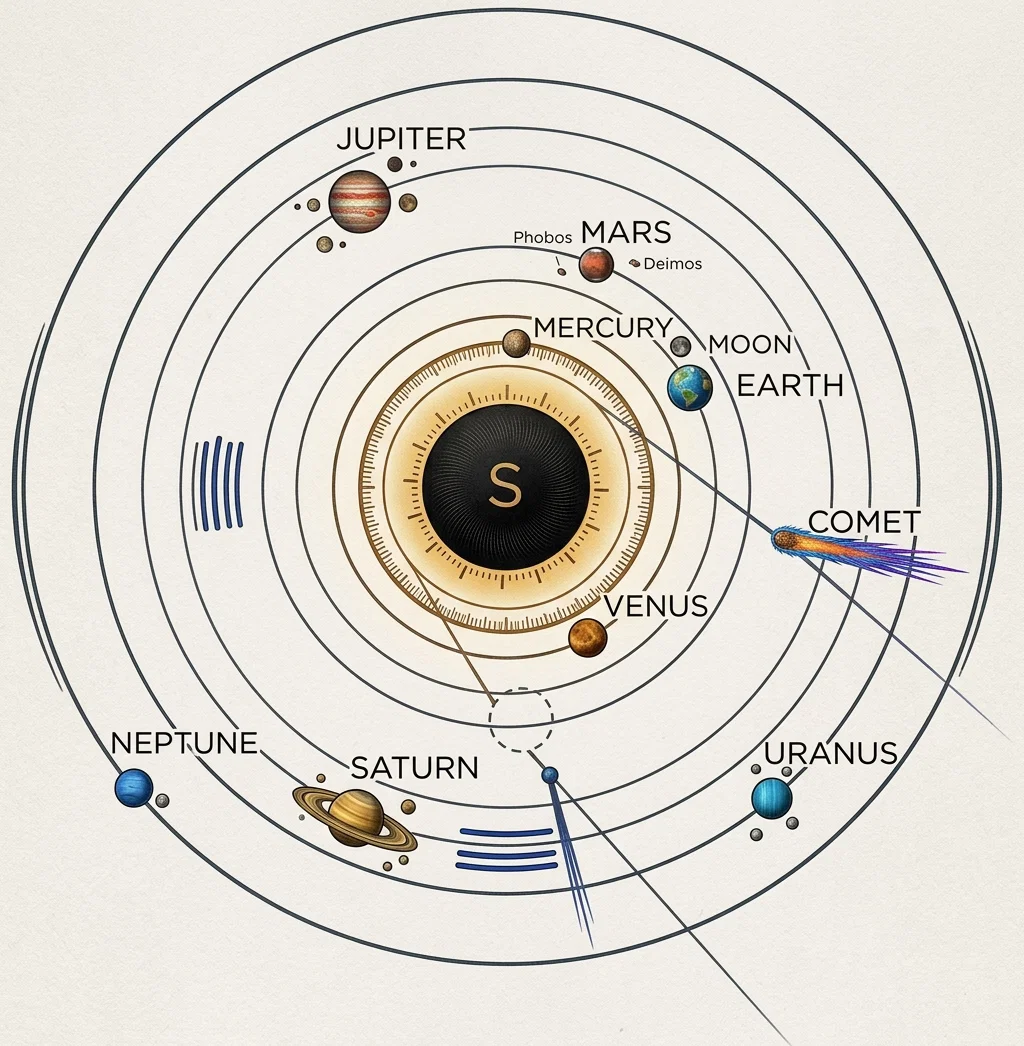
Diagram of the Solar System.
There are many striking comparisons which might be given, showing the great extent and size of this immense luminary of our solar system. Its light and brilliancy are no less remarkable. Euler estimated that “the light of the sun is equal to 65,000 candles at a foot distant, while the moon would be but one candle at 7½ feet, and Venus one at 421 feet, and Jupiter one at 1,320 feet.” These comparisons are only relative, for it is not easy to form any definite comparison of the light of the sun by figures expressed in “candle power,” for any of these artificial illuminations are black in comparison with the light of the sun. Even the most brilliant electric light when placed between the sun and the eye seems black; for the sun is nearly four times brighter than the brightest part of the electric arc. Langley made an experiment at a steel manufactory in Pennsylvania in comparing the direct sunlight with a stream of molten metal directly from the Bessemer converter. Altho the metal was absolutely dazzling, the sunlight was found to be 5,000 times brighter. It is said that the light of the sun is equal to that received from 600,000 full moons.
It has been lately discovered that the rays of light and the rays of heat which come from the sun are distinct from each other; for it can be shown that some of the rays of the sun produce heat, and yet they have no power to give light or color. It is said that the red rays produce the greatest heat, and the violet the least, and the temperature is greatest beyond the red rays where there is no light. Not only this, but it is also noted that different rays of the sun produce different chemical effects. Thus white muriate of silver will be blackened by the violet rays in fifteen seconds, while it will take twenty minutes for the red rays to produce the same effect. Phosphorus will be kindled by the red ray, but extinguished by the violet. It is therefore seen that the light of the sun consists of three different kinds of rays, one producing color, another producing heat, and another chemical effects. Our study some time ago on the subject of light will be remembered in this connection.
While it is difficult to give an adequate idea of the sun’s light, it is more difficult to give anything like a definite conception of its enormous heat. It is said when the sun is at its zenith, its heat is so great that if continued, it would every year melt a layer of ice over the whole earth nearly 170 feet in thickness. This heat is nothing more than energy— working power; and the amount of energy coming from the sun and resting upon five square feet of the earth, is said to be that of one horse-power, or it will do the work of about five men. Ericsson, the great Swedish engineer, who it will be remembered built the Monitor that defeated the Merrimac in the Civil War, built a solar engine, as did also Mouchat another celebrated engineer. There is enough heat falling upon the deck of a steamer in tropical regions, if it could be utilized, to propel it about ten knots an hour. The intensity of the heat of course decreases as we come away from the sun. This rate of decrease is such that the heat of a certain area on the surface of the sun is considered to be about 46,000 times greater than that received by a similar area of the earth. So that if we could utilize the heat as it is on the surface of the sun, we would have coming from one square yard of surface 100,000 horse-power. Indeed, it is so great that if a column of ice could be extended from the earth to the sun, three miles in diameter, and then all the heat of the sun suddenly turned upon it, it would melt it in a second of time, and convert it into steam in eight seconds.
Altho the sun has a circuit, going forth from one end of the heaven to the other, yet it may be said, so far as our globe is concerned, to be fixed and immovable; for the apparent motion, as all so well know, is due not to that of the sun, but to the turning of the earth upon its axis. The phenomenon is just the same as that when on a boat passing down the river, the banks seem to be moving and not we. However, the sun does rotate, or turn upon an imaginary axis, as does the earth. It has been said to take about twenty-five of our days for the sun to perform its revolution. This motion has been determined by dark spots which are discovered through the telescope upon its disk, these spots passing from the eastern side to the western in regular succession. The whole solar system, including the sun and its attendant planets, has a movement through space, but of that we may speak later.
God’s laws, not only moral but physical, are not only marvelous, but they are perfect, converting the soul, and His testimony is sure, making wise the simple.
FREDERICK GRIGGS.
So. Lancaster, Mass.