First of all comes the railroad. There are perhaps between two and three thousand miles of railroad in operation in Japan. The trunk line runs north and south and connects the cities of the extreme north with those of the south. From this main trunk there are branches connecting with the west coast. The traveler has his choice of first, second, and third class fares, which respectively are three, two, and one cent per mile. The great masses of the Japanese travel third class. The accommodations vary with the price, of course; first class is good, second is fair, while third is poor.
Next come the coasting steamers, small boats of several tons burden, that ply among the many towns on the coast. They are poorly equipped, and the passengers suffer many inconveniences. Still the missionary can employ them advantageously in making short trips to coast towns that are not accessible by railroad. I have made the journey from Kagoshima to Kobe on one of them, a distance of perhaps 500 miles.
But while speaking of steamers we must not omit the superb ocean liners of the Nip-pon Yu-sen Kwan-sha, which run from Yokohama, Japan, to Shanghai, China. Chief among these boats are the Tokyo Maru and the Kobe Maru, twin sisters. They were built in Glasgow, Scotland, and are strictly first class in all their appointments. The Japanese have a proverb that one has never seen anything beautiful if he has not seen Nik Ko, a famous city to the north of Tokyo. We might add that one knows not what a trip of pleasure and comfort is till he has sailed the inland seas of Japan in one of these steamers. The excellent equipment of the ship, the smooth sea, and the exquisitely charming scenery which only Japan affords, all unite to beguile the hours and delight the soul. It seems almost like a trip through fairy land.
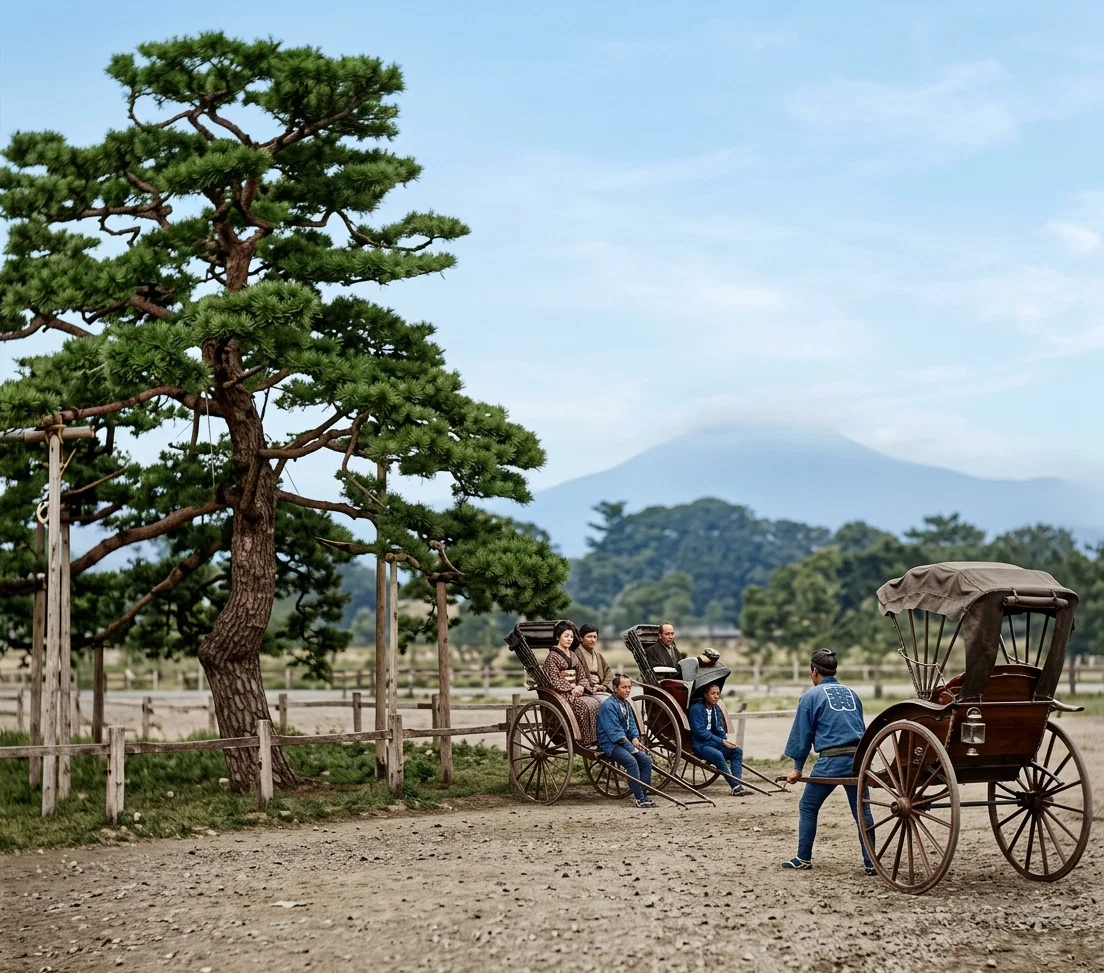
Jinrikisha Men, Waiting for Customers.
Japanese Court.
But after all, perhaps the most convenient and useful of the means employed for travel is the far-famed jinrikisha. The name itself, when understood, defines itself. Let us analyze it. Jin-riki-sha—three words. “Jin” means man, “riki” strength, and “sha” vehicle. Now read the meaning backward, and we have, as a definition of the word, a vehicle operated by the strength of man. And such it is in reality. It is small and light, having two wheels and an adjustable top. The body is well upholstered, and is mounted upon two elastic springs, which in turn rest upon the axle. A pair of shafts extend to the front, united at their ends by a cross-piece. That is the jinrikisha, the lazy man’s luxury, and the busy man’s convenience. One soon grows dependent on them, and when deprived of them feels their absence keenly. Their convenience, added to the fact that they are well-nigh ubiquitous, recommends their use to all. The prices charged for them are also reasonable. Ten cents per hour is good pay for the use of one. They are available at almost any hour of the day or night and at almost any street corner. It has been said that in the city of Tokyo alone, there are about 40,000 of them.
But, queries one, do the Japanese men actually pull them?—Certainly. Without any harness, or trappings of any kind, and perhaps with just enough clothes to cover the middle portions of his little brown body, a pair of straw sandals on his feet, and a straw sun-shield on his head, he steps nimbly between the shafts, and after the passenger has mounted and is comfortably seated, he stoops down, grasps one in each hand, rises up, and at the signal trots away with all the grace and ease of a well-groomed American roadster. Trot, do you say?—Yes; he trots. How fast and how long?—That depends upon the distance, and the time at the passenger’s command. He can go from three to seven miles per hour, and continue his trotting for miles together. I once traveled from Moji to Kagoshima, a distance of nearly 300 miles, and most of the journey was made in rikishas. There were three of us in the party, and our luggage. Consequently we employed four men and their jinrikishas. One of the men, of athletic build, strong, robust, and gifted with remarkable powers of endurance, remained with the party three consecutive days, during which he trotted 120 miles, 40 miles a day, and pulled a man who tipped the scales at 160 lbs. And what is more remarkable, he exhibited no symptoms of fatigue at the close of the third day’s run, and would gladly have gone farther with us, but we came to an arm of the sea, and quit the land, and traveled in a large canoe about thirty miles.
But perhaps the thought is constantly rising in your mind. Can one quite divest himself of the idea that his fellow-man between the shafts is reducing himself to the level of a beast of burden? Well, now there are two sides to the question. Remember, the whole of Japan is less than the one State of California, and into that little country are crowded more than 42 millions of souls. Extreme density of population is usually accompanied by great scarcity of work, much illness, and grinding poverty. Japan is no exception. Those men who draw the jinrikishas usually make about $10 or $12 a month,—good wages. They have no other means of living. They will beseech you to employ them. If you refuse for reasons of humanitarianism, you are depriving wife and babe of rice and raiment; and your philanthropic action will seem to him to be of misanthropic intent. But as a matter of fact, everybody who goes to Japan rides in jinrikishas, and if you go, you will, too.
These vehicles, combining cheapness with convenience and comfort, are a valuable auxiliary to the evangelist. He can by means of them penetrate far into the interior, away from railroad points, and dispense the blessings of the Gospel as he goes. If he contemplates a long journey, he can easily procure a fresh man every morning, if he chooses. He can also carry with him a good supply of books, papers, and tracts, for sale or free distribution. Japan without the jinrikisha would hardly seem like Japan.
Before leaving this portion of the subject, we must not fail to mention the postal facilities, which are truly efficient. They have free delivery of mail both in cities, villages, and even in the rural districts. Perhaps we can best illustrate the painstaking accuracy of the post-official by relating an experience. While living in the town of Kokura, I received from the Yokohama office an empty newspaper wrapper, bearing my address. Accompanying the wrapper was a prepared blank with instructions to fill the blank spaces by giving the name, date, etc., of the paper which the empty wrapper ought to have enclosed, and to return the same to the Yokohama office. Compliance with the request brought to us in a few days the missing paper.
During the long journey from America, many papers became separated from their wrappers. Consequently a number of wrapperless papers, and paperless wrappers were received at the office in Yokohama, and the officials had no way of determining which one of the many unaddressed papers belonged to any one of the many addressed wrappers. So they sent the wrappers to the parties to whom they were addressed, accompanied by the above-mentioned blanks. Upon receiving again those blanks properly filled, they, guided by the description it contained, sought out of the mass of papers the one described, wrapped it carefully, and mailed it to its owner.
The efficiency of the service is a source of great comfort and convenience to the missionary, and is a material aid in the prosecution of his work. Japan belongs to the Postal Union, and money-orders can be sent to any of the foreign countries.