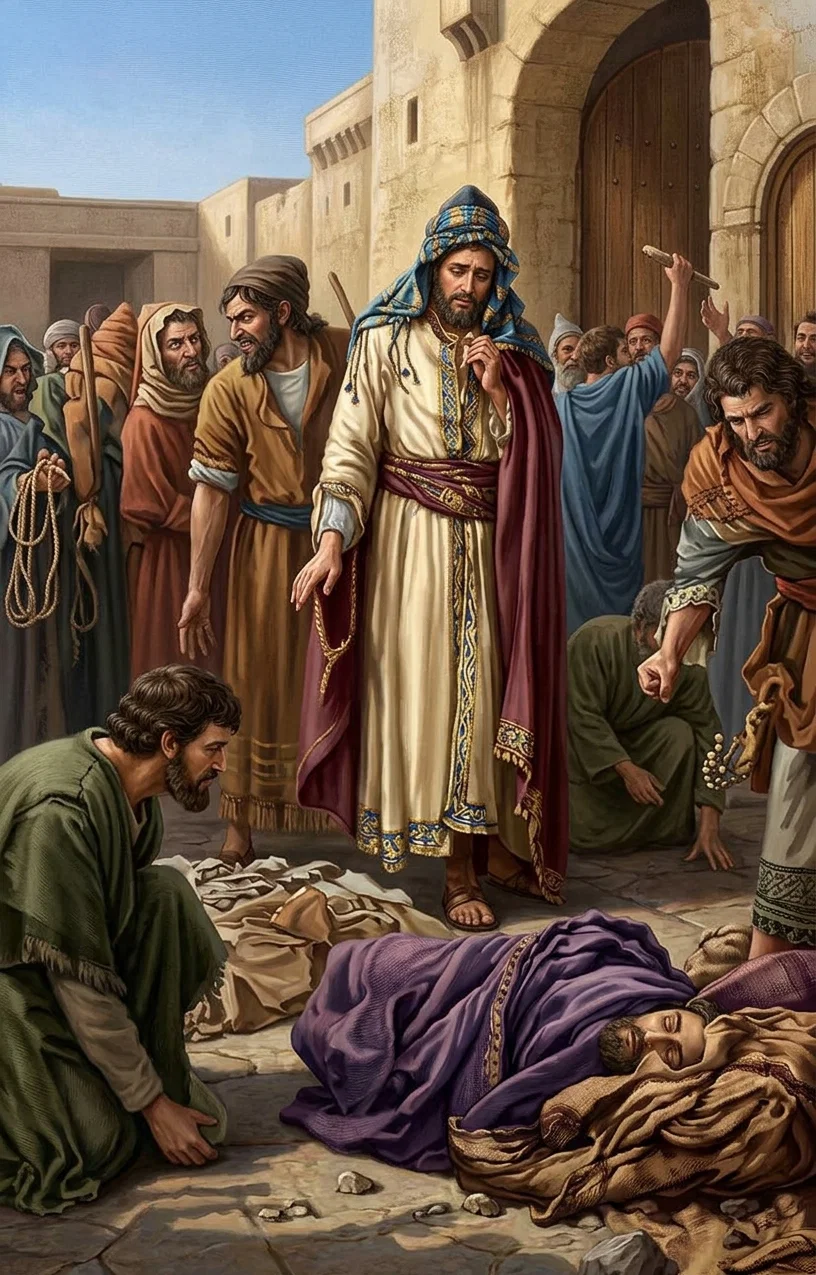
THE STONING OF STEPHEN

9%

Pacific Press Publishing Company · Oakland, California · Feb 19, 1902

FromSigns of the Times, Vol. 28, No. 8.

Read the full edition

THE STONING OF STEPHEN.

WHEN brought before the Jewish council, Stephen was given but a mock trial, false witnesses having been hired to give prejudicial testimony in his case. The very same story was told against him, in fact, that was employed to condemn Christ to the cross. After listening with mock gravity to the pitiless falsehood of the priestly hirelings, the high priest turned to Stephen with feigned surprise, and asked, “Are these things so?” Acts 7:1.
The artist's conception of the death of Stephen. His murderers still stand by with malignant attitude; the “devout men” are coming to give him honorable burial.
He well knew that they were not so, but tried to appear impartial in the matter. And altho the condemnation of the prisoner was doubtless assured from the first, and Stephen understood it thus: yet notwithstanding this was to be his last testimony, he was ready to reply to this question in a way to leave himself entirely out of the controversy. Being a witness for Christ, he was more concerned to bear a testimony which would set forth the claim of Jesus to the Messiahship.
He therefore began by calling attention to those points of history to which he knew they would not object, in order to reach his favorite theme. Starting with Abraham, he recited the promise of God to that patriarch, and showed its application to Isaac, Jacob, and Joseph, then to Moses and David, the lineal descendants of Abraham. Referring to the deliverance of Israel from Egyptian bondage, he testified that Christ was their invisible leader and benefactor, from whom they turned to worship false gods. After reviewing the whole course of God’s providence toward His people, the devoted witness, under the impulse of the Spirit, cried out: “Ye stiff-necked and uncircumcised in heart and ears, ye do always resist the Holy Ghost; as your fathers did, so do ye. Which of the prophets have not your fathers persecuted? and they have slain them which showed before of the coming of the Just One; of whom ye have been now the betrayers and murderers.” Verses 51, 52.
The effect of this climax was far different from that produced on the multitude of common people at Pentecost when Peter uttered substantially the same sentiment. Ch. 2:22, 23. They, when “pricked in their heart,” repented, and were baptized; but these, when “cut to the heart,” gnashed on the speaker “with their teeth,” like angry dogs. This was the signal that they were ready to take his life, but their threatening attitude caused no tremor of fear in the breast of Christ’s loyal deponent. There was at that time something which attracted his attention more. The Holy Ghost, with which he was filled, drew his gaze upward toward where Christ was standing, by the brightness of the glory of God. Just then a rift appeared in the vail which shut heaven away from earth, and glory shone through upon the face of the persecuted witness for Christ. Acts 6:15. With the strength of sight provided by the Holy Ghost, Stephen was permitted to behold Him for whom he had so boldly witnessed, and for whom he was about to die. By this view his faith was doubly rewarded, and he received strength with which to pass the terrible ordeal just before him. As the angel in the garden of Gethsemane had presented the cup of strength to Christ (Luke 22:43), so the Holy Ghost on this occasion had provided the martyr a view of glory for his encouragement.
The ecstatic joy of the occasion was the incentive which drew forth from Stephen his final testimony in behalf of Christ. He had before declared Him exalted to a place in heaven, and now he exclaims, “I see the heavens opened, and the Son of Man standing on the right hand of God.” Acts 7:56. These were the words that sealed the fate of Stephen. So long as he had confined his testimony to a question of mere faith, his hearers could bear with him, tho made angry at his statements; but when his upturned face caught the rays of glory from heaven’s throne, in plain view of all the council, and it was seen to shine like the face of an angel, whose dwelling is in glory, and this view was accompanied by the positive testimony that his eyes were looking on his Beloved, his enraged auditors stopped their ears and cried aloud, to break the force of hiswords. With one accord they then rushed upon him, and dragged him out of the city, where he was stoned to death.
As his Master, for whom he had witnessed, was taken out of the city to die (Heb. 13:12), so His devoted follower was led along the same path, which had been consecrated by Christ’s earthly pilgrimage for all His adherents. Heb. 10:20. As his Master had died with a prayer of forgiveness on His lips for His persecutors, so Stephen, the faithful witness for Christ, testified under tortures to having the same spirit as his Master. Kneeling on the ground in the place of his execution, the martyr first committed his life to Jesus, and then, while receiving upon his devoted body the murderous missiles, his last sentence was a fervent prayer for his tormentors, that their sin might not be laid to their charge. Verses 59, 60.
The life and death of Stephen had been so Christlike that he was beloved by all who knew him. His burial was therefore the occasion of the greatest lamentation. Even tho his life had paid the forfeit of his faithfulness, he being dead yet speaketh. It is thus that God makes one’s testimony ring out through all the ages. Heb. 11:4.
It is evident from the course of Stephen that he was “filled with the Holy Ghost,” by virtue of which he was able so boldly and truly to testify for Christ. That power did not desert him in his dying moments, and when he prayed for the sin committed in his murder, not to be laid to those who were about him, it must have been dictated by the Holy Ghost, which is the power and mind of Jehovah. But why release those actors from responsibility in the matter?—Because their minds were so blinded by Satan that they were really made to believe, in their ignorance, that they were doing God service in putting Stephen to death. For this reason God pitied them, and the same pity was so fully felt by him who was filled with God’s Spirit, that he expressed it as his last earthly request. Doubtless this prayer covered the thought that their murderous act, under the circumstances, might not be permitted to hinder them from receiving forgiveness in case they repented. In other words, the dying martyr so desired their salvation that notwithstanding they were putting him to death in the face of the Spirit’s mighty protest, he wished their sin might not be counted as unpardonable. See Matt. 12:31, 32.
Dictated, as this prayer must have been, by the Holy Spirit, it shows the mind of God toward those poor benighted souls, who, while professing to be His children, were lending themselves to the work of Satan, the sworn enemy of God and of all who are loyal to Him. The danger of repeating the sin of the church of that day is by no means past. Power had been committed to the Jewish church of that time, by which it might visit corporal punishment upon those accounted heretics, and it was simply used in a way to suit the carnal feelings of those who composed that church. The same power in the hands of the church now would bring the same results, because unregenerate human nature is the same now as then. It can not be denied that many of the present-day church-members do not show regenerate lives, altho their influence is strong in the councils of the church. In view of this, it is best for the church not to exchange what little of the power of God it does have, for the power of civil law. God’s power converts men’s hearts, but civil power can not convert men, especially when it is controlled by the church; then, it only persecutes. God’s power alone is sufficient for the guidance and maintenance of the church. J. O. CORLISS.