WATER AGAINST STONES

7%

Pacific Press Publishing Company · Oakland, California · Feb 12, 1902

FromSigns of the Times, Vol. 28, No. 7.

Read the full edition

WATER AGAINST STONES.

What a nuisance these cobble-stones are; who cares for them? Of what use can they possibly be to any one? How many a farmer wishes they were all taken off his land,—gray cobble-stones, black cobble-stones, big cobble-stones, and small ones—all sizes, shapes, and colors. It is hard to tell just when a stone is too large to be called a cobble-stone, or when it is too small—so small that it is called a pebble. The larger loose stones are called boulders. They were called so by people before geologists gave them other names. They were called this name because they were loose, and could be bowled around over the ground, so that they become rounded like balls. These boulders range in size from that of a bushel basket to mammoth rocks weighing many thousands of tons. I have seen fields covered so thickly with cobble-stones and boulders that I could not see how it could be cultivated or hardly used for grazing lands.
Now all these stones came from somewhere. They did not grow right where they are on the top of the ground. It is the journeys which these stones have taken that have given them their rounded bodies. It is because of this rounded shape that cobble-stones are so named; they have had so many hard knocks as they have traveled around the world. So it often happens with young men and women who break away from the parent rock and wander around. They often get some very hard knocks by the blows which the world can give.
There are often many different kinds of rocks in a field. In any country where rocks are to be found on the ground, there are ledges of rock under the ground and often near the top. It sometimes happens, however, that these ledges are even two hundred miles away from the boulders that were broken off from the ledge. Generally these ledges are of one kind of rock. They can, in some cases, be traced for many miles through the country. Now, nearly all of these boulders came from these ledges. They have wandered from them all the way from one to two hundred miles. For instance, there is a large copper region south of Lake Superior. Boulders from this copper ore are found as far away from this region as southern Michigan, Indiana, Illinois, and Ohio. There is no probable source from which these boulders could have come other than the copper regions near Lake Superior.
Many other illustrations similar to this could be mentioned. It certainly must have taken some mighty force to have thus caused these boulders to be carried so far away; and such a force it was, being none other than that of the great flood of waters which the Lord permitted to come upon the earth in the destruction of sin.
“The entire surface of the earth was changed at the flood. As the waters began to subside, the hills and mountains were surrounded by a vast turbid sea. Everywhere were strewn the dead bodies of men and beasts. The Lord would not permit these to remain to decompose and pollute the air; therefore He made of the earth a vast burial-ground. A violent wind which was caused to blow for the purpose of drying up the waters, moved them with great force, in some instances even carrying away the tops of the mountains, and heaping up trees, rocks, and earth above the bodies of the dead. By the same means the silver and gold, the choice wood and precious stones, which had enriched and adorned the world before the flood, and which the inhabitants had idolized, were concealed from the sight and search of men, the violent action of the waters piling earth and rocks upon these treasures, and in some cases even forming mountains above them. God saw that the more He enriched and prospered sinful men, the more they would corrupt their ways before Him. The treasures that should have led them to glorify the bountiful Giver had been worshiped, while God had been dishonored and despised.
“The earth presented an appearance of confusion and desolation impossible to describe. The mountains, once so beautiful in their perfect symmetry, had become broken and irregular. Stones, ledges, and ragged rocks were now scattered upon the surface of the earth. In many places, hills and mountains had disappeared, leaving no trace of where they once stood; and plains had given place to mountain ranges. These changes were more marked in some places than in others. Where once had been earth's richest treasures of gold and silver and precious stones, were seen the heaviest marks of the curse. And upon countries that were not inhabited, and those where there had been the least crime, the curse rested more lightly.”
But this mighty scattering of these great fragments of rock is only one part of the work which has been wrought to bring these stones, Old Hard Head and his fellows, into their present home and into the bodily shape in which we now find them. The changes made in the earth's surface by this display of God's power account for the general position of all boulders and smaller stones. While God was in the whirlwind, He has ever since been in the quieter workings of nature by which these loose stones have not only been moved about, but have had their form changed as well. This calmer work has also largely been accomplished by the action of water—the rains of the centuries. The old saying that “a continual dropping wears away stone” is a very true one.
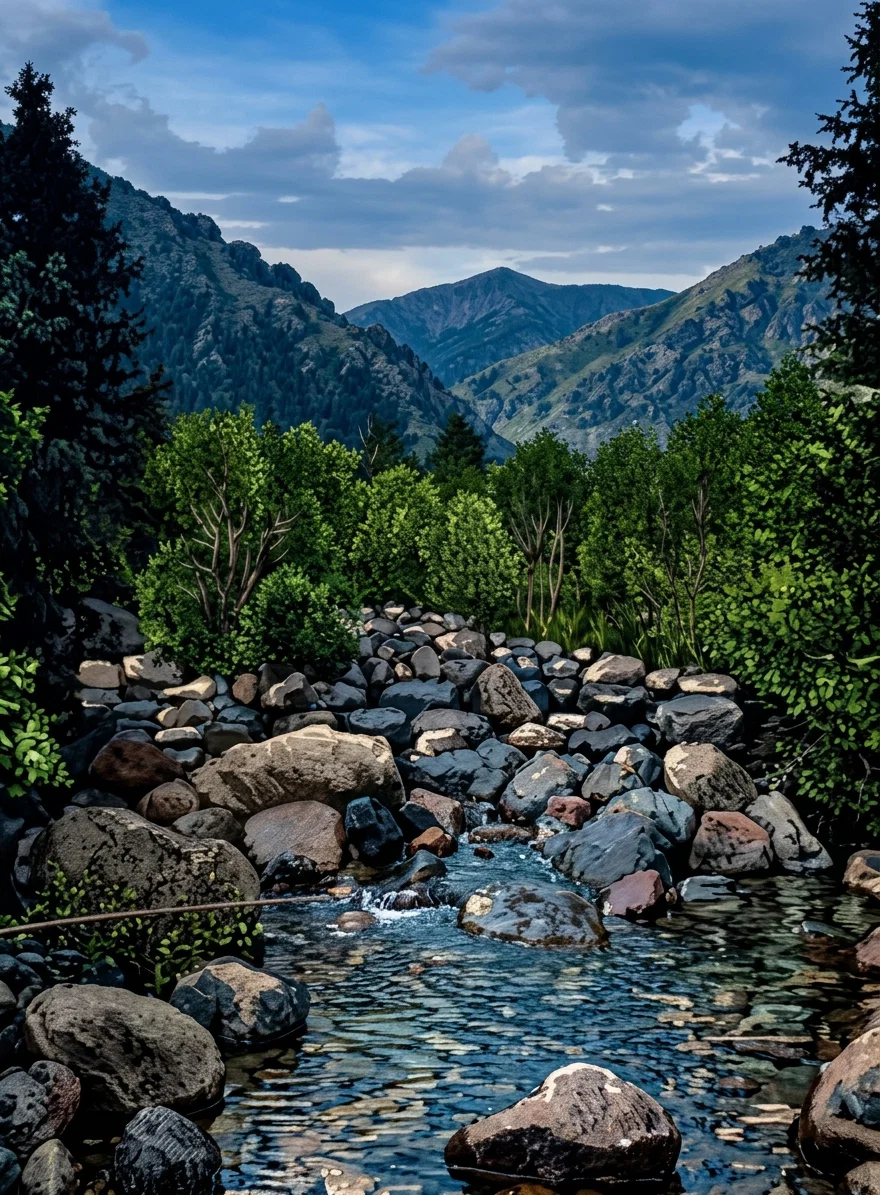
Walk with me down this slope to yon little brook, singing all its way to the river. You see that all the slope is strewn with stones, all more or less angular. We will now walk down the stream, examining closely the stones which lie in it. As we walk along, we see that they are growing smaller and rounder. As we approach the mouth of the brook where it enters into the river, we find that these stones are becoming but small pebbles, and are rapidly passing into gravel and sand. If we examine some of the grains of sand under a microscope, we shall find that they are of the same material—for they are but little stones—as were the boulders away back up the stream. If the boulders were of red sandstone, we shall find the particles of sand to be of the same color.
Does the fact that the stones are lying near the mouth of the stream make them smaller? How did they get down in this way? If we watch the stream on a fine day—on such a one as that on which we took our stroll along its course—we shall have rather hard work to find the answers to our questions; for the water is low, and the current is feeble. We can not tell much about the working power of a stream by what it does when but little water is passing over its course. So we will take another walk beside it after a heavy rain, and when it is in flood. We can not see the stones now, but by listening very attentively we can hear them knocking and grinding one against another. As they do this, their rough places are worn off, and the parts of the stone which are thus worn off become the sand which we find down the stream. They smooth and polish not only themselves, but the rocks over which they pass as well.
Summer and winter, with their heat, and cold, and sunshine, and tempest, make similar changes in the rocks which are not in a stream, and which do not have the variety of interesting experiences and rapid changes which the rocks rolling down the stream do. But the changes, while very much slower, are none the less certain. As shown in a previous article, stones do something else than wear away; they grow as well, not as trees grow, but they grow nevertheless. It is true that when the Lord spoke the world into existence by the breath of His mouth, the greater portion of the stones which we see were created. However, the Lord has continued to carry on this work of making stones just as He has continued to make trees.
FREDERICK GRIGGS.
So. Lancaster, Mass.