AGRICULTURE IN BRAZIL

7%

Pacific Press Publishing Company · Oakland, California · Feb 12, 1902

FromSigns of the Times, Vol. 28, No. 7.

Read the full edition

AGRICULTURE IN BRAZIL.

[From Mission Board Correspondence.]
BRAZIL is pre-eminently an agricultural country; yet its agriculture differs from that of the United States as much in its methods as in its products.
In many places the surface of the land is so abruptly broken that it does not generally admit of the use of the plow and other more modern implements. Yet there are important areas where these implements are being used to advantage, and there is considerable increase in their employment. As a rule, the hoe is the main implement for field-culture, and it is twice as heavy and large as the field-hoe in common use in the United States. It is more like a grub-hoe, and weighs from two to three pounds. Farming implements are imported from England and the United States.
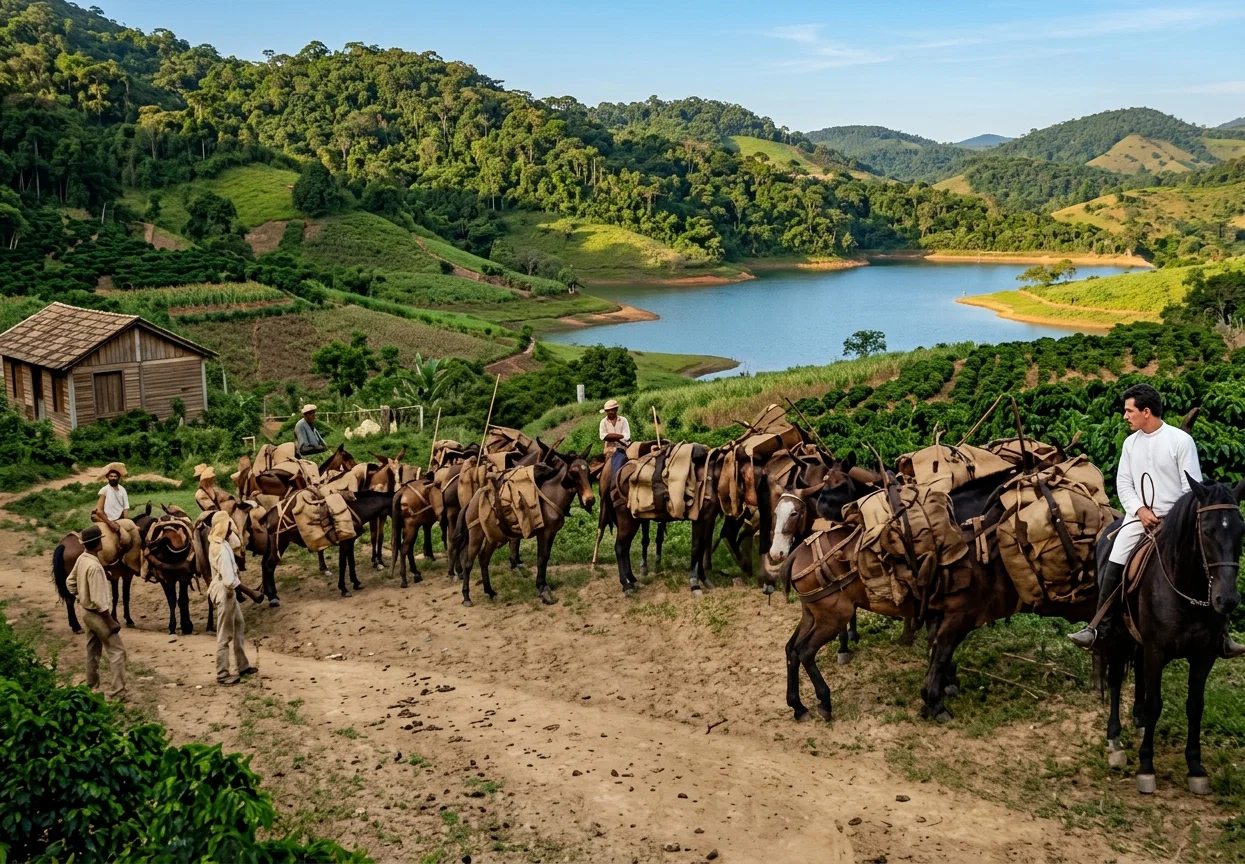
A Pack-train in Brazil.
Coffee is the leading crop, and is raised successfully in every State except the two or three most southerly ones. The coffee tree is from eight to twelve feet high, according to age and the richness of soil, and is one of the most beautiful of productive plants. Its foliage is abundant, and of a rich dark-green color, the tapering leaves being about five inches in length and two inches in width in the widest part. Its abundant blossoms are of a delicate white color, and in shape and size resemble the lilac flower.
The coffee tree begins to yield when it is three years old. Between the rows of newly planted trees, corn, rice, and beans are grown till the coffee plants are in bearing condition.
The coffee berry grows on slender branches, with scarcely any more stem than that of the acorn. When ready for gathering, it has a brownish-red color. The tree is very pretty when the long twigs are loaded with red berries and the green foliage.
The skin of the berry is somewhat tougher than a grape-skin, and on cutting it open a sweet, juicy pulp is found to surround the two coffee-beans within, each enclosed in its separate husk or shell.
The coffee berry is gathered by hand, dried, shucked, and shipped all over the world as one of man's chief but harmful luxuries. The steamer on which I sailed from Rio to New York last year hadon board 30,000 sacks of coffee. It is estimated that about 500,000,000 pounds of coffee are exported from Brazil to the United States annually.
Formerly coffee was principally grown by slave labor on large plantations, many of them situated on sides of high hills and even upon mountains. When slavery was abolished, many of the slaves still remained on the plantations, where little homes have been provided for them.
Corn is grown successfully in all parts of the country, and forms one of the principal crops. The accompanying picture represents a company of farmers bringing coffee, corn, farina, and general produce from the interior down to market.
Soon after the American Civil War, several Southern planters, slave-holders, went from the South to Brazil, and took up the same occupation there. A few families followed on a little later, and they located about three hundred miles southwest of Rio de Janeiro in the State of Sao Paulo. There are perhaps forty or fifty families in that section now, and the most of them are farming more or less as we farm in America, only after methods somewhat Brazilianized. Most of them have good homes, and are doing very well. They use mules on the farm, and oxen on the carts for transportation.
Sao Paulo is a good State, and it is being rapidly developed. They have railways and wagon-roads, and the soil and climate are good. Some of our good farmer brethren would do well to move there, and live the truth among the people. Who will go?
W. H. THURSTON.