A GREAT FAILURE

6%

Pacific Press Publishing Company · Oakland, California · Jan 29, 1902

FromSigns of the Times, Vol. 28, No. 5.

Read the full edition

A GREAT FAILURE.

JUDGED by the world's standard, Napoleon Bonaparte was one of the great men; but in the one great purpose of his life, no man ever more signally failed. In his career were fulfilled the words of Job: “Man that is born of a woman is of few days, and full of trouble. He cometh forth like a flower, and is cut down; he fleeth also as a shadow, and continueth not.”
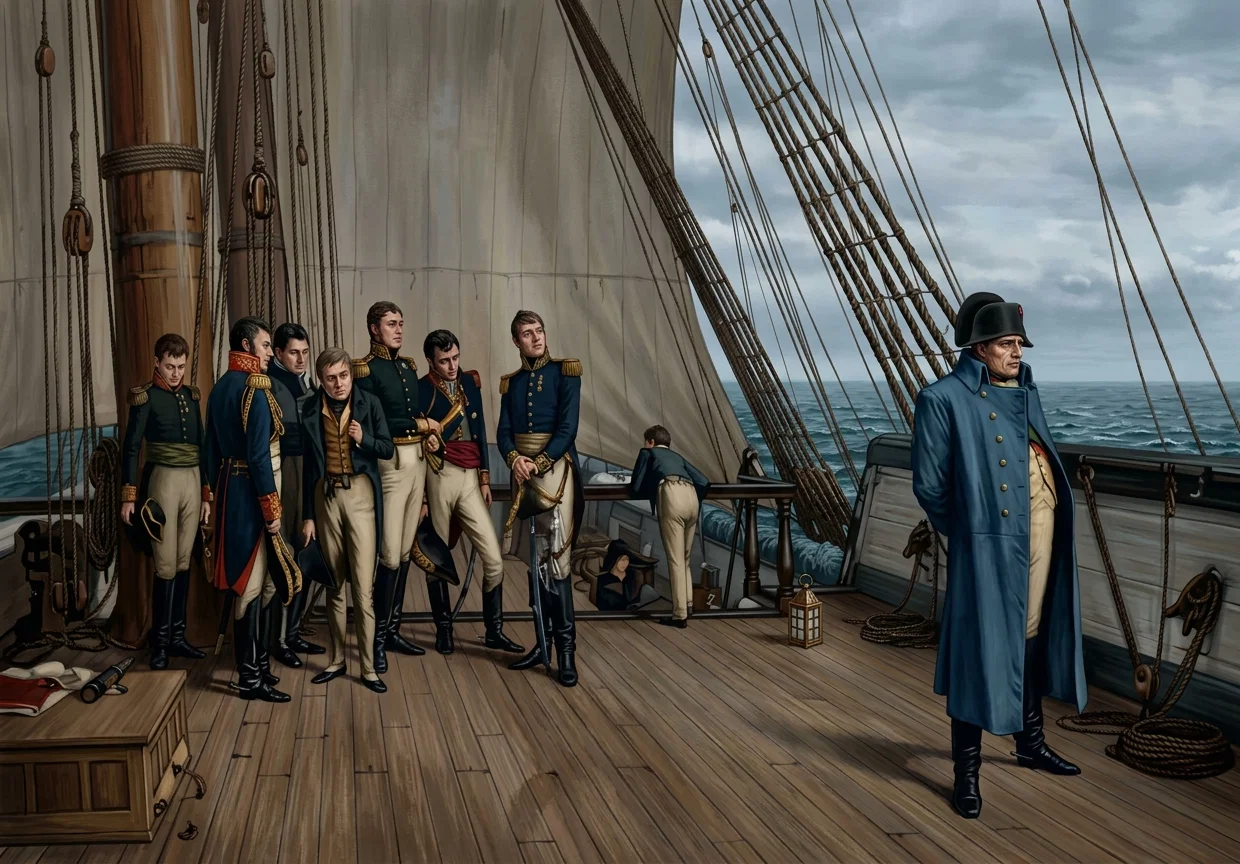
NAPOLEON ON THE BELLEROPHON.
NAPOLEON undertook the impossible. Altho he had espoused every principle in politics from republicanism to absolute monarchism, and had made many varied pretensions as to his purpose, he admitted when all was over that he had “endeavored to organize a grand federal system in Europe,” and claimed that he had regarded that purpose as “agreeable to the spirit of the age, and favorable to the progress of civilization.” However, to attain his purpose he had sought, and gradually acquired, the title of emperor; and all the factors gained for the “federal system” became subject to his dictation. In a heated discussion with a civilian official, Napoleon said, “You are no soldier; you do not know what passes in a soldier’s mind. I grew up in the field, and a man like me troubles himself little about the lives of a million men.”
In the explanation of the great image which Nebuchadnezzar saw in his dream, as set forth in the second chapter of Daniel, the prophet says of the fourth kingdom (Rome): “Whereas thou sawest the feet and toes, part of potter’s clay, and part of iron, the kingdom shall be divided; but there shall be in it of the strength of the iron, forasmuch as thou sawest the iron mixed with miry clay. And whereas thou sawest iron mixed with miry clay, they shall mingle themselves with the seed of men; but they shall not cleave one to another, even as iron is not mixed with clay.”
This iron kingdom became so degenerated by mingling the miry clay of luxury and corruption with the iron strength by which it had gained the ascendancy, that it fell to pieces. There was not sufficient internal adhesiveness to withstand the crush of external pressure. Therefore the parts that had formed the Roman Empire never could be cemented into one government again.
The very symbols of iron and clay, together with the express Word of God, forever forbade such a consummation.
SEVERAL attempts have been made by ambitious men to imitate the Western Empire of Rome on the same territory. The last, and the one that came nearest to apparent success, was the effort of Bonaparte. At times the goal seemed almost within his grasp, when unexpected reverses—political or military, domestic or foreign—would compel a revision of schemes. Between 1800 and 1805 he was absolute ruler of France, including Belgium, the left bank of the Rhine, Savoy, and Nice, and practically ruler of Holland, Switzerland, and north Italy. He was then a king of kings. At first the title of emperor meant merely a military ruler, but by this time it had come to signify, as in medieval times, a paramount control over a confederacy of principalities.
LATER the empire took in Germany and Austria. Now Napoleon began to make kings and princes of his brothers and other favorites. He created many hereditary dukes, counts,and barons, setting up a system extremely monarchical and lavishly wasteful. In 1806 the confederation had twelve members, and the empire controlled as much or more territory than was comprised in Western Rome. But it lacked England, and Napoleon lacked the ability to hold securely what he had gained. With all his genius, he made frequent blunders at critical moments. His ambition would lead him to overreach and nearly lose all. His selfishness would cause him to break with valuable allies and personal friends; and his rashness often led him to take desperate risks on the prestige of former very close successes.
ALL through Napoleon’s career he had indulged the hope of subduing England; but this one portion of the Roman Empire never came under his control. Several times he overreached and met disaster while endeavoring to weaken England. In the early part of his career he planned the expedition to Egypt in order to destroy England’s interests in the Orient, and the whole affair proved disastrous in the extreme. He sold the Louisiana Territory in America to the United States for $15,000,000, to raise means with which to build a navy to destroy England’s prestige on the seas. But in its first engagement (at Trafalgar) Lord Nelson’s fleet sent the new ships to the bottom of the Mediterranean.
ANOTHER attempt, not wholly a military scheme, was also a failure. He sought to establish a grand continental commercial blockade, and annexed territory on the Northern Sea in order to carry out the project. But in this he incurred the opposition and enmity of Russia, and made her an ally instead of an opponent of England, as before. It also turned out that the blockade was more injurious to the welfare of the continental States than to England.
THE disastrous campaign against Russia was also undertaken to humble his former ally, which had now become friendly to England, in fact was England’s only open sympathizer. With Russia conciliated or defeated, Napoleon thought to pit the whole continental coalition against England, and thus bring her to his feet. He had humbled Austria and Prussia while they were assisted by a strong contingent from Russia. Now with these two factors under his dictation, Russia seemed a comparatively easy prey. The army sent against Russia consisted of French, German, Austrian, Polish, and Italian troops. Everything seemed propitious, for England was at war with the United States. But the result, as all students of history know, was a defeat from which Napoleon and his great project never recovered.
AFTER this unparalleled reverse, Napoleon lost the confidence of the French; he was obliged to abdicate, and was stationed on the little island of Elba. But he did not long remain; it was not his first practical banishment. His expedition to Egypt was of that character in part; for he had been encouraged in the project mainly to get him out of France. But when he returned, he found the government in such a state the people were glad to have his help. So, after his retirement to Elba, the government was in bewilderment. The great coalition was broken, and every former ally was now the enemy of France. Says the historian, “Never was a great State in a position so untenable and monstrous as France after Napoleon quitted the helm.” Again the people are described as being “disgraced, bewildered, and alarmed,” regretting even the loss of the reign of Napoleon. So when he suddenly appeared again in Paris, he was once more placed at the head of the army. This time he was set to defend the national honor against triumphant foreigners. He promised to turn over a new leaf, and stand for national independence and modern ideas.
BUT this last chapter of his active career was of short duration, just one hundred days. Immediately on hearing of his return, the great powers issued a declaration putting him “outside of all civil and social relations,” and consigning him to public vengeance as “an enemy and disturber of the peace of the world.” And following his defeat at Waterloo, he was held in no higher esteem by the ascendant party in France. There was no chance for escape; so he went on board the English cruiser Bellerophon, at Rochefort, and surrendered to its captain. It was the best he could do. He recognized that his career was ended, and being regarded as an outlaw by all Europe, he surrendered to England because he deemed her “the most powerful, the most constant, and the most generous” of his enemies. England banished him to St. Helena, where he died six years later, May 5, 1821.
IT is generally conceded that even if Napoleon had won Waterloo, it would have been merely to postpone the inevitable for a few weeks at most. His army was now terribly emaciated, at best but a handful as compared with the half million or more already marching against France from different parts of the old confederacy. Militarism, after a trial of about twenty years, had utterly failed as a peace-maker and prosperity promoter; and its weakness as against the decree of the Almighty was most thoroughly tested. Of the three governments that France had endured within twenty-six years, this great military power was the only one that actually succumbed before an invader. Such was the fate of the last and the greatest effort to make the iron and the clay cleave together.
“ALL flesh is as grass, and all the glory of man as the flower of grass. The grass withereth, and the flower thereof falleth away; but the Word of the Lord endureth forever. And this is the Word which by the Gospel is preached unto you.” 1 Peter 1:24, 25. G.