CLOUDS

7%

Pacific Press Publishing Company · Oakland, California · Jan 8, 1902

FromSigns of the Times, Vol. 28, No. 2.

Read the full edition

CLOUDS

In the studies on heat, I spoke of the fact that heat caused the particles of water to vibrate. This vibration causes a separation in the molecules of water, so that they become lighter than the air, which presses under them and forces them up. As an illustration of the wonderful action of heat on water, thus causing it to separate, it may be stated that at the moment of evaporation the water has expanded to about 1,700 times the volume that it has in its liquid state. That is to say, that if heat could be so applied that a quart of water could be evaporated in an instant of time, it would occupy the space of 1,700 liquid quarts. The air is naturally heaviest near the earth, owing to its weight from above pressing down and condensing it. The air forces these particles of water up until they reach a place where they are just the weight of the air.
The law that heat expands an object and cold contracts it, plays an important part in the formation of the clouds. When this vapor, through the action of heat, has arisen to the place where it is just as heavy as the air, it forms clouds. The atmosphere has cold and warm currents passing through it. As these clouds come into a strata of cold air, the vapor is condensed and falls in the form of rain, hail, or snow. As the particles of water fall through the air, they gather moisture from the air and increase in size. If the condensation takes place in an atmosphere below the freezing point, the vapor crystallizes into snowflakes. Of these there are many forms, but all agree in being six-pointed or six-sided, and of having angles of 60 degrees between their branches.
The exact method of the formation of snowflakes is not clearly understood; but it is thought that electricity often plays an important part in the formation of hailstones. Hailstones are masses of ice, or of snow and ice, which are sometimes as large as hens’ eggs, or even larger, often weighing several ounces; but the Scripture says that, before the end of this world, there are to be hailstones weighing over a hundred pounds. The structure of hailstones is often composed of layers of ice and snow alternating. This would show that they have passed through various conditions of atmosphere.
Clouds are continually changing in form and color. In form they are of four kinds, named cumulus, cirrus, stratus, and nimbus. Then there are many combinations. The most common of these combinations are the cirro-stratus, cirro-cumulus, and strato-cumulus. I want to make a little study of these various forms; for when one has learned to distinguish them, he will have a never-ending source of pleasure in watching them. Cumulus clouds are mountain-like masses, often looking like piles of wool. They are generally seen on warm summer afternoons, and are very common in equatorial regions. They often result in showers and thunder-storms. These clouds often pile up to the height of five miles or more. Cirrus clouds are light and feathery, and resemble cats’ tails, ostrich plumes, daubs of thin white paint, or loose wisps of straw. They take on various fantastic and queer forms. The usual height of these clouds is about five miles, and they are composed of minute crystals, or snowflakes.
Stratus clouds vary in height from 1,000 feet to three miles. They are those clouds which extend in long, horizontal bars or layers. Nimbus clouds are those from which rain or snow is falling, no matter what may be their form.
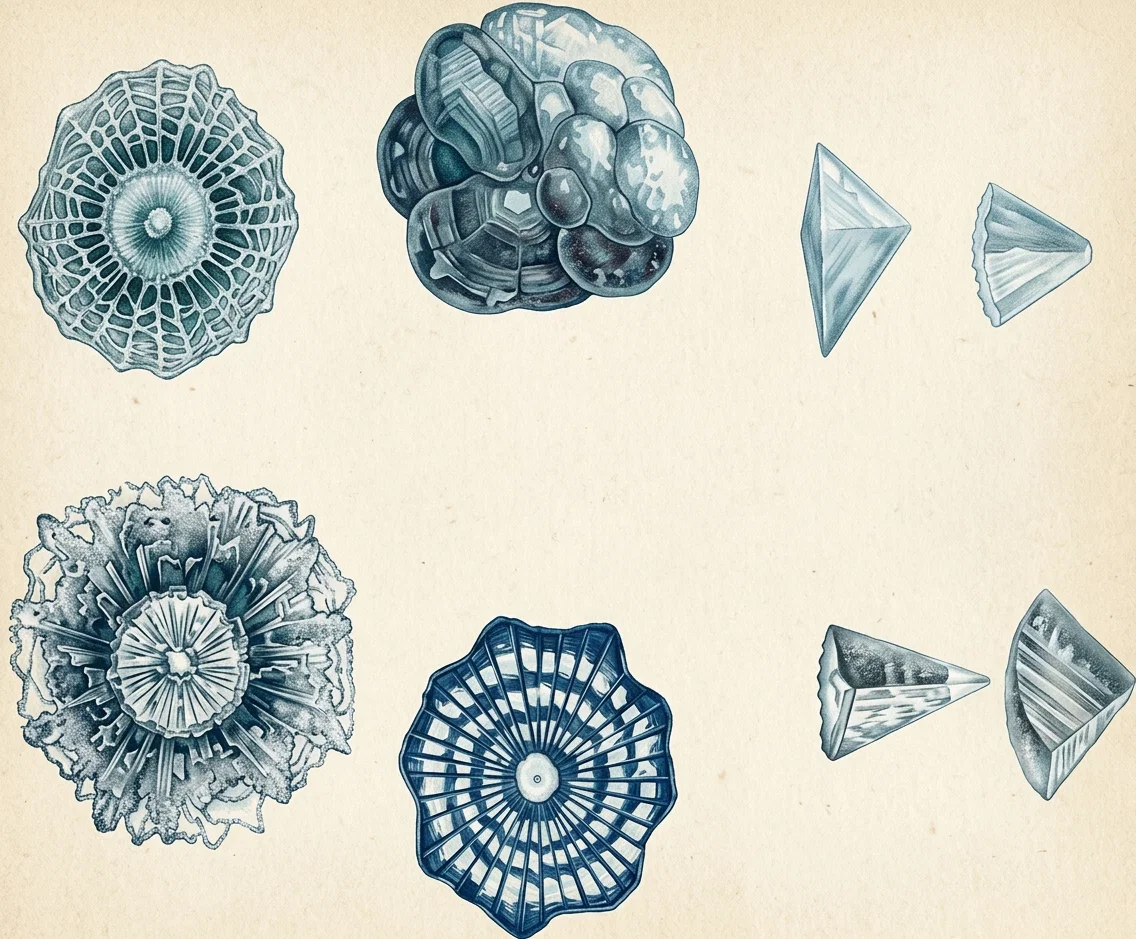
Various forms of snowflakes. Observe the hexagonal (six-sided) forms of crystallization in all.
This division of clouds which I have above given was made by Mr. Luke Howard in 1803. The names are descriptive. Cirrus is a Latin word meaning lock or curl. So we have the feathery, curling clouds so named. In the word cumulus we get the idea of heaping together; while the word stratus gives us the idea of a layer, from the Latin stratum, to spread. Nimbus is a Latin word meaning cloud.
The difference between clouds and fogs is that fogs are near the earth, and clouds higher. So when we are in the midst of a very heavy fog, we can get a very good idea of how it would seem to be in the clouds.
Various forms of hailstones. Note their irregularity.
Every form of clouds is beautiful, from the dull-gray stratus to the golden-edged cumulus. They are continually undergoing a change of shape. God paints the clouds, and gives them their changes of form for the delight of His children. There is beauty in the heavens—always beautiful—as well as in the earth. These things of beauty which God gives us are given to draw our thoughts away from ourselves to Him. If we could only learn this most valuable lesson! and we can. There is much in the clouds to call our minds to God. The Lord speaks of the clouds as garments, with which He has clothed the waters that are to be scattered upon the earth at His command. He also speaks of them as a bottle, in which He confines the waters sent forth upon the earth, as it were through a watering-pot. The children of Israel were led by a pillar of cloud when they departed out of Egypt. This pillar was ordinarily in front of the people; yet when they came to the Red Sea it was placed behind them, and thus hid them from their foes, the Egyptians. When, however, the Egyptians saw this cloud moving forward the next morning, they followed and were led into a death-trap; for the waters of the Red Sea, which had been opened for the children of Israel, closed over them, and they were drowned. Thus does God protect His people. Clouds are a shelter from the great heat of the sun. Who has not exclaimed, as a cloud has for a few moments shielded him from the rays of the sun, “How good this shade seems!” So does the Lord not only shade His people in a physical sense, but in a spiritual as well; for He protects His children from the fiery assaults of the enemy of their souls, as the land is protected from the heat of the sun by the clouds. On the other hand, the goodness of those who trust to their own goodness, is compared to a morning cloud, which vanishes with the sun, and affords no protection.
After one has looked up the texts in the Bible, and made a study of clouds as spoken of by the Lord, he can not fail to find a continual inspiration from a study of the coverings of the heavens. The Maker of heaven and earth, when He ascended to heaven, after having accomplished the redemption of His people, was received out of sight in a cloud; and when He returns, He will again come on a cloud. The throne of God, as it appeared to the prophet Ezekiel, was as a cloud. These clouds, however, can not be of water, but rather of heavenly messengers. “By His knowledge the depths are broken up, and the clouds drop down dew.” FREDERICK GRIGGS.
So. Lancaster, Mass.