THE EASTERN CHURCH

7%

Pacific Press Publishing Company · Oakland, California · Jan 22, 1902

FromSigns of the Times, Vol. 28, No. 4.

Read the full edition

THE EASTERN CHURCH

(Condensed from “Constantinople and Its Problems,” by Henry Otis Dwight, LL. D.)
On visiting the cathedral attached to the Greek patriarchate at Constantinople, the traveler is shown the throne occupied by the patriarch on certain high feast days. It is a massive armchair of some heavy wood, richly colored by age. The Greeks declare this to be the veritable throne used by St. Chrysostom when he was bishop of Constantinople; a relic marvelously preserved for the comfort of the faithful through the vicissitudes of fifteen hundred years.
The Eastern Church has actually had bishops upon the episcopal throne of the city, from Chrysostom down, in long and unbroken succession. Feuds of mingled political and theological origin shook the throne of the Byzantine Empire long before it fell, for such feuds are mere incidents of its unbroken story. Turmoil and dissensions and anarchy have many times made the streets about St. Sophia slippery with the blood of priest and statesman; the great dome itself has echoed with the clash of arms and the angry shouts of zealous Christians [of course the word “Christian” is used in a very general sense] ready to hurl epithets and missiles, or to ply cudgel and knife, in discussion of such questions of popular interest as the natures of Jesus Christ, the title of mother of God for the Virgin Mary, and the propriety of using pictures or images in worship. But through all this noise and strife, orthodoxy has not been rent asunder, nor lost its hold upon the people. To-day, as fifteen centuries ago, the patriarch of Constantinople is the “Ecumenical Patriarch of the Orthodox Church,” if a creed is what feeds life.
No branch of Western Christendom, with its small areas of unruly kingdoms, was so intoxicated by the possession of power as was the Eastern Church when it captured the imperial throne of the Roman Empire, with sway over vast regions in the East. It was as a supreme political power that it had to lay down principles of world-wide scope, which emperors had commanded it to define. It fell into theory to the neglect of practical affairs because of its responsibility to fix principles which underlie the ruling of a world.
The flavor of uncounted wealth and unlimited power then tasted by the clergy, has ever remained in memory as the type of the kind of success toward which Christian pastors must bend their efforts. Under guise of a laudable desire to establish the kingdom of Jesus Christ upon a proper foundation, imperialism then supplanted Christ as the central figure of the church. To this day the Eastern Church has never lost its dream of supremacy in actual combination with the civil and political forces of the world. Its prelates still confuse Church and State in an inextricable medley of aspirations such as marked the later Byzantine history. And from a political rather than a religious point of view they deal with the questions which our modern life brings within reach of their somewhat limited vision.
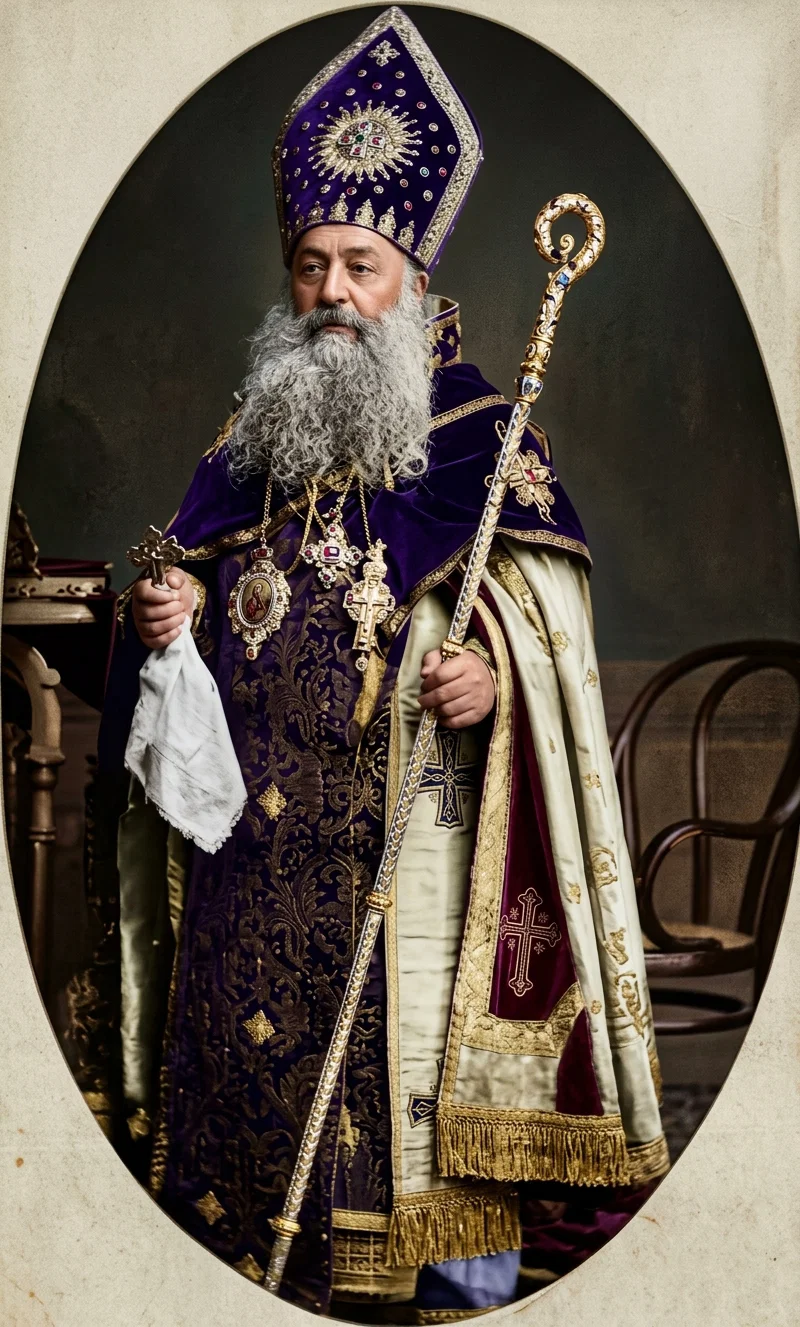
The Patriarch of the Greek Church at Constantinople, in his official robes.
The dealings of the Eastern Church with Islam, under the virile energy of which it fell into servitude, illustrates its development as a political power.
When the Turks took Constantinople, the sultan quickly and shrewdly declared a policy which continued in a certain degree the partnership between the church and the government. The patriarch of Constantinople was maintained as the supreme ruler of his people, and the office of “grand logothete,” the official charged under the Greek Empire with conveying the requirements of the church to the emperor, was continued as the channel of communication between patriarch and sultan. To this day the Greek patriarchate has its grand logothete at the Sublime Porte, and its imposing guard of Turkish soldiers to attend the patriarch when he rides abroad.
The essence of such an alliance between the Mohammedan sultan and the Greek patriarch must be political. Its unspoken but irrevocable condition must be the consent of Christianity to remain a political organization, without the attributes of spiritual aggressiveness placed by Christ upon the conscience of His followers. Neither sultan nor patriarch at the time of this compact took into his thought for an instant any possibility that Christians might attempt to win Mohammedans to Christ. Christian liberty of propaganda was surrendered for the sake of political power. The two elements of the Eastern question of our day were then established,—a ruling Mohammedan power which openly demands universal political supremacy, and a subject organization equally claiming universal supremacy as a political power, and equally striving, tho secretly, to forward that claim. This dream of supremacy has never been lost by the hierarchy, which views itself as heir to those disciples of Christ who demanded dignity in a political organization for the glory of the Lord.
A single illustration of the standpoint of the Greek clergy will tend to make these statements more clear.
A quarrel a few years ago with the Bulgarian Church in Macedonia formed the occasion for the adoption by the Greek Holy Synod at Constantinople of a measure intended to force the Turkish Government to grant the wishes of the Greek patriarch. The bishops of the Holy Synod ordered the closing of all Greek churches throughout the country, and then told their astounded parishioners that the measure had been forced upon them by the Turkish Government. The fact of the case was that because the Turkish Government refused to restore the Macedonian Bulgarians by force, as if literally sheep, to the fold of the Greek shepherds, the Greek patriarch had resigned.
The closing of the churches was merely a politician’s stratagem, expected to goad the people into violent outbreaks by leading them to suppose that the Turks were denying them their religious privileges. The Turkish Government issued an emphatic denial, thus turning the wrath of the Greek rabble against the priests. But the whole discussion of the outrage centered upon the value of the measure as a political expedient. For the people know too well that their interests require politics to outweigh religion in the councils of their leaders. The spectacle of the largest Christian Church of Turkey sportively suspending divine services for weeks, as a political measure, proves to every Mohammedan, beyond cavil, that Christianity is a lie and a folly beneath contempt.
The idea that obedience to God consists in observance of rites and ceremonies, and has no relation to moral conduct, is firmly fixed in the minds of the common people in each branch of that church. Worship is understood to be recital of certain forms of words at appropriate times. Faith is assent to creed. Piety is ascetic attention to forms of worship and to fasting. Manliness is determination to crush an enemy, and humility is a groveling, cringing spirit.
A few years ago a band of robbers captured a Vienna express train in the province of Adrianople, and held for ransom a number of European passengers. After a ransom of about $40,000 had been paid by friends, the prisoners were released. They gave a lively account of their life in the mountains while the robbers were eluding pursuit and negotiating for the ransom. The most curious part of the story related to the great piety of these robbers, who were members, in good and regular standing, of the Greek Church. Every day they read prayers and the lessons of Scriptures with great unction. They doubtless ascribed to this pious observance their success in getting the ransom and escaping capture. At all events none of them suffered loss of social standing or fell under the discipline of the church for their crime. Neither the robbers nor the Greek clergy saw anything in the enterprise inconsistent with spotless purity of character.