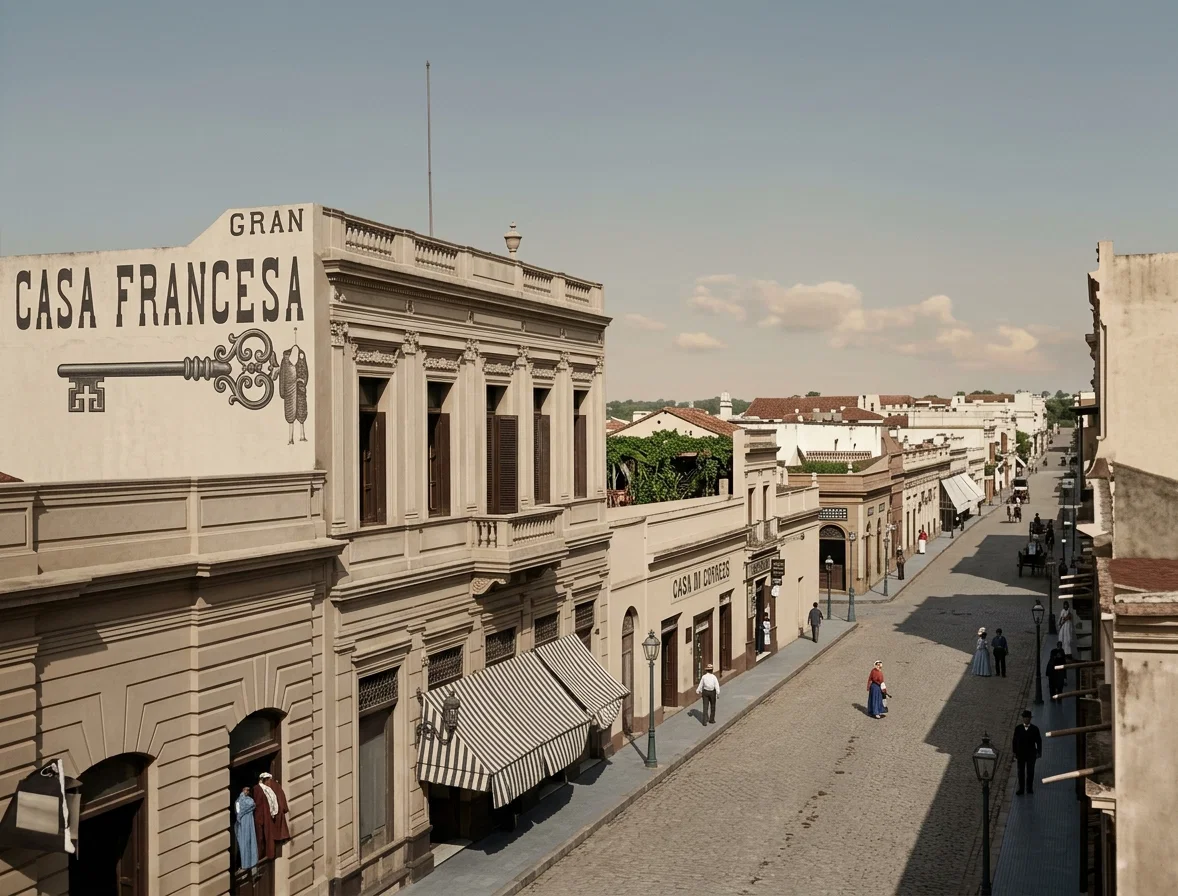
Calle Palmas (Palm Street), the Main Business Street of Asuncion, Paraguay.
The republic of Paraguay is located in the heart of the South American continent between latitude 20° 10′ 14″ and 27° 31′ south, and has an area of about 81,000 square miles, or a little less than the combined area of the States of New York and Pennsylvania. Prior to the war of 1866–70 with the allied powers of Argentina, Uruguay, and Brazil, the country contained a population of 800,000 souls, which by that event was reduced to 243,000. However, the lost ground has been somewhat recovered, the country containing at present a population of 655,500, divided as follows: Asuncion, 70,000; country and smaller towns, 433,000; Chaco, west of Paraguay River, 14,000; yerbamaté forests, 25,000; colonies, 10,500; Indians, 100,000; soldiers, 3,000.
Paraguayan history may be divided into five periods, as follows: (1) colonial; (2) independent and the tyranny of Dr. Francia; (3) the dictatorship of Lopez I.; (4) the dictatorship of Lopez II., with the six years’ war; (5) the constitutional period with reorganization.
The Colonial Period.
April 3, 1526, Sebastian Cabot, famous as an explorer of North American waters, sailed from Spain, with four ships, with the object of discovering a shorter route to the Molucca Islands in the East. The following year he explored the Paraguay River, discovering the country bearing the same name; but the first permanent settlement was not effected until 1537, when Asuncion was founded by Juan de Ayolas. During the colonial period, which reached to May 14, 1811, the country was ruled by “adelantados,” or governors, authorized by the Spanish crown. It was not separated from Buenos Ayres until 1617, the latter province being ruled conjointly with Paraguay until that date. The history of this period is made up almost exclusively of Indian wars, and revolutions, and conspiracies against the governors.
Paraguay was on the road to Peru, where the Spaniards supposed that great wealth was stored, and this fact brought the country into prominence. The first expedition to Peru consisted of 3,000 men commanded by Juan de Ayolas, who in the ascent of the Paraguay met and defeated the Indians in two engagements. After making terms of peace with them, he built a fort on the present site of Asuncion. Leaving his chief officer, Juan Irala, in command, he penetrated to the mountains bordering on Peru, and gathered there an abundant quantity of precious metals. On his return, however, he was surprised and killed by the Indians, all his company sharing the same fate. After much scheming and intrigue, Irala succeeded in being appointed his successor. His first act was to transfer the colonists of Buenos Ayres, numbering 600 to Asuncion, which he fortified. In the year 1539, discovering a plot of the Indians to massacre all the Spaniards, he executed the ringleaders. The other conspirators, in proof of their gratitude, brought as many Indian women as the Spaniards desired, who then became the wives of the latter. Under Irala, Spanish dominion was securely established in Paraguay. He promoted colonial wealth by the introduction of cattle, sheep, and goats from Peru, founded new settlements, and otherwise developed the country.
On Irala’s death, in 1557, he was succeeded in the government by his son-in-law. The history of the period from his death to the date of independence is occupied by the administrations of thirty-two governors. The conditions attending these times can best be described in the words of the historian as follows:—
From the very beginning of Paraguayan conquest, the series of administrations presented all the characteristics of the epoch of decadence that afflicted the metropolis [Spain], whose kings transmitted one to another the deplorable heritage of tyranny, fanaticism, and ignorance, bequeathed them by Phillip II. The two and a half centuries of colonial rule were to Paraguay a blank considered from the standpoint of progress, liberty, and civilization. Not only did this period witness a series of bloody battles with the Indians for their subjugation, but bloody strife among the conquerors themselves, who for the greater part aspired to carry out personal ambitions rather than to conserve the public good.
The first champion of liberty and independence was found in José Antequera, a native of Lima, Peru, who, because of his sentiments in the above direction, became the victim of Jesuitical hatred and conspiracy. Apprehended and imprisoned at Lima, he found a congenial companion in one Fernando Monipó, who readily imbibed Antequera’s spirit of liberty. The latter succeeded in making his escape in the latter part of 1726. He proceeded at once to Asuncion, where he openly agitated the right of liberty and independence. Permeated with revolutionary ideas, the court and officials of Asuncion refused to receive the new Spanish governor, Ignacio Loreta, who, on his return to Lima, inculpated Antequera because of the existing state of affairs. His testimony was confirmed by the Jesuits, and carried weight with the viceroy, who at once ordered Antequera’s execution, which was effected with difficulty in 1731.
On receiving the news of Antequera’s death, the Paraguayans arose in rebellion, looting the convents and driving the Jesuits from Asuncion. This uprising was not put down, and order restored, until 1735.