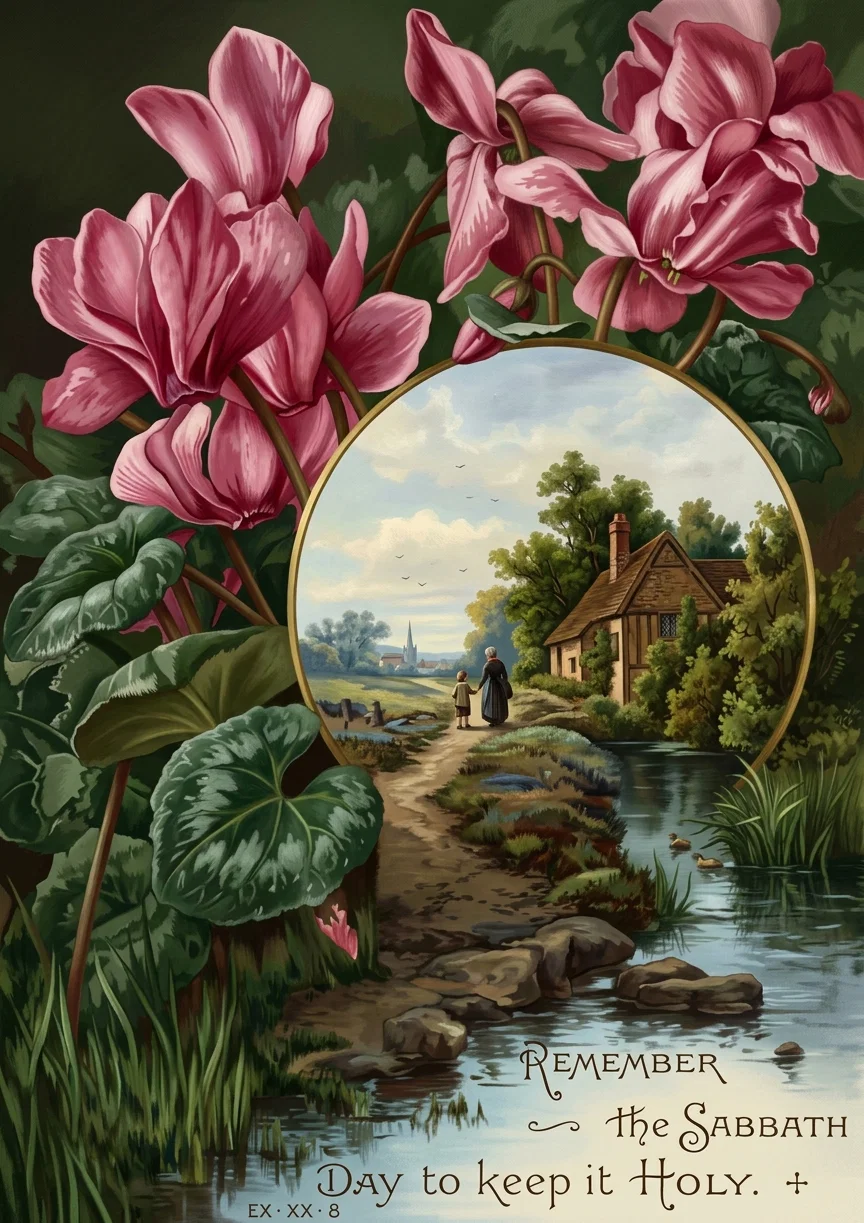
THE FOURTH COMMANDMENT

6%

Pacific Press Publishing Company · Oakland, California · Dec 18, 1901

FromSigns of the Times, Vol. 27, No. 51.

Read the full edition

THE FOURTH COMMANDMENT.

REMEMBER the Sabbath day to keep it holy. Six days shalt thou labor, and do all thy work; but the seventh day is the Sabbath of the Lord thy God: in it thou shalt not do any work, thou, nor thy son, nor thy daughter, thy man-servant, nor thy maid-servant, nor thy cattle, nor thy stranger that is within thy gates; for in six days the Lord made heaven and earth, the sea, and all that in them is, and rested the seventh day; wherefore the Lord blessed the Sabbath day, and hallowed it.
Having seen, from a brief consideration of the three preceding commands, that they are simply the fruitage of the Spirit-filled life; and that such a life is found only in Jesus Christ, we know that the keeping of them is only a natural result of the reception of the Gospel. But here we have a command which some of the professed followers of the Master exclude from a place in their Christianity. Has it a place, in fact, in the Gospel of Jesus Christ?
In order correctly to answer this, we will need to refresh our minds in reference to some of the first principles of this Gospel. In the first three verses of Romans 1, it is made plain that the Gospel all centers in Christ. All Christians believe that. And no text in the Bible contains the whole object of the gift of Christ in fewer words than John 3:16: “For God so loved the world that He gave His only-begotten Son, that whosoever believeth in Him should not perish, but have everlasting life.” And that this everlasting life is not a gift reserved for the future is clearly seen; for “he that believeth on the Son hath everlasting life.” And again: “He that hath the Son hath life; and he that hath not the Son of God hath not life.” “I am come that they might have life, and that they might have it more abundantly.”
Now in order to give men this life; or rather, in order that men may receive the life, what must be done for them? You say it is promised to every one that believeth. That is true. Now for the effect produced on the believer: “These words spake Jesus, and lifted up His eyes to heaven, and said, Father, the hour is come; glorify Thy Son, that Thy Son also may glorify Thee; as Thou hast given Him power over all flesh, that He should give eternal life to as many as Thou hast given Him. And this is life eternal, that they might know Thee the only true God, and Jesus Christ, whom Thou hast sent.”
What is that? Are only believers in Christ possessors of eternal life? and are such the only ones who know God? If God be true, this is the exact status of the case. “O righteous Father, the world hath not known Thee; but I have known Thee, and these have known that Thou hast sent Me.” “When they knew God, they glorified Him not as God, neither were thankful. . . .” “Professing themselves to be wise, they became fools.” “The world by [its] wisdom knew not God.”
The whole work of redemption, then, can do no more than to acquaint man with God. “Acquaint now thyself with Him, and be at peace.” “Being justified by faith, we have peace with God.”
This same story is told in another way in Hebrews, chapter eight: “For this is the covenant that I will make with the house of Israel after those days, saith the Lord: I will put My laws into their mind, and write them in their hearts; and I will be to them a God, and they shall be to Me a people. And they shall not teach every man his neighbor, and every man his brother, saying, Know the Lord; for all shall know Me, from the least to the greatest.” Why do they not need to be taught, saying, “Know the Lord?”—Because they already know Him. But who are the ones that know Him?—They in whose minds and hearts the law is written. This is the new covenant.
View it from another standpoint: “The anointing which ye have received of Him abideth in you, and ye need not that any man teach you.” Only such as have the law written in mind and heart, knowGod; and only they who know God have no need of being taught, saying, “Know the Lord;” and yet they who are anointed “need not that any man teach” them. Truly, then, the anointed ones must be the very same that know the Lord. In fact, the anointing, namely, the gift of the Holy Ghost, is the very thing which writes the holy law upon the tablets of our hearts, and therefore brings to us the knowledge of God, by bringing into our lives the life, the character, of God Himself. “The love of God is shed abroad in our hearts by the Holy Ghost which is given unto us.” “Love worketh no ill to his neighbor; therefore love is the fulfilling of the law.” “By this we know that we love the children of God, when we love God, and keep His commandments. For this is the love of God, that we keep His commandments; and His commandments are not grievous.” Once more: “The fruit of the Spirit is love. . . . Against such there is no law.”
Now the Spirit-filled man needs not that any man teach him; the commandment-filled man needs not that any man teach him; the new-covenant man needs not that any man teach him;—saying, “Know the Lord.” And why?—Because this man knows the Lord. Now what place has the Sabbath of the Lord our God in this Gospel matter? Let Jehovah speak:— “Hallow My Sabbaths; and they shall be a sign between Me and you, that ye may know that I am the Lord your God.” Now, all that Jesus Christ is to men; all that the Gospel is to us; all that the new covenant brings; all there is for us in the Holy Ghost; is that we may know the Lord our God. And the sign that we may know Him is that we “hallow” God’s Sabbaths. Is not the Sabbath, therefore, the sign of all there is in the Gospel for man?
All who have received Christ, know the Lord. The Sabbath, to those who hallow it, is a sign that they know the Lord. Is it not, therefore, the sign that they have received Christ? The work of the new covenant is, that we may know the Lord. Is not the hallowing of God’s holy Sabbath, therefore, the sign that the one so doing has already received the new covenant? But only those who have received the Holy Ghost are acquainted with the Lord. Is not the hallowing of the Sabbath, then, the sign that they have received the Holy Ghost? But none of this is received except “by faith.” Is not the Holy Sabbath, then, the sign of justification by faith?
“We which have believed do enter into rest.” “There remaineth therefore a rest to the people of God. For he that is entered into His rest, he also hath ceased from his own works, as God did from His.” What are our works?—The works of the flesh. When is it possible for one to discontinue the works of the flesh?—“This I say then, Walk in the Spirit, and ye shall not fulfil the lust of the flesh.” But who can walk in the Spirit?—“If we live in the Spirit, let us also walk in the Spirit.” Such as live and walk in the Spirit, have ceased to follow the flesh, and have therefore “ceased from their own works, as God did from His.” “For we which have believed do enter into rest, as He said, As I have sworn in My wrath, if they shall [or, they, the unbelieving ones, shall not, Heb. 3:18,] enter into My rest; altho the works were finished from the foundation of the world. For He spake in a certain place of the seventh day on this wise, And God did rest the seventh day from all His works.” To be sure, God’s works were righteous, and our works are unrighteous; but we who have entered into His rest, have ceased from our unrighteous works, as God, in creating, ceased from all His righteous works. But how do we know that God ceased from all His works?—From the fact, says the apostle, that He rested on the seventh day from all His works. He could not have rested from all, had not all been finished.
Now are we not in good company? We have ceased all our own works, namely, the works of the flesh; and this we have been enabled to do because we are led of the Spirit. We are led of the Spirit, because we live in the Spirit. But having ceased our own works, we have entered into His rest. This is, of course, rest from sin. We are now through with sin, as God, when He entered into rest, was through with creation. God memorializes His finished work by setting apart each seventh day. We memorialize that, and also our redemption, when we cease from ordinary labor on that same day, and keep it holy. But O, what does it mean?—It is a sign that I have ceased living for myself on all the days. “He died for all, that they which live should not henceforth live unto themselves, but unto Him which died for them, and rose again.”
Are the thousands who profess His name, and who are at the same time in the mad rush for wealth and worldly honor—are these living only unto Him who died for them, and rose again? Have such ceased from their own works, as God did from His? Only those who have ceased living unto themselves can follow the Spirit.
“Moreover also I gave them My Sabbaths, to be a sign between Me and them, that they might know that I am the Lord that sanctify them.” Then the Sabbath is a sign that we are sanctified. But only those are sanctified who are set apart wholly unto the Lord. “Sanctify them through Thy truth: Thy Word is truth.” Says Christ, “I am the way, the truth.” And so we see, the Sabbath of the Lord our God, to those who “keep it holy,” is a sign that the work of redemption has already been wrought in them.
The world knows not the Lord. What business, then, have they in attempting to keep that which is a sign that they do know the Lord? Thank God they do not attempt it. The world has another day than the Sabbath of Jehovah. They make no pretense of hallowing the Sabbath of the Lord our God. If it were the same that God, our Father, has set apart to be a sign of all that He has ever been, of all that He is, and of all He can ever be to us who have received Him, how sad it would be to have those who profess His name engage in the work of compelling all who know Him not, to signify, outwardly, that they know Him. It can not be that such “professors” have themselves a true knowledge of God.
Is not our God the same throughout all the ages? Is it not the same to know Him at one time as at another? Then how appropriate the memorial, which, in every age, stands a living witness to the fact that all who keep it holy are persons who know the Lord. And these are the redeemed of earth. E. J. HIBBARD.