In 1519 Cortez, with six or seven hundred Spanish followers, landed on the coast of Mexico. He founded the city of Vera Cruz; and here he left part of his soldiers, while with the remainder, and six thousand Mexicans who had joined his train, he made his way to the city of Mexico, the Aztec capital. Like another Venice, the city rose from the bosom of the lake, and, again like Venice, many of its streets were waterways.
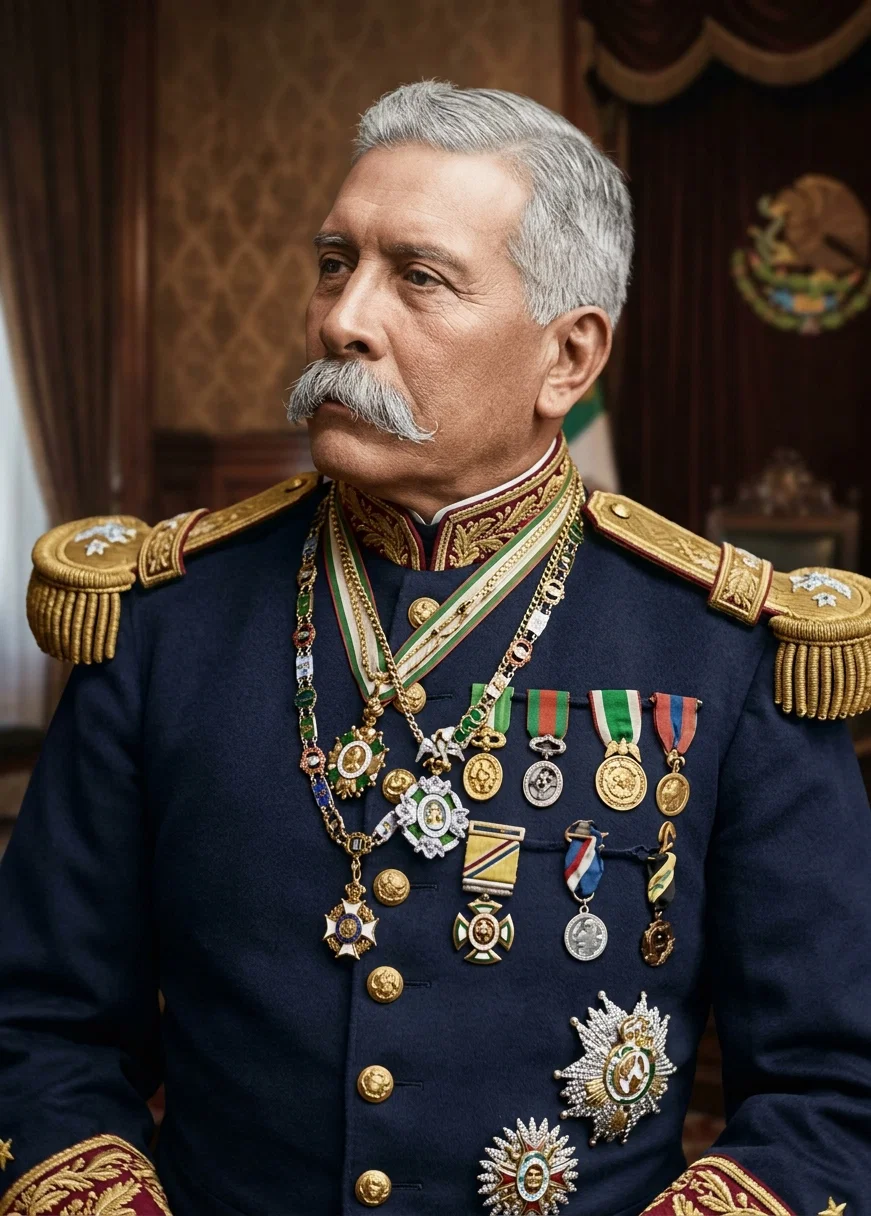
Porfirio Diaz, President of Mexico.
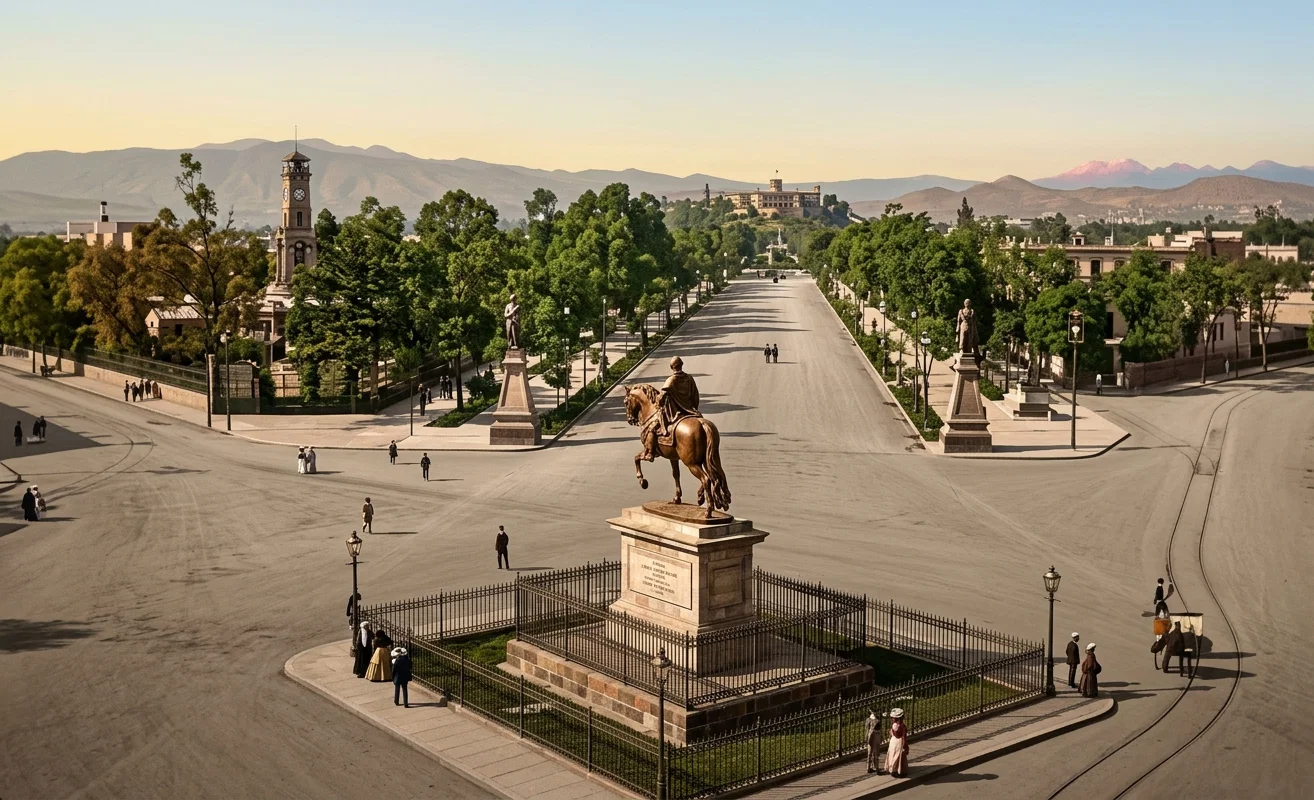
The Principal Drive in Mexico.
The invaders were surprised at the architectural skill displayed in its public buildings, palaces, and temples, and perhaps not less so at the royal gardens, where unnumbered flowers bloomed, and “all kinds of birds and beasts were kept in well-appointed zoological gardens.” In the immediate neighborhood were hanging gardens and floating islands, terraced rocky hills with their stone aqueducts, and the stately Chapultepec, its rocky walls two hundred feet high and palace crowned. On every hand were evidences of the wealth and skill of the natives. Very fair was their city in the eyes of the Spanish adventurers, whose interest was not lessened by a rumor that had reached them that here Montezuma reigned over an extensive empire; “that thirty vassal chiefs, called caciques, obeyed him; and that his riches were immense and his power absolute.”
There were many native tribes in Mexico; but the Aztecs were the dominant race. The Aztecs had a literature of their own, including poetry, which they expressed by picture-writing. Their laws were humane, and they were skilful in many lines of industry; but they were warlike cannibals. Other sacrifices were offered; but “the type of a religious function was a sickening butchery, followed by a cannibal feast.” The victims were captives taken in their numerous wars.
The principal temple was in the heart of the city, in a plaza nearly a quarter of a mile square. In the center of the plaza was a pyramid 375 by 300 feet at the base, rising by five terraces to the height of eighty-six feet. On the platform that surmounted it were several temples, and before that of the war-god was the green stone of sacrifice, where human beings by tens of thousands met a horrible death, their funeral wail the fearful sound of the great snake-skin drum, which could be heard several miles.
For some reason the water has receded, and the city is now more than two miles from Lake Tezcuco. And where once stood the great pyramid, with its altar for human sacrifice, now stands the largest and most magnificent cathedral in America, built at a cost of $2,000,000. The plaza has decreased in size, so that it now covers only about fourteen acres; but from it still radiate the principal thoroughfares of the city.
In 1521, by war and treachery, Cortez had effected the conquest of Mexico, and from that time until 1821 it remained a Spanish colony. The Spaniards brought their religion with them, and plenty of priests; and the Mexicans soon adopted, in name at least, the religion of their conquerors. The state of affairs under the rule of Spain and the church is thus described:—
The Indians were reduced to peonage on the great estates of the Spanish planters. Foreign bishops amassed fortunes, while the lower clergy of the priesthood were allowed a pittance. Immense estates were gathered into the hands of the church, which finally became the chief creditor of the nation. By deed or by mortgage a third of all real property was thus held, and the nation came under the thrall of the church.—Encyclopedia of Missions, vol. 2, p. 92.
The Indians of that early day very naturally bore a grudge against the “conquering and oppressive Spaniards”; and this prejudice even extended to the “fair-faced queen of heaven.” But the resourceful Catholic Church, whose strong point is becoming “all things to all men,” contrived to produce a Virgin Mary for the Mexicans of their own dusky race, and that, too, by a miracle. Surely it was a miracle. Did not the beautiful lady appear to a Mexican? And was not the “good bishop” fully convinced that the picture of the dusky virgin was supernaturally impressed on the man’s coarse tilma? That was in 1531, and the picture has ever since been worshiped by the Mexicans as the Lady of Guadalupe. Hers is the “holiest shrine in all that vast land of ‘shrines and images.’” A lady who visited this church thus describes it and the scene:—
It was on the morning of a day that was full of light and color that we went to Guadalupe—blue sky, white awnings and adobe walls, lava rocks and red rebozos, white pantaloons and swarthy faces and gleaming white teeth, naked babies and black-robed priests, groups of tortilla-makers and pottery-sellers, and rows and rows of improvised tents and shelters, in the shade of which all the gambling devices known to savage, semi-civilized, and cultured minds were skilfully carried on.
Stepping through the little door of the darkened vestibule, we emerge underneath the blue, star-sprinkled vaulted roof of Guadalupe’s new home. The great interior, flooded with light strained through a thousand tinted panes, opens before us like a dream. Only the sculptured urns of holy water stand near the entrance, and then the vista leads away to the white marble altar, against whose classic background stands the picture. Surrounding it, and up and down the marble steps, and along the high-hung balcony that leads to the choir, is a polished railing containing twenty-six tons of solid silver. The picture hangs fifteen or twenty feet above the floor; but it is difficult to guess accurately as to height beneath a roof that seems to be a part of the sky.
On our return to the city, a sound of rude music reached us, and there, marching straight toward their Mecca, was a band of Indians, probably fifty in number, ending a pilgrimage of many days from the country beyond the mountain range. Their leader played on a small piping instrument, but with high enthusiasm, and his soiled and travel-worn blanket was filled with roses, an offering to the virgin. It was nearing the great annual feast-day of the 12th of December, the anniversary of the miraculous appearance of the picture on the tilma, and the Indians were gathering in from all directions. One by one, in Indian file, with springing step they crossed the heavy threshold bar of the church; turning neither to the right nor to the left toward the gala sights and sounds about them, every face looking heavenward and every hand making the sign of the cross, they entered in, and were lost to our sight.
Spanish rule in Mexico ended in 1821; but the people were still in the vice-like grip of church domination. It was not until religious liberty was proclaimed in 1857 that its power began to be broken. At this time the city of Mexico “might almost have been said to be a city of convents.” The people were corrupted by the clergy, of whom it is said, “The licentiousness of their lives was scarcely disguised; and their exactions for the performance of the marriage ceremony were so oppressive that to a large extent the masses dispensed with the sacred rite altogether, and with the poor, concubinage became the rule.” And the people were not allowed the Bible. If found in their possession, it was burned.
Since 1867 it has been the aim of the government to promote religious liberty; but tho its legal power has been broken, the church still holds the great mass of the people in bonds of ignorance and superstition.