GROWTH IN PLANTS

7%

Pacific Press Publishing Company · Oakland, California · Nov 6, 1901

FromSigns of the Times, Vol. 27, No. 45.

Read the full edition

GROWTH IN PLANTS.

“Consider the lilies, how they grow.” Here are the directions for the study of all plant life—consider how they grow. All life originates in God, with whom is “the fountain of life.” Ps. 36:9. He not only created everything, but He upholds everything by the word of His power—keeps it in life. We will often forget this unless faith is exercised. One reason why we are apt to forget Him so easily in our study, is because we can see so many of the things which go to produce life. Sunshine and shower, soil and care, can be seen, and we come to look upon these things which we see and which our hands handle, and forget that which is not seen—life. Life depends upon growth, and when growth ceases, life ceases. Here is one of the first and most important lessons which can be taught to a child. Life in the true sense only exists when the child is developing. He can be taught from plants that when he ceases to develop, then he is beginning to cease to live. The plants can thus continually spur him on to growth—mental and spiritual.
The growth of every plant depends to a great extent upon its environment. In the word environment should be included everything, from tree and rock, sunshine and shade, moisture and all animal life, to even a grain of sand. When the environment of a plant is changed, the plant itself is changed. This is seen in even the bark of a tree which, brought from a warmer to a colder climate, will become thicker. Color in plants will be heightened or lessened according to the amount of sunshine or shade. Many interesting and valuable experiments can be performed by transplanting plants, making the conditions radically different. Not only are these studies of environment as shown by changing the plant to a different soil, air, moisture, light, etc., valuable, but quite as much is the study of the same plant when growing naturally in these different environments.
There is a most beautiful lesson to be drawn from this study of environment and its effect upon an individual, whether that individual be a plant or a person. The lesson is this: The Lord, in judging an individual, takes into consideration the place in which he was born, or in other words, the environment by which he is or has been surrounded. He tells us this in the following words, “The Lord shall ‘count, when He writeth up the people, that this man ‘was born there.” Whether in Zion or Babylon, Palestina or Tyre, the Lord knows the influences which surround each person. He holds each responsible for all good influences. Not only that, but he holds parents responsible for the making of a helpful environment.
The study of reproduction in plants is intensely interesting to children. Each seed contains a whole plant. This can be seen very readily in some seeds, as for instance the bean, which when split open will reveal to the one who looks carefully, the outlines of the little plant with its stalk and leaves. After the bean has been soaked in warm water for several hours, the plant is much more readily seen in the seed. Many different kinds of seeds can be planted in a box of rich earth placed in a warm place, and then the plants pulled up and examined at different stages of their growth. It can then be readily seen how the young plant is fed from a portion of the seed, and how it manages to get its start in life.
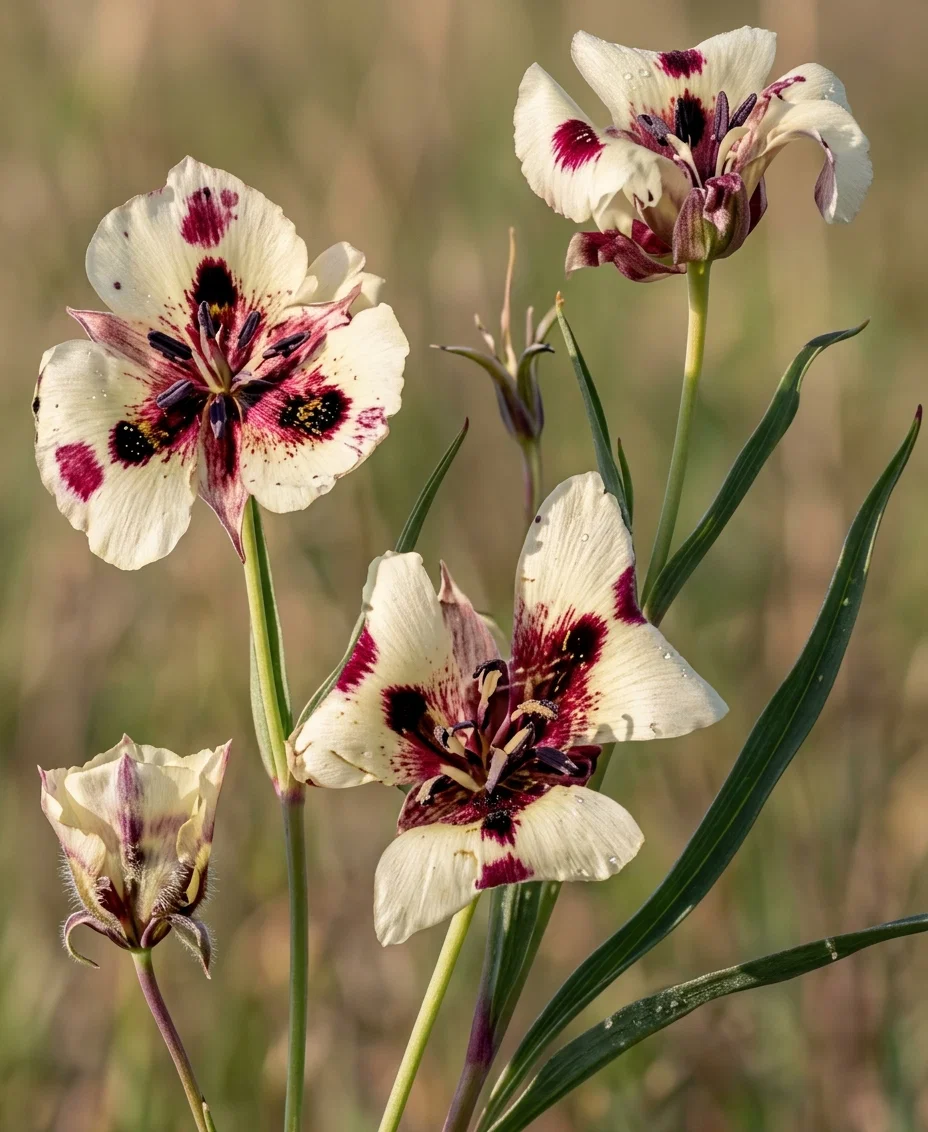
Mariposa Lily.
Mariposa Lily.
This study can be carried on even in midwinter, and it often makes a very interesting study for the children, when they are confined inside the house by the inclemency of the weather. However, the proper study of plants in the winter, is that of their winter life. The effects of frost and freezing should be noted. The phenomena of growth is perhaps quite fully absent, tho in mild winters dandelions are often found in January and February. Generally speaking, however, the plants seem to understand that Jack Frost is a particularly active and wily foe at this time of the year, and do not care to heed the call of the warm days of a mild winter. The action of frost is shown most in the buds. The living parts of the buds are in their centers. Collections should be made and the buds examined. Note the number of buds which are alive as against those which have been killed. Note as to the sap in the twigs and the trees. Is there any between the bark and wood of a tree? Does the sap in a twig freeze?
In the study of plants the commonest things should be examined—wheat, corn, grass, pumpkins, and potatoes. Few children, and older people for that matter, can tell the difference when looking at their heads between spring and winter wheat, and yet a little observation will readily teach the same. Take potatoes—undoubtedly most people think that potatoes grow on the roots of the plant. But this is not the case. They grow on underground shoots or branches. These shoots grow out from the root of the potato plant. While the shoots or branches do not have leaves, the potato has leaf buds or “eyes.” It will be most interesting to wash the earth carefully away from a hill of potatoes without breaking off any roots, or the branches on which are the potatoes. There are a multitude of such observations which can be made, which will abundantly repay all effort.
Children do not care simply to look at plants. While they are great lovers of flowers, they soon weary of simply plucking and admiring them. But let them have a handful of flowers, and give them some colored crayons or a brush and paint with which to reproduce them, and their admiration is so long continued that it develops into a deep love. Children do not care simply to look at the structure of plants. They want as well to know their use or function. Together with the study of plants, as such, should be studied beautiful passages from the Bible and other writings which help to bring the child in love with plants. There are many beautiful little poems descriptive of plants which when read to children awaken a deeper love and reverence for the plant.
No parents should feel that they are too ignorant to take up the study of plants with their children.
The getting of facts is not the end of education; but the power to see and feel and love is. It must be remembered that this power of observation has to be acquired; but no one is too old to acquire it. Many a Sabbath day will be passed more pleasantly by the children if the parents take them for walks and talks through fields and by wayside. Little children can not see in the Sabbath day all those who are older do. But through right cultivation, a love for it may be acquired, so that they shall always “remember the Sabbath ‘day.” These Sabbath-day walks and talks are apt to be rather uninteresting and unprofitable if there are no week-day studies in the same direction. What one gains through his own senses is enjoyed much more than is that which has been told him. Let us then see and consider, and the Lord will give us understanding.
FREDERICK GRIGGS.
So. Lancaster, Mass.