THE MAORIS

4%

Pacific Press Publishing Company · Oakland, California · Oct 30, 1901

FromSigns of the Times, Vol. 27, No. 44.

Read the full edition

THE MAORIS.

[An address before the Union Conference held at Cooranbong, New South Wales, July, 1901.]
THE Maoris are widely scattered in New Zealand, and on this account it is rather difficult to work among them. One man worked a year and then left, owing to discouragement, as they were so scattered. There are 40,000 Maoris in New Zealand. The recent census, while it shows an apparent increase, at least shows that they are not diminishing very fast. But even where they are found in largest numbers, there are still not many in any one place. In Whakatani County one may ride all day, and only see one or two natives. There are not more than two hundred in any one place. Maybe the Lord has ordered it so, that they may not be corrupted by living together in large companies.
The evangelized natives are chiefly Anglicans and Wesleyans. The Mormons have done much work among them, but the effect is not lasting.
We first visited the Urewera country. This part of New Zealand is perhaps the least known of any, owing to the hostility and jealousy of the natives. The Urewera tribe is that in which the notorious Te Kooti did most of his work. These people made the most violent attacks against the government troops. They are the most hardy and warlike of all the native tribes. They live in the mountains, and are said to number 900 or 1000. Until two years ago they were very jealous of the attentions of the whites. The climate where they live is the severest in the North Island. Their chief crop is potatoes. Some time back these failed, owing to frosts, and the government had to ship potatoes there to keep them from starving. The mountains are high and cold. It was in these regions that Te Kooti planned all his raids.
The Hauhaus include the bitterest enemies of the government. They follow Te Kooti’s religion. There is not the least doubt that he made a religion. He obtained some education, and possessed unusual strength of mind; and possibly this helped him to exercise a sway over men. He went over a good part of the North Island, and secured as many Ringatus as possible. He saw that as long as the people adhered to the Anglican religion, he could do nothing with them. They would not fight against their friends. He therefore made His own religion by mixing up various beliefs. He invented a ritual, and the Maoris have learned this ritual by heart. They are called Ringatus (those of the standing hand) because, whenever their ritual calls for “Amen,” they say it standing and holding aloft their right hands. Te Kooti taught them that the seventh day is the Sabbath, and they observe it as well as ordinary Sunday-keepers observe Sunday. Their moral condition is very deplorable, but perhaps they are not worse off than the evangelized natives.
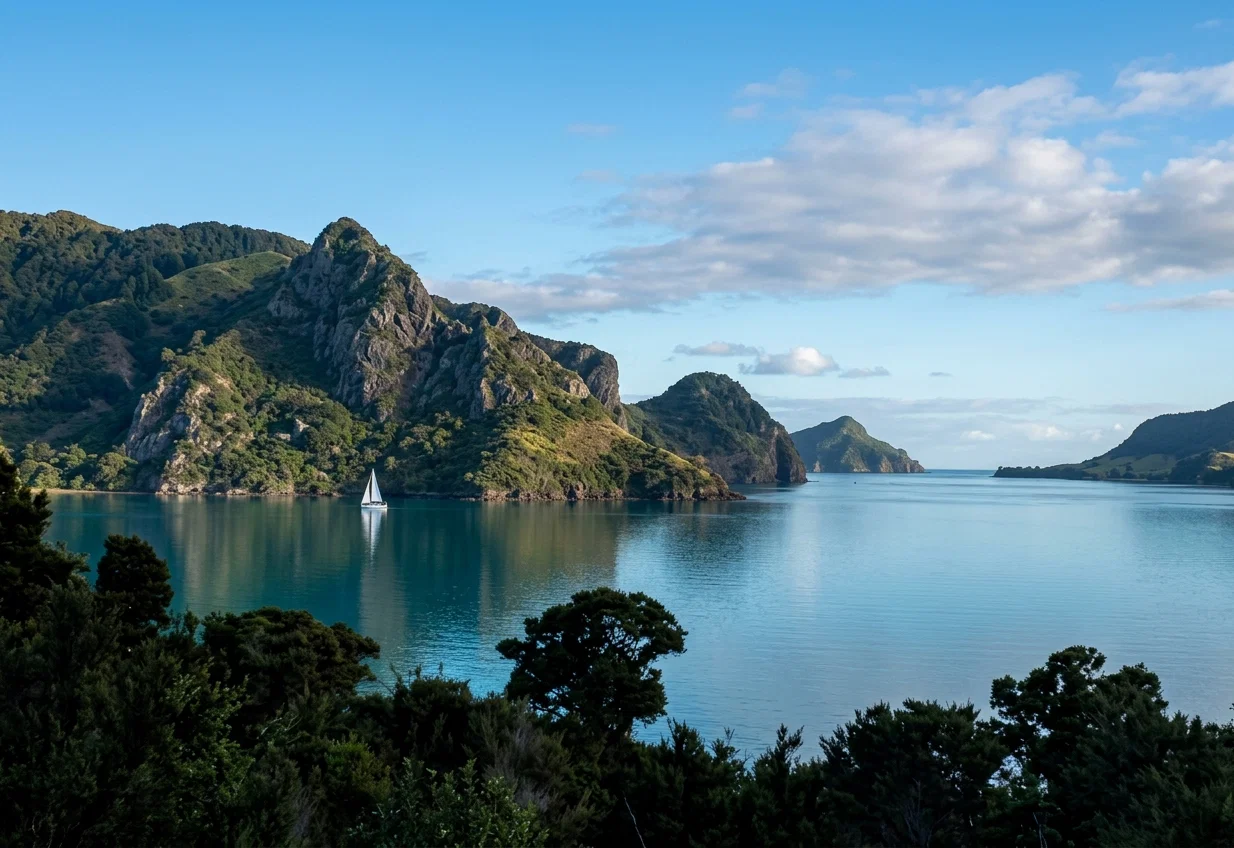
Entrance of Whangaroa Harbor, New Zealand.
Two years ago when the government was surveying a road to Gisborne through their country, they made armed resistance. Troops were sent up, but the friends of the natives persuaded them to let the work go on. Now they are helping to build the road themselves. Along this road, which is made in many places by cutting into the hillsides, there is the most beautiful scenery. Here one may see mountains clothed in forests towering above his head, and deep precipices at his feet. Twenty-five miles of road still remains to be done. It is most delightful to ride along this road, and see the Lord’s wondrous hand in nature.
The time for the isolation of this people is past.
Their habits have changed, and now is the time for some society to enter and do the work. They are not friendly with the English Church; they are prejudiced against it, and no one of that body could work among them. They believe the seventh day is the Sabbath, and they look with suspicion upon any one who brings them Sunday. There is no regular religious effort made for the people of that tribe at the present time.
The point now is this: Shall we go on now, or wait till some other society has gone in and won their confidence? (A voice: “Now is the accepted ‘time.”) Yes; and now is the day of salvation for them. I believe it.
Mr. Allen, an agent of the British and Foreign Bible Society, visited these natives several times. He walked through their country alone to learn about them. He first visited Matatua, the old home of Te Kooti. He asked them to let him speak, but they refused. He asked them a second time, but was only allowed to read a few texts. When we went there, they asked us to speak to them right away. As we came up the hill toward them, “Haere mai! haere mai!” greeted us from all directions. Old and young were calling to us, “Welcome, welcome! Come, come!” We spoke to them that day in their best house. This was ninety feet long, and thirty feet wide. The corner posts were exquisitely carved and adorned with the images of their ancestors. There was no hole, or chink, or crevice anywhere, except a small door and window. The house had an earthen floor and an iron roof. They had a fire in the center of the building. Unwisely, I stood up to speak. Moses Shepherd stood beside me. As I was going to the door at the close of the meeting, I staggered and reeled. I had been poisoned by the bad air. There were a hundred there. (Pastor Gates: “Yes; and they were all smoking, ‘too.’”)
Their ordinary dwelling-houses are made of raupo. The sides and roofs are thatched with this, leaving an opening in front. Everything is done to make the sides as air-tight and warm as possible. They build a fire in the room, and the smoke is awful. They lie on the floor to avoid it.
In their services a lay preacher does the reading. He reads a few verses, and they respond with part of the ritual, and so on till their service is ended.
I wish to impress this fact: The Maoris are pleased to find a people who keep the seventh day. They were very glad to see us, and treated us very well. The Seventh-day Adventists have a special mission to go to the Maoris with the Gospel. But it must be done at once. The first who go there will have the advantage.
(A voice: “What Bible do they use?”)
The Bible used is the Anglican Bible somewhat revised. Many of them object to the few new words in the revision. They prefer the old copy. (Pastor M’Cullagh: “Have other societies made any efforts ‘among them?’”) The Salvation Army made a small effort for two years, but left for want of support. Their missionary asked the natives in vain for ten acres of land. This question of land is a burning one with the natives. Some time ago the government forced a missionary society to disgorge 30,000 acres they had obtained from the natives. When this missionary asked for land, the natives said, “What is the ‘matter? The old missionaries wanted land, the government want land, this man wants land. We don’t ‘want him.’” It is not wise for us to ask for it. Let the Lord move upon them to offer it if it is needed.
Let me tell now of my visit to the King country. It is situated in the valley of the Waikato River, and to the westward of it. Here is found more advanced civilization among them. They welcomed us as readily as the others. They are more intelligent, as there are more schools among them. The children are being taught the English language. We visited Brother Hill at Raglan, where we were kindly treated. Here we find a native school taught by two sisters who are Roman Catholics. They invited us to have lunch with them, which we did. We asked one of the sisters, “How do the natives ‘spend their Sundays?’” “O,” she replied, “they ‘work all day.’” “What,” we said, “don’t they ‘keep any day?’” “Yes; they keep Sunday on ‘Saturday.’” “Why do they do that?” we asked. She answered, “To show their contempt for the ‘white man’s ways, I suppose.’” Now, how is it that these people were observing the same day as ourselves? (A voice: “They had been reading the ‘same Bible.’”) Exactly. God has a people there for us to work among, and we must do it at once.
Around Kawhia there are 750 natives living in their own places. One old man there said to me, “If you do not stay with us, we shall all die.” Andthat is true physically and spiritually. Well, we are so pleased with the prospects that we have agreed to recommend that our first effort be made in the north of the King country.
There are some natives in the Waikato country, but they are very scattered. In Kawhia there are 1,440 natives, and these can be reached in half a day’s drive round there. We must have both a boat and a horse, however, to work among them. Some time ago the government started to survey Kawhia South, in order to establish a town there, but the natives objected. Maybe the time will come when the country will be opened up.
Let me tell you one reason why we proposed to start at this point. In the Urewera country there is a lawsuit on about the land. It might be that if we built there, soon the people would leave, and we should have no one to work among.
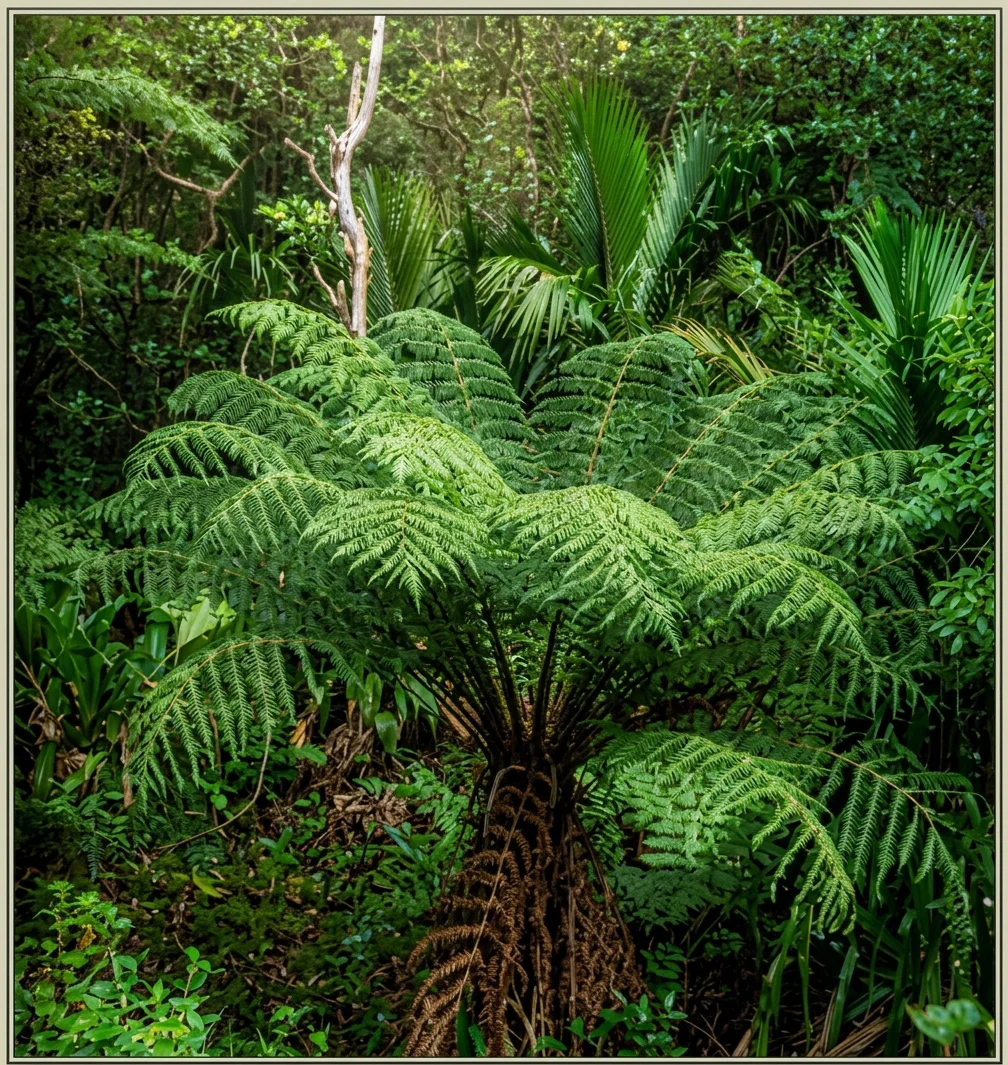
A Tree Fern.
A Bush Scene in Whangaroa.
A Tree Fern. A Bush Scene in Whangaroa.
Their literature is very limited. They have a Bible. Mr. Allen, the missionary I spoke of, has sold them more. Besides this they have no other literature. I have heard that there is a small native paper published on the eastern coast. We are having prepared one tract on the coming of Christ. There is also in the hands of the translator a tract on health. “Christ Our Saviour” is now being printed at the Avondale Press. This literature will open the way for the living preacher. We want a few young people to go among them selling and giving this literature. About one-fifth of the Maori children can read English.
There is abundant evidence that the harvest is ripe. Now is the time to begin. There is a most remarkable opening. J. E. CALDWELL, M.D.