ANARCHY

25%

Pacific Press Publishing Company · Oakland, California · Oct 23, 1901

FromSigns of the Times, Vol. 27, No. 43.

Read the full edition

ANARCHY

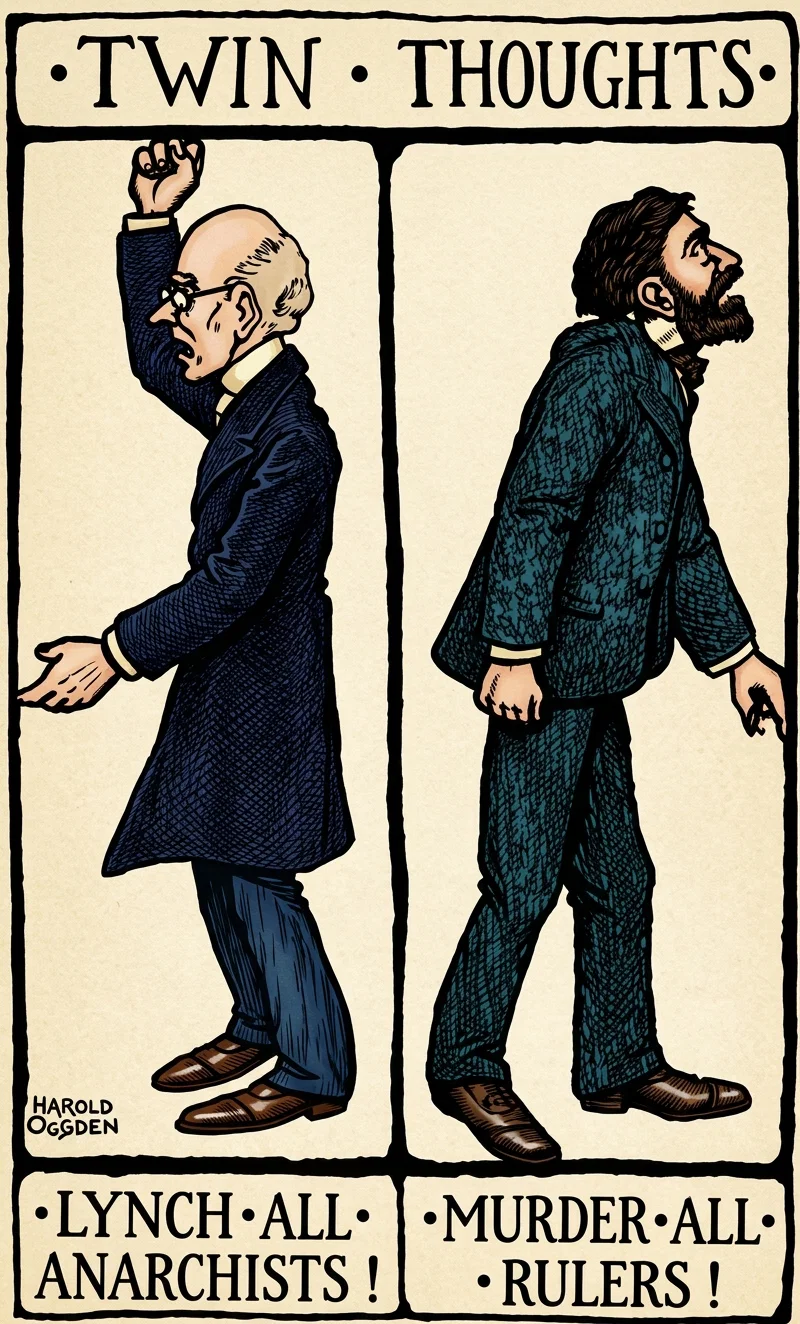
Another vain appeal to civil law is being agitated. This time it is for a law to keep out of the country that class of people who may become Anarchists. One prominent religious journal says keep them out, “whether they be known as Anarchists, Communists, ‘Nihilists, or what not.’” Yet the editor of that same paper, in a public address, expressed regret that some one did not beat to death with a pistol the assassin of President McKinley. But lawlessness is anarchy, and the principle involved in the proposed law would include at least this one of its advocates. Such a law, however, would be impossible of enforcement, except in the cases of outspoken persons, unless the immigration inspectors should be expert mind-readers. Another point to be considered is, that anarchy is most prolific in those countries where the laws against it are most stringent. There is nothing that so tends to the incitement of anarchy as too much law. People generally have a contempt for law that can reach them only through some kind of inquisition; such law usually takes effect upon innocent, well-meaning people, while the vicious are able to evade it. Again, it is easy to reckon any man as an anarchist and list him in the “what not” (or miscellaneous) class, if his course becomes unpopular or distasteful to more influential people. Such a law in some countries would banish Christians; indeed, it would make it very uncomfortable for them in some localities even in so-called “Christian nations.” All evil is anarchy, and it is only punishable by civil law when it becomes overt. G.
—The Milwaukee Journal.
It is but a logical coincidence that in some localities in the United States the saloon men are persistently working to enforce the Sunday-closing laws upon other branches of business. True, they are actuated by a spirit of spite, but that is perfectly consistent with the real spirit of all Sunday laws. From the very beginning of Sunday laws the design has been opposition to the law of God regarding the Sabbath day; and their revival in the United States during the last twenty years has been incited by the fact that attention has been called afresh to the Sabbath of the Lord as set forth in His Word. As the Sunday law is the essence of human opposition to the law of God, it is fitting that it should be championed by men engaged in the liquor traffic, whose business naturally fosters a spirit of violence eminently calculated for such intolerant work. It is natural that they should instinctively seize such a bludgeon, made ready totheir hand, for the reeking of vengeance. The plea for laws closing saloons on Sunday has all along been a covert scheme for stirring up the ire of men in that business, with the expectation that, in a spirit of spite, they would become effectual instruments in the compulsion of general Sunday observance. The scheme seems to be working quite well in some quarters, and will likely become more extensive in its operation. It is time the people were awakened to some of these last-day delusions. G.