THE ISLAND WORK

5%

Pacific Press Publishing Company · Oakland, California · Oct 16, 1901

FromSigns of the Times, Vol. 27, No. 42.

Read the full edition

THE ISLAND WORK.

[From an address by E. H. Gates, delivered July 18, 1901, at the Union Conference in Coonabarabran, N. S. W., and published in the Union Record.]
It pleases me to see the great interest which you are all taking in the island work. I heard an aged brother say the other evening, referring to the much-needed launch for Fiji, “We shall have that launch.” Yes, we need that launch very much indeed. Brother Fulton was both astonished and delighted yesterday, to have £5 [$25] put into his hand by one of the students at the school, to form the nucleus of a launch fund.
Never was a work begun with more enthusiasm than the island missionary work. Great enthusiasm was manifested in building the missionary ship Pitcairn. The Sabbath-school children in America with their pennies raised over £2,000; and that was ten years ago.
Polynesia originally embraced the whole of the Pacific Islands; finally it was divided into five great groups. Now for a little geography. All to the east of Fiji and south of the equator is known as Polynesia. Melanesia lies to the west and southwest of Fiji. The islands to the northwest of Australia are called Malaysia. Those to the north of the equator and to the east of the Philippine archipelago are known as Micronesia. Australia, Tasmania, and New Zealand, together with a few islands adjacent, are designated Australasia. The meanings of some of these names are interesting. Polynesia means “many islands.” Melanesia means “black islands,” and Micronesia means “small islands.” In Malaysia there are over forty million inhabitants. Java alone has twenty-five millions, and is one of the most thickly populated places on the face of the earth. The Philippine Islands have from seven to ten millions.
The Society Islands are one of the most important island groups in the Pacific. It was here that the missionaries first began their work in 1797. The work went very hard, and it was sixteen long years before a single convert was made. Now, however, the natives are all professedly converted. We began work there ten years ago. Ten months ago I visited them again. The climate is very warm and extremely enervating. The same climatic difficulty has to be faced in Raratonga, where Brother and Sister Piper are now located. Our missionaries should be relieved occasionally in order that they may go to a cooler climate to recuperate.
We have now only one man and his wife working in the Society Group. Bro. Cady, however, will soon return. We have met with quite a measure of success in these islands. There are about one hundred and twenty-five Sabbath-keepers and three organized churches there.
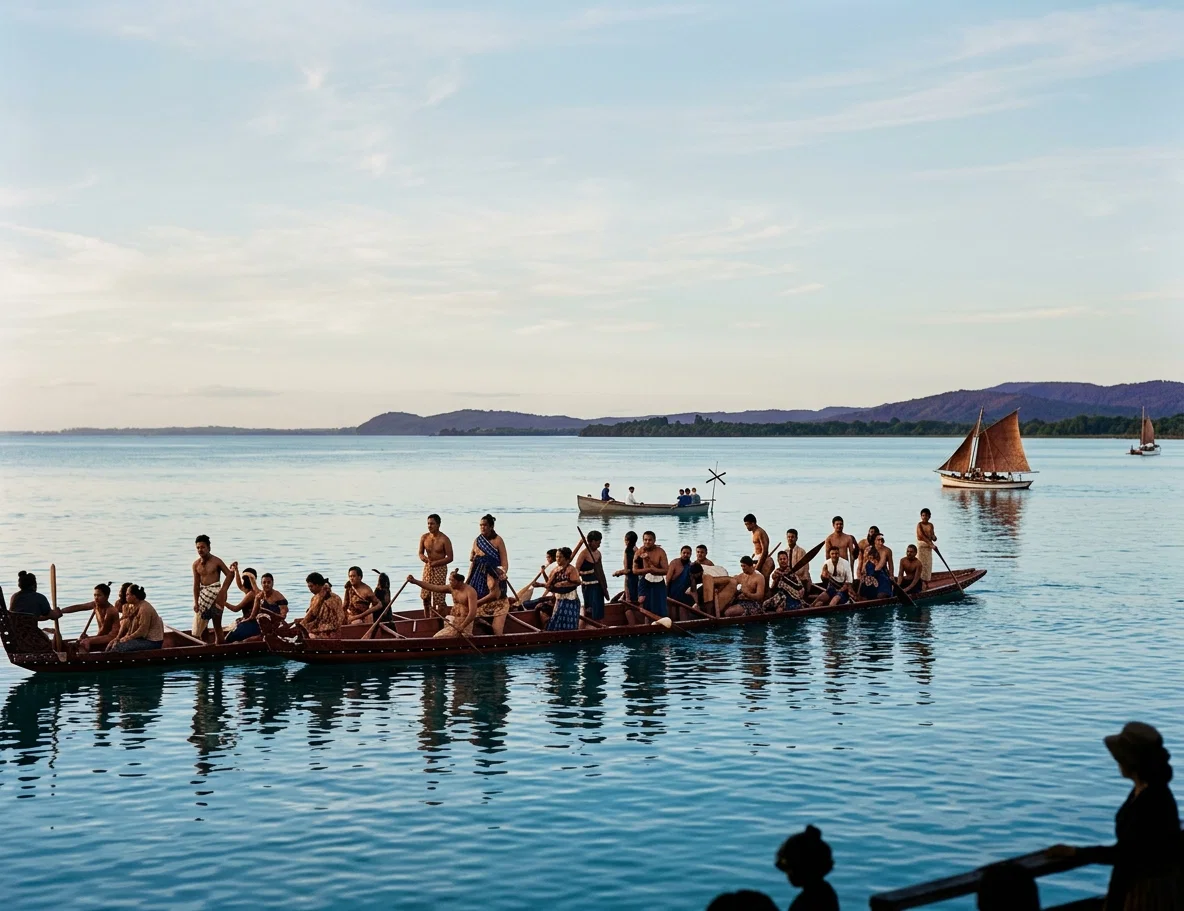
A Maori War Canoe. South Seas.
The church building at Papeete is very fine. It measures twenty-four by forty-eight feet, and it has the appearance of being built of stone. On Raiatea is Bro. Cady’s home, 120 miles from Papeete. I first visited there in 1891. At that time the French were trying to get Raiatea, and we were particularly warned to be on our guard against a certain man who was said to be a French spy, and who might get us into needless trouble. To-day that man and his whole family are Sabbath-keepers. He has been a great help to us in translating books into the French language. The inhabitants of the Society Group have “Steps to Christ” and “Bible Readings” in their own language.
Brother Cady expects soon to start an industrial school on Raiatea. He owns a hundred acres of land, on which are growing four thousand excellent coconut trees; they are very fine trees indeed. Hitherto Brother Cady has conducted simply a Bible school. According to the laws enacted by the French, the teachers in the schools must be Frenchmen. Brother Conradi and Dr. de Forest have offered to send a teacher from France, so you see that we shall have no difficulty in meeting the law in this respect.
Brother Cady took four young islanders with him to Healdsburg College, Cal., to be educated. He feels he can make good workers of them. One great advantage is that they will be able to endure the climate. Brother Cady is bearing the expense of educating these young people at Healdsburg. I should like to tell how he has managed to meet a part of that expense. Before leaving for America he purchased three or four hundred strings of shells at tenpence [about twenty cents] apiece, and took them with him to the General Conference. He began to sell them for a dollar apiece. Brother Corliss arose and said that they were worth five dollars apiece. Brother Cady expects to get at least a hundred pounds out of these shells.
You will remember that some time ago the donations from the Sabbath-schools for one quarter were devoted to the work in Tahiti. I understand that there are eighty-six pounds in the treasury at Summer Hill. That will help us wonderfully in our work in Tahiti.
We sadly need a little schooner of our own. Pitcairn Island is now quite cut off since we sold our missionary ship Pitcairn. When at Pitcairn Island I gave a talk on tithing. I advised them to tithe all their produce and to bring the tithe into the storehouse. Every tenth coconut tree was branded “L.X.,” meaning Lord’s tenth. They wondered how their produce could be turned into cash, but I said to them, “If the Lord does not see His way ‘to realize on the produce that you have put ‘into His storehouse, you are not to blame.” The General Conference has promised £500 toward a new missionary ship. It is 1,250 miles from Pitcairn to Tahiti, and there are a great many small islands between.
Part of these comprise the Gambier Group, where there are extensive pearl fisheries. About eighty years ago there were 10,000 people in the Gambier Group. Many years ago Roman Catholic missionaries settled in these islands, and they have very successfully Christianized the natives according to their standard. Out of the 10,000 original inhabitants there remain only a few hundreds, and these are in the greatest darkness and degradation. There are a few French converts in Tahiti, but, as a rule, the French are hard to reach. The son of an excellent old French sister in Tahiti has recently accepted the truth in France.
Southwest of Tahiti is Tonga, also known as the Friendly Islands. Our work began there ten years ago, when we sold books to the value of £4, on an average, to every white family on one island. One man bought £16 worth at once. He told me that he had read “Great Controversy” fifty times. I should like to tell you about a trader there who was once a very hard case indeed. Brother Tay visited him and sold him a book. To-day he is a Seventh-day Adventist. In his library is a copy of all our books, and he also has many valuable scientific books. He is now a most excellent man. Another man and his wife who came from Auckland, have accepted the truth; and another who was a fearful drunkard has become a Sabbath-keeper. Others there are obeying the truth.
The work in these islands is indeed in a prosperous condition. Last November it was decided to build a church house. The building is now finished.
Brother Butz, who has translated thirteen little tracts into Tongan, has been called away to America. Most of the Sabbath-keepers on these islands are English.
At Raratonga we have a church organization of twenty members, mostly native converts. As many of you know, there has been very severe persecution of the Sabbath-keepers in this place. The secretary of the government, who has long been our bitter opponent, was recently killed.
Malaysia is a very difficult field indeed, as it comprises so many nationalities. There is a measure of religious liberty in Malaysia. In Sumatra a mission is conducted by Elder Munson. He is very anxious to get a man and wife from Australia to teach the Chinese, and to act as nurses.
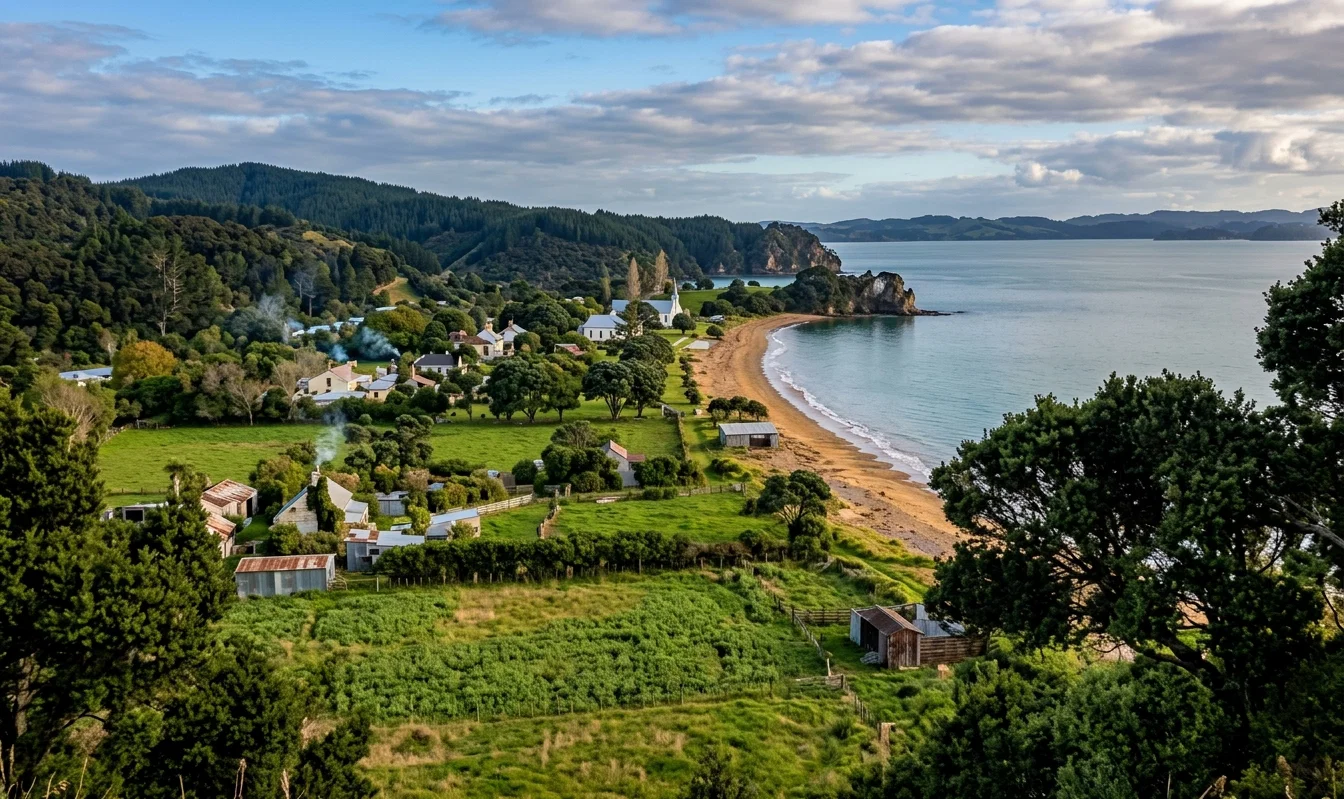
The Place Where the First White Man Landed in New Zealand.
I am glad to hear that some of the students at the Avondale School have signified their desire to labor in this field.