IN NEGRO-LAND

7%

Pacific Press Publishing Company · Oakland, California · Sep 25, 1901

FromSigns of the Times, Vol. 27, No. 39.

Read the full edition

IN NEGRO-LAND.

The Soudan is an extensive region of Africa lying south of the Sahara, and extending to within about five degrees of the equator. Its area is “perhaps 2,000,000 square miles, and its population is variously estimated at from 80,000,000 to 90,000,000.” The climate is tropical, with two seasons, a wet and a dry. During the wet season there are tremendous thunder-showers, and continuous down-pours, flushing the watercourses and flooding the low-lying areas.
Wherever the country is well-watered, the rich soil and tropical heat produce a luxuriant vegetation. The forests are extensive and exuberant. Here grows the giant baobab, attaining a girth of eighty feet. Here, too, are superb palms, beautiful tamarinds and euphorbias, graceful mimosas and acacias, the honey-yielding jerjak, and many other trees both curious and beautiful. The forests abound in insect-life. There are myriads of termites, very large bees, wasps, and ants, and a variety of beetles and butterflies.
The lion, panther, hyena, and jackal are the chief beasts of prey. The rhinoceros finds a home in these forests, as do zebras, giraffes, antelopes, and “endless species of monkeys.” Large herds of elephants frequent the swampy districts about Lake Tchad; and crocodiles and hippopotami abound in the rivers, which are also the haunts of numerous flocks of waterfowl.
Men who have seen and studied the country tell us that in all parts of the Soudan, but especially in the southern portions of it, “there are vast tracts of rich lands filled with untouched treasures, lying fallow, and covered with millions of human beings, who can easily be brought under the influence of civilization.”—Encyclopedia of Missions, vol. 2, p. 356.
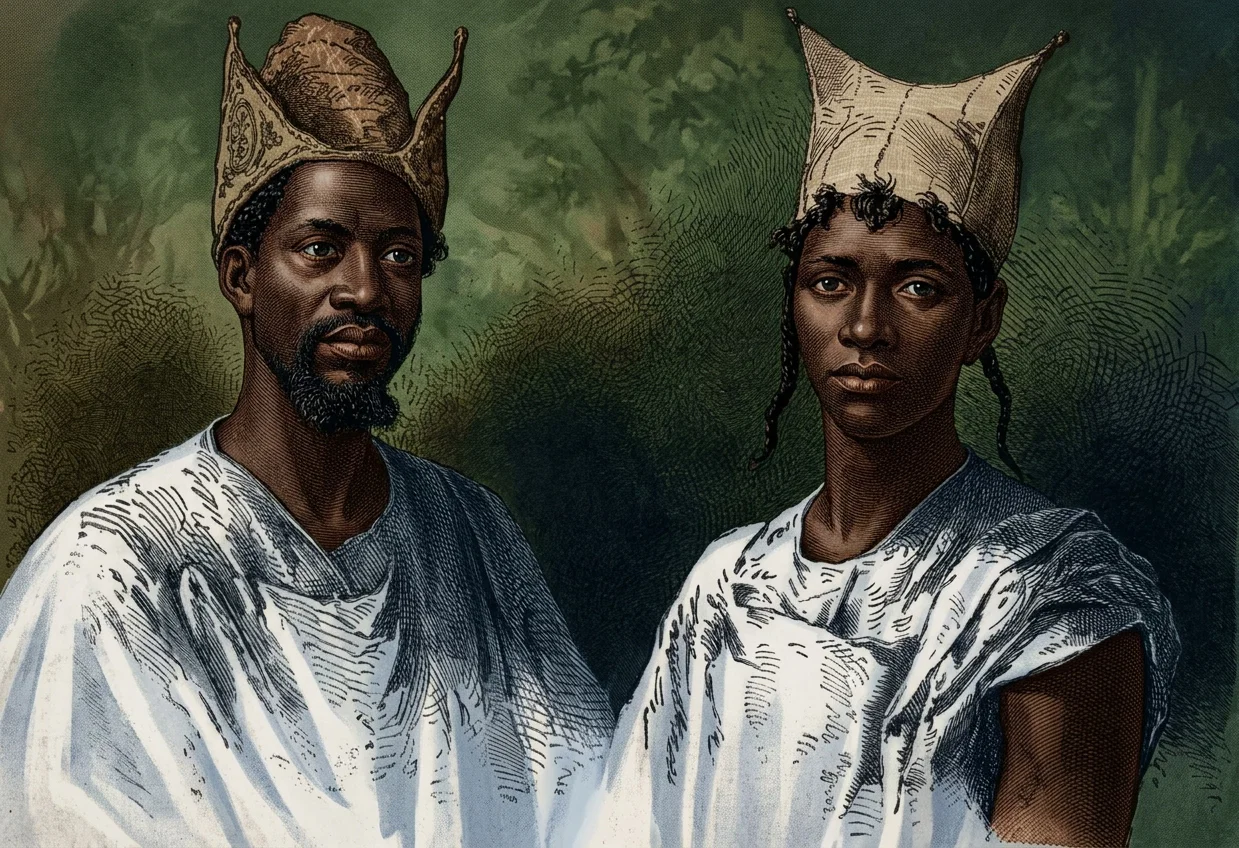
This tropical region,—tropical in its climate, its productions, and its animal life,—is the homeland of the negro, tho in “other sections, especially to the south, occasional tribes of negroes may be met with.” Its name, Bilad es-Soudan, “the country of the blacks,” implies this. Many tribes of pure-blooded or mixed blacks are found within its borders. Of these the Mandingoes are a leading race in the western part of the Soudan, where their simple language is generally spoken. The Bambarras, a powerful tribe, numbering about 2,000,000 people, are of Mandingo stock.
Types of Bambarras.
Types of Bambarras.
The Bambarras and some other negro tribes of the Soudan profess the Mohammedan faith; but their allegiance to the new religion is said to be little more than nominal. There are, however, many Mohammedans in the Soudan—Arabs, many of them traders, and not a few slave-traders.
The great mass of the negroes are pagan. Indeed, Africa is said to include six-sevenths of all the pagans in the world. The negroes are very superstitious. They believe in spirits and a spirit-world, and in witchcraft in its various forms. “This faith is made by the priests and medicine-men an instrument of terrible oppression; and it is thus the source of ‘wide-spread misery.’”
Faith in a spirit-world also involves a belief in life after death. Hence the human sacrifices at the burial of kings and chiefs so common in Ashantee and Dahomey, on the Niger, and in some central African countries. The deceased must be honorably attended to the world of spirits; wives and slaves, therefore, must accompany him, and the sacrifice sometimes takes the horrible form of interment alive. On the other hand, many tribes have no conception of a future existence. “When a man was born, he was born,” said one chief, “and when he died, he was dead; and there was an end of the palaver.”—Encyclopedia of Missions, vol. 1, p. 9.
These African negroes are not so much given to the worship of idols as are the people of some other countries. Their religion is what is called fetishism.
A fetish is a charm; and almost any object—a tree, a stick, a stone, a shell, a plant, the limb of an animal, a vessel filled with some strange compound—may have power imparted to it by certain medicine-men—power to preserve the owner or bearer from danger, or power to injure his enemies. Particular fetiches fulfil particular purposes. “One guards against sickness, another against drought, a third against the disasters of war. One is used to draw down rain, another to secure good crops, and a third fills the sea and rivers with fishes, and brings them to the fishermen’s net.”
An army of missionaries have gone to the great Dark Continent, and many are laboring there now. But there is a wide field unoccupied. Eastern Soudan especially is practically virgin territory, so far as missionary effort is concerned, and no doubt millions there have never even heard the story of the cross.
E. J. BURNHAM.