[By Homer C. Stuntz, D. D., in Christian Advocate.]
Four American missionary societies have opened work in the Philippines. These are (named in the order of occupancy) Methodists, Presbyterians, Baptists, and United Brethren. Altogether their working force consists of sixteen American missionaries. Of these only three were proficient in Spanish before appointment, and none, of course, had any knowledge of local vernaculars, in which we must preach for the evangelization of this generation.
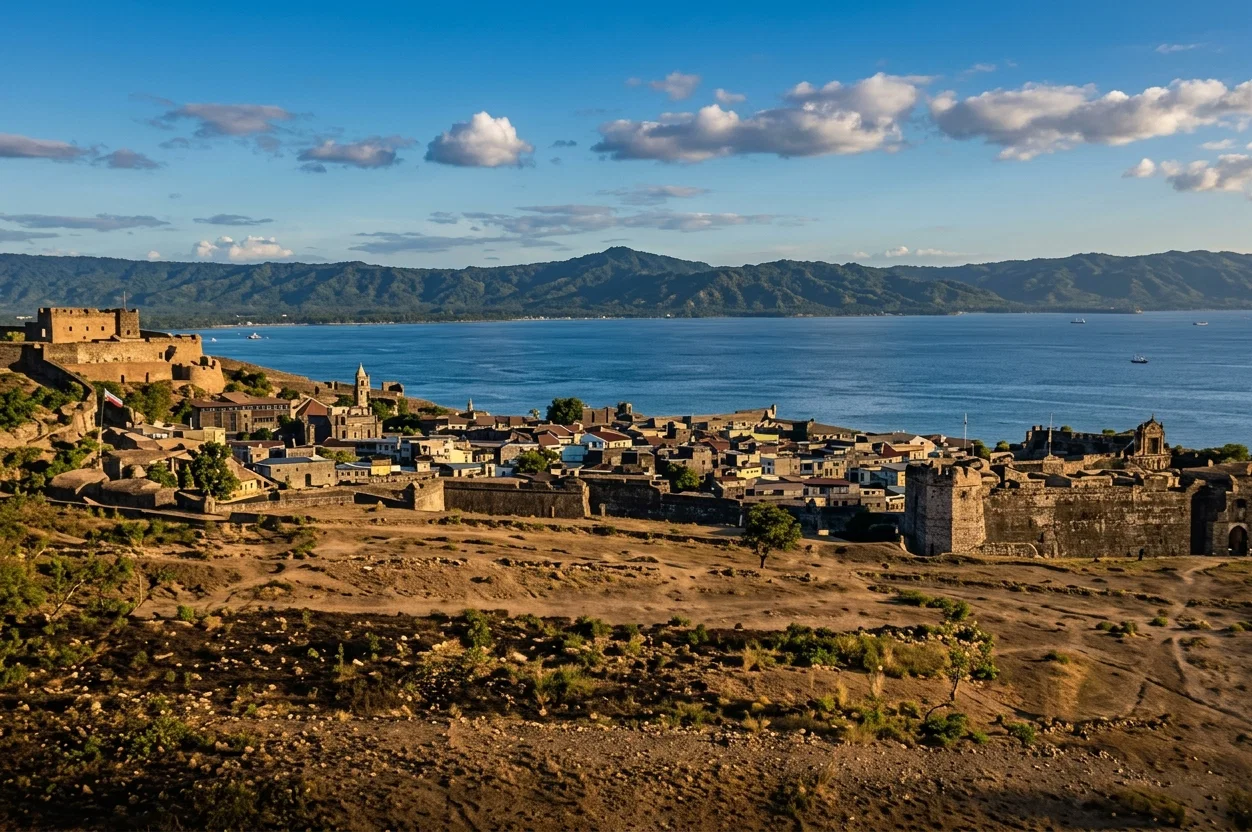
Manila Bay,
By the allotment of territory to each mission, which was suggested by the recently formed Evangelical Union of all Protestant forces at work in the islands, these sixteen men are occupying Luzon, and parts of Negros and Panay Islands only. A policy of comparative concentration has been forced upon the representatives of these societies by the paucity of workers and the multiplicity of tongues. The Presbyterians, contrary to their policy in other fields, are holding the longest line. Their seven men are distributed all the way from Manila to Iloilo (pronounced Ee-lo-ee-lo), a distance of about 300 miles, the latter city being in quite another vernacular field. The Baptists are with them in the islands of Panay and Negros. The latter are not at present seeking territory elsewhere. The United Brethren have the “Ilocano country,” the long, narrow coast-strip in northern Luzon, from the Gulf of Lingayen to the northernmost limit of the island. We Methodists share the city and province of Manila with our Presbyterian brethren, and have as our peculiar field that portion of the island of Luzon contained in the provinces of Bulacan, Pampanga, Tarlac, Nueva Ecija, Pangasinan, Bataan, and Zambales. This gives the Presbyterians four languages, the Methodists three, the Baptists two, and the United Brethren one with which to deal in all their missionary operations. The Methodist territory is the most compact, and most easily covered from the natural center at Manila. It is traversed through its entire length by the only railway in the islands—a railway so poorly equipped, and bearing so many marks of the recent war that it is but a sorry excuse of a road. Still it is better and somewhat more rapid than locomotion by caribou carts. The Presbyterians have decidedly the advantage, in the fact that more than 1,000,000 people in their field speak the chief language of the islands—the Tagalo.
Out of a thousand perplexing difficulties which confront us, four stand out clear and stubborn:—
1. The pre-occupation of the public mind owing to political and military conditions. It requires but slight exercise of the imaginative faculty to enable one who has never visited the archipelago to recognize that the Filipino has had plenty of new material for thought since that May morning upon which Spain’s submarine fleet received such a substantial reinforcement here in the bay! Events have crowded fast on the heels of other and equally disturbing events. Raided first by Americans, and then by Filipinos, having municipal government set up in his native city, with at least the germ of popular government in the heart of it, with the sore question as to the return of “los Frailles” to their posts throughout the islands discussed at every village gathering as well as in the various papers—all these matters have pre-occupied the public mind. And they will so pre-occupy it for many months to come.
2. The sleepless hostility of Catholicism. Not a move do we make that is not opposed. Accustomed for three centuries to absolute rule, the powers of the church are bitter in their resentment against Protestant effort. If we try to rent a building, and the friars hear of it, all the machinery of the church is set in motion to head us off. If we attempt to purchase land, their rage knows no bounds, and they will defeat us if possible. It is almost impossible to get on at all in such transactions if we appear in them. Our own mission was prevented from securing the best building in the city for use as a temporary place of worship by the English-speaking congregation until we build the permanent church, by pressure brought to bear upon the owner, a fanatical Spanish supporter of the church. There are over 1,200 friars congregated in Manila. They are in comparative idleness. Our Brother Nicholas Zamora says that they do nothing but “eat and say mass;” but they are plotting by day and by night to outwit the government by holding their ill-gotten properties, and to retard the movement toward Protestantism as much as lies in their power. They have issued nearly twenty tracts in Spanish and Tagalo since New Year’s. They publish a daily paper, the chief business of which seems to be to ridicule and belittle the work we are doing. This hostility will continue. It will be restrained by no such safeguards as exist at home. It is only a question as to what they dare to do. The will is present, and Jesuits have not usually been at a loss for means.
3. The multiplicity of languages. There are at least sixty languages in the group of islands making up the archipelago. Language areas are small. In the Cagayan valley, in northern Luzon, I am told that there are seven languages in actual use between the mouth and source. Nearly every little stream that puts into the main channel has its own speech along the length of its valley. This hinders the Protestant movement sorely. When a missionary has toiled as long and as faithfully to acquire a vernacular as he would toil to master the Hindustani or Bengali language, he has access to less than one-fiftieth of the people that even the Bengali would give him. All literature must be translated and printed in these different tongues, and the expense of these translations and publications appals one. We are robbed of the esprit du corps which exists where large bodies of people with similar ideals and similar enthusiasms meet and work side by side.
4. The pitiful smallness of the force with which the work must be done. I took lunch on a small gunboat in Cavite Harbor recently. It is a 1,200-ton vessel, with a crew of about 150 men, and eight commissioned officers of the navy are doing duty on that one tiny craft! The share of each seemed to me almost microscopic. If the society would undertake to equip the Philippine Mission in half that proportion, I should have at least twenty-five new missionaries by Christmas! We have appealed for at least four to be here by that time at the latest, and we hope that this very modest request will be granted. We shall then have nine men to evangelize 2,000,000 people!
But there are manifold encouragements. There is an eagerness to hear the Gospel that is almost past belief. The people crowd upon us. Our own church has the largest total of visible results so far, there being 1,100 probationary members in the city and vicinity of Manila already. These are largely from among the poorer people. “Not many noble, ‘not many mighty,’” are successfully “‘called’” so far. Many of the “noble” would join us at once, if we were satisfied with hatred of the friars as both a sufficient body of doctrine and religious experience. But these people are all self-respecting, industrious men and women, with trades and occupations from which they support themselves. Many are fishermen, whose labors supply the city markets with delicious and wholesome food. Several are printers. Some are gardeners; some are merchants. All are employed in one way or another, and want nothing in the way of financial aid of any sort. They have raised the money and erected two modest little chapels, in which they worship God after the dictates of their own conscience. Plans are on foot to erect at least three more in the near future. They are inexpensive affairs, costing from $25 to $50 each. Built of bamboo for framework, and nipa palm for roof, they are commodious and clean.
In the city of Hagonoy, in the Province of Bulacan, a small congregation, handed over to us by our Presbyterian brethren when the division of territory was made, raised funds and bought a suitable building13for a chapel and came to the city for us to send some one as pastor. We did not know that they even contemplated so bold a stroke until it was done.
At a suburban town north of Manila—Malabon—a number of the leading citizens furnish the theater free for a Protestant service every Sunday, and they are there in force, sitting in a body behind the preacher with notebooks and Spanish and Tagalo Bibles in hand drinking in the message. So far we have not made any call for converts at this place, but will do so soon.
In a neighboring village a gentleman, the presidente of his “barrio” or ward of the town, asked our Brother Goodell to hold a service there on a recent Sunday. He took his band of workers from the earlier theater service and held a meeting in the home and yard of the presidente, and was invited to return. On the next Sunday he found that the man had actually built a neat hall for the services during the week, and it was placed at our disposal for meetings as long as we care to use it. Already several have found Christ at this place, and the germ of a church can be seen.
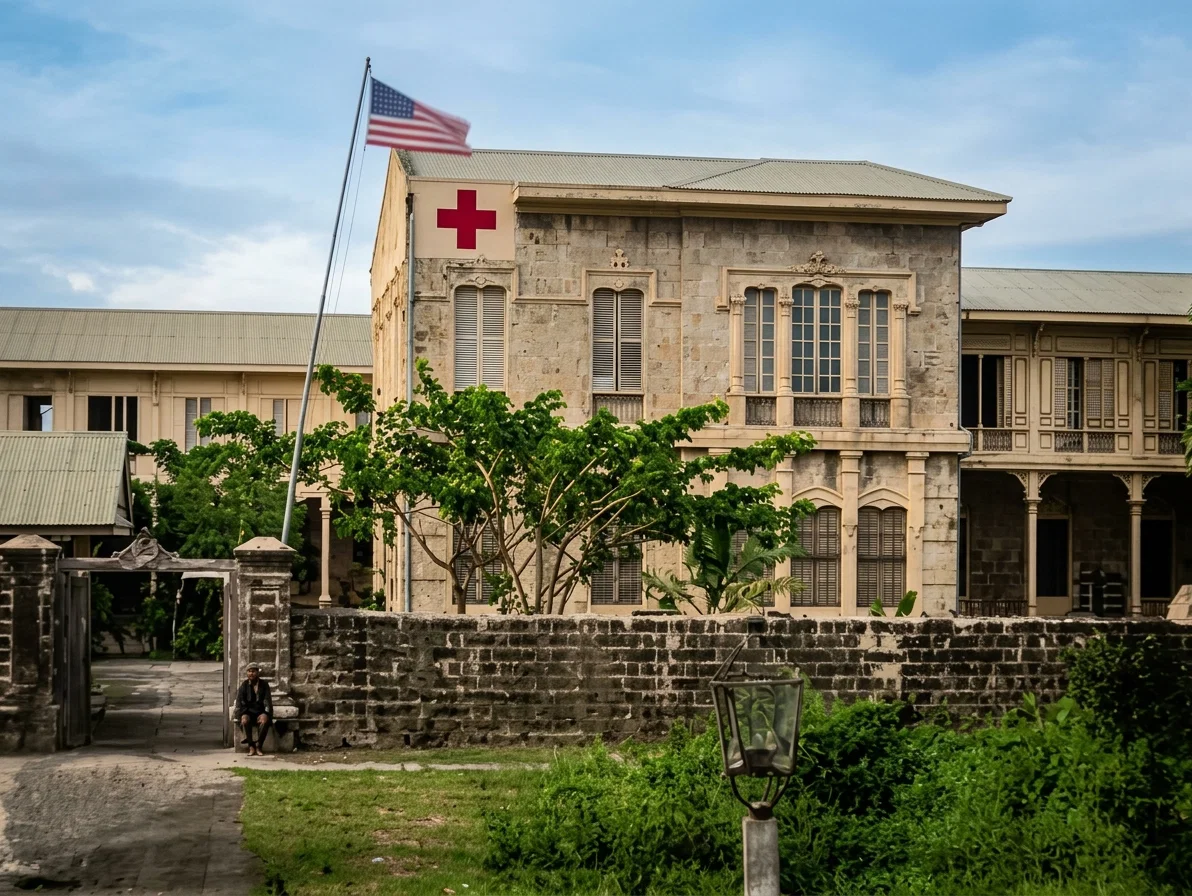
Red Cross Building, Manila.
Since writing the above, I have had an interview with Señor Pantaleon Sembrano, a resident of the Province of Tarlac with whom I made a tour of northern Luzon recently. He reports wide and effectual doors at the places visited by himself and our Brother Martin, of Dagupan. At all the chief cities of that part of the province services have been arranged for, and the leading men have agreed to support a native preacher, if we can send them one. Sambrano has been baptized. I think he is converted, and he is certainly full of a self-sacrificing zeal for the spread of the Gospel. He and his brother and his brother-in-law are holding Sunday-schools in their homes in three separate cities, and their homes are open to the Methodist itinerant. On a recent Friday I received a deputation from the Province of Bataan. They want services there in four neighboring cities. We shall go out shortly and leave a native preacher on the “Bataan circuit,” if we can spare them a man in whose judgment and ability we have confidence. But the laborers are so few, and the fields are so white!