PROBABLY no other river in the world is regarded with such veneration as is the Ganges by the Hindus, from its source amid the snows of the Himalayas, to the place where through many mouths it empties its waters into the Bay of Bengal; but at Benares, the “Holy City of India,” it is held in special sanctity. Benares is one of the oldest cities in the world. There is no authentic history of its origin, for the people of India are not historians. Gautama, the founder of Buddhism, is supposed to have lived about the sixth century before Christ, and he chose this city as the center from which to propagate the new faith. Benares must, therefore, have been at that time a great and important city.
In the twelfth century A.D., Benares came under the sway of the Mohammedans, by whom the Buddhists were expelled. When the Mohammedans, in their turn, lost the ascendency, Benares became once more the seat of Hinduism. During the occupation of the city by the invaders, both to show their power and their detestation of idolatry, they converted all the larger temples into mosques and tombs, and mutilated or destroyed the remainder. There are in Benares at the present time 270 mosques, the most noted of which is the mosque of Aurangzeb, which stands on the site of a Hindu temple, demolished to make room for it. This lofty building, which faces the river, is surmounted by two minarets of exquisite symmetry, rising 147 feet above the highest part of the mosque. Near the Golden Temple, very sacred to the Hindus, is another famous mosque, also erected on the ruins of a temple destroyed by the Mohammedans. Between the worshipers of mosque and temple there is constant friction, leading not infrequently to open riot.
In 1775, Benares was ceded to the British, and under English rule there is security to life and property hitherto unknown. The city is on the northern bank of the Ganges, on a cliff one hundred feet above the water. The river at this point is crescent shaped, giving a frontage of three miles and a depth of one mile. There are fifty principal ghats, or flights of steps, leading down to the water to facilitate bathing. During a recent visit to Benares, under the escort of a resident missionary we paid a visit to some of the temples, shrines, and holy wells for which the city is famous.
The streets of Benares are mere alleys, too narrow to admit of wheeled traffic. Sacred bulls roam about at will, and the foot passenger is constantly jostled by fellow pedestrians, many of whom are priests watching for opportunity to act as guides to pilgrims. Benares is said to contain 30,000 of these priests. The streets of the city are not only narrow, but dark, as the houses, several stories in height, almost entirely exclude the sun. The houses, which are built chiefly of stone, have windows high above the street, and very small, to prevent observation. In many cases the upper stories project beyond the lower, and in some instances houses on opposite sides of the street are connected by bridges.
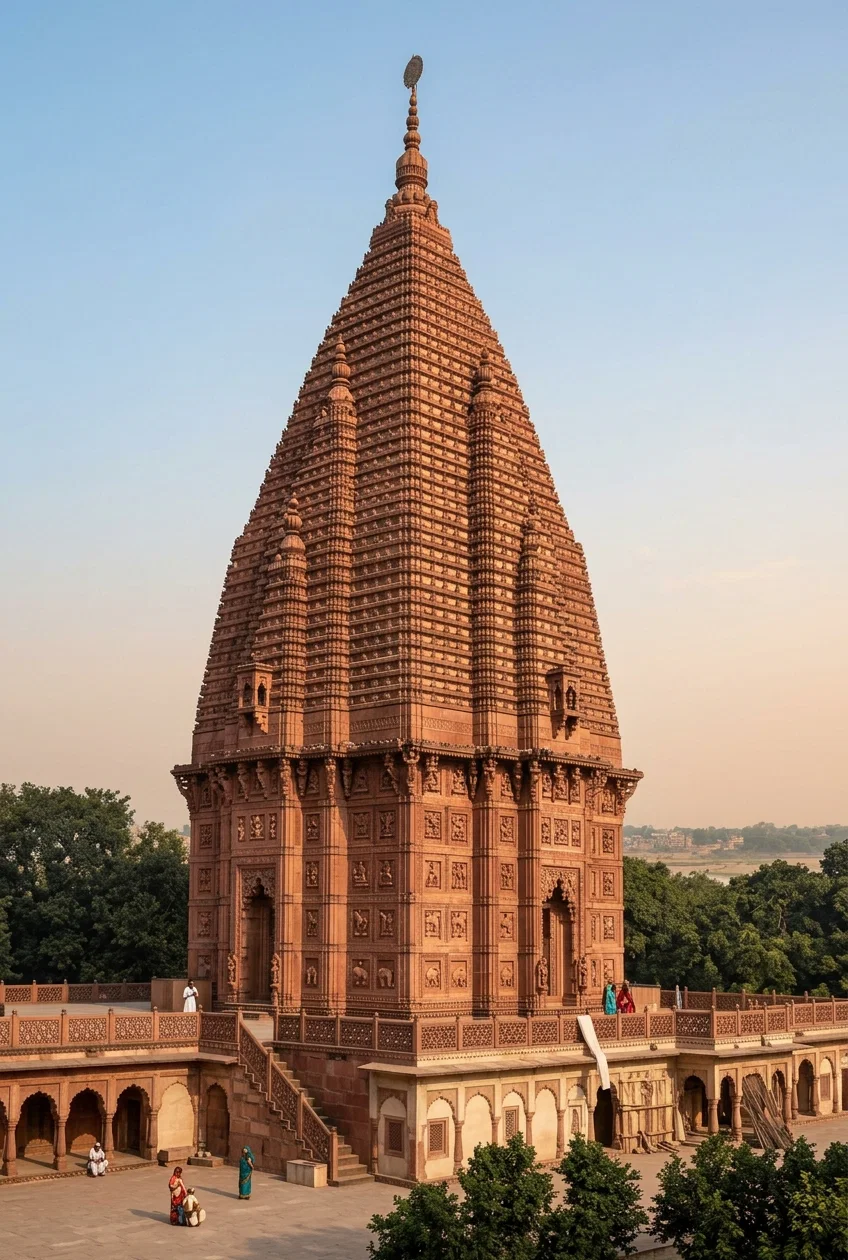
Temple at Ramnagar near Benares.
The so-called holy wells of Benares attract as many pilgrims as do the temples. One of these is called the “Well of Knowledge.” The offerings presented consist chiefly of flowers, which are cast into the well, whose waters are thus made putrid; but an attendant priest serves to each worshiper a sip of the nauseous fluid. The “Well of Fate,” whose waters are not less foul, attracts myriads of devotees. Another well bears the title of “Complete Source of Felicity,” and is regarded as chief among the places of pilgrimage in the holy city. Into this well, in addition to flowers and the leaves of the bael tree, milk is poured as an oblation. Steps lead down to the water; and each seeker after happiness laves his head and his body in the loathsome water. Many of the temples are as foul as are these wells, but all are thronged with worshipers.
The regularity of the ghats leading to the river is broken at intervals by platforms where, under canopies, sit priests who read and expound the sacred books of Hinduism to the pilgrims who gather about them, and who are expected to bestow a gratuity in return for this pious service. Down the long flights of steps men, women, and children were continually making their toilsome way. The children, with wondering eyes, were plunged for a moment beneath the water, then, shivering, were placed on terra firma. There is sometimes among the women bathers a strange admixture of devotion with laughter and talk of household and family concerns, while occasionally some irate female improves the opportunity to heap upon her neighbor all sorts of abuse. Parties of pilgrims from the same region of country like to keep together; for the Hindu is by nature extremely timid, as well as gregarious.
There is always a babel of voices, for the kaleidoscopic multitude has come from all parts of the great Indian empire. There is no more pathetic sight than that of the aged pilgrims who are brought here. Supported by their friends, slowly and painfully they make their descent to the water’s edge, looking out with wistful eyes upon the river of whose sanctity they have heard since the dawn of existence. Much of sorrow has life held for them, and perhaps much of sin. The days of their pilgrimage almost over, before plunging into the great Unknown, they would plunge beneath the sacred flood which they have been taught to believe can wash away the accumulated guilt of a lifetime. This ceremony over, they are helped out of the water, and with diminished physical strength and little accession of heart-joy, begin the painful ascent.
Some of the men seen at these bathing ghats are haughty of mien, with intelligent faces, silent and apparently unobservant of all that is passing around them. The prince and the peasant come to this holy place for cleansing, the prince in all the pomp13and splendor befitting his high station, carried in a palanquin by obsequious bearers and followed by a retinue of retainers; the peasant, unattended, and with no costly garments to be laid aside, steps down into the water with his loin cloth, and emerging climbs the slippery steps, leaving a wet trail behind him. Notable among the objects on the river’s bank are the spacious and imposing residences which Indian princes and lesser noblemen have provided for their accommodation when on pilgrimages to the holy city. Palaces, mosques with graceful minarets, temples with gilded domes and pinnacles, are side by side with ruinous houses, broken ghats, and heaps of rubbish.
Among the Hindus, cremation is the usual mode of disposing of their dead. The burning ghat at Benares is pre-eminently the most holy place in India where this rite can be performed. The space allotted to this purpose is in immediate proximity to one of the most frequented ghats leading to the river. When bereaved friends are too poor to purchase sufficient fuel entirely to consume the body, it is only partially burned, and the charred remains are then consigned to the Ganges. Such wrecks, rising to the surface, attract greedy vultures, and these may often be seen perched upon a carcass borne outward by the current. Such spectacles met our gaze as we were rowed past the city. The bathers paid no more heed when such an object floated past them than if instead it had been a log of wood.
The Hindus believe that notwithstanding the sanctity of the place, the spirits of their deceased friends will not attain eternal felicity unless the fire which consumes their bodies is lighted with a coal taken from a domra, the lowest and most despised caste in India. The domra who holds the monopoly of the sacred fire at this ghat is a man of great wealth. His business stand is close to the ghat, where under a bamboo shelter he keeps a smouldering fire ready to serve customers. He knows nothing of fixed prices, but takes advantage of wealth and station. A Hindu prince was compelled to pay one thousand rupees for a coal with which to light the funeral pyre of a deceased relative.
In the vicinity of the burning ghat are numerous tomb-like structures. These mark the spots where in former times widows were burned alive with their dead husbands. To Lord William Bentwick belongs the honor of abolishing by law the horrid rite of sati, or widow burning. For many years the trio of famous missionaries at Serampore,—Carey, Marshman, and Ward,—had done all in their power, both by voice and pen to induce those in authority to set in motion the wheel of the law against so monstrous a custom; but it was declared that the time had not yet come for taking a step which affected so vitally the religious and social life of the Hindus. When in 1829 Lord William Bentwick was made Governor-General of India, he resolved that no time should be lost in stamping as a criminal offense this diabolical rite. To William Carey, the great missionary, was given the honor of translating from English into the vernacular, the edict which prohibited, on pain of death, the rite of sati. The paper was sent down to him from Government House on Sunday, and instead of going into the pulpit, according to custom, he sent for his pundit, and at once began the translation of this important document. “It is a work of mercy,” he said, “as the delay of a single day means the sacrifice of two victims.”
The impression left upon the mind of the visitor to Benares is that the city is wholly given to idolatry. Is this because the inhabitants of this far-famed city are more ignorant than are the inhabitants of other Indian cities? The holy city is the seat of Sanscrit learning. There are in Benares 200 monastic institutions, with 2,000 students in attendance. These come from all parts of India, and each, when his course of study is completed, is expected to return to his own neighborhood, to be there an expounder of Hinduism.
The disciples of the heavenly Master might learn lessons of stewardship from some of the disciples of the false religions of the Orient. A wealthy shopkeeper in Benares set apart a garden for the residence of two hundred Brahman students, who were to be fed and clothed at his expense. The Maharaja of Kashmir maintains a Sanscrit school in a fine building near one of the ghats, with eleven Pundits and two hundred Brahman students. Another Maharaja maintains a still larger school near the Golden Temple, and there are numerous private schools.
What kind of instruction is given in these schools?
“False morality, false history, false philosophy, and ‘false physics,’” says one well qualified to judge. The effect of such an education as is given in these schools is seen in the pundits, who, as a rule, are the most bigoted portion of the community, and opposed to all reform.
Some of the pilgrims who visit Benares deem it sacrilege to enter the holy city standing upright as men. Instead they prostrate themselves and measure their length along the ground. Touching the sacred soil with his forehead, the pilgrim rises and places his foot where the forehead had been, then again prostrates himself, and in this manner continues his slow and painful journey. After leaving the boat, we turned to look once more upon the river with its teeming life, and while we thus stood a long railway train on its way to Calcutta came thundering across the magnificent iron bridge which spans the river at this point, and which is nearly a mile in length. How wide the contrast between this splendid bridge, a triumph of nineteenth-century engineering, and the devotee of Hinduism, like a worm measuring his length along the ground—the one an exponent of Hinduism, the other of Christian civilization.