ON THE WAY TO INDIA

7%

Pacific Press Publishing Company · Oakland, California · Aug 21, 1901

FromSigns of the Times, Vol. 27, No. 34.

Read the full edition

ON THE WAY TO INDIA.

From Queenstown to Aden.
THOSE who have ever had an experience of tossing upon the trackless ocean for nearly a week, out of sight of land, can imagine something of our delight as the green hills of Ireland appeared in view at 6:30 Wednesday morning, June 5. Sailing along the southern coast, we entered the harbor of Queenstown about noon. Our steamer did not touch the wharf at that place, but waited in the mouth of the harbor till quite a number of passengers were transferred to a small steamer to be taken to land. Then we glided across the waters of the Irish Sea so smoothly that most of the time our great steamer seemed almost motionless.
Arriving at Liverpool, Tuesday morning, June 6, we had a very pleasant ride over the verdant and charming fields of England to the great city of London. This metropolis of the British empire occupied an area of 117 square miles in 1896, and had a population of 4,421,492; and the population of Greater London at that time was 6,177,913. Our London friends who came to meet us at the train, not only gave us a hearty welcome, but rendered us every possible assistance, and only by their active and timely aid were we able to get away on the train that we wished to take the same day, so as to give us a quiet Sabbath of rest at Marseilles, and time to take the steamer June 9.
Crossing from England to France, the water was rough. Our ride across France was an interesting one, tho the scenery was not equal in beauty to that of England. The French system of farming appears to be different from any other that we have ever seen. Their crops are raised in narrow strips, that seem to average from one to three rods in width, caused by the division of the land at the time of the French Revolution. We spent a part of the day Friday in the beautiful city of Paris, and arrived in Marseilles early the next morning. Here we supplied ourselves with deck chairs and fresh fruit, before our good French steamer, Earnest Simon, started on her long Eastern voyage.
Monday, June 10, at 4 P.M., we passed between Corsica and Sardinia. Tuesday morning we found our steamer was running toward the center of a burning mountain, that rose high before us, and we were informed that it was the volcano of Stromboli. But instead of running into it, we turned to the left, and passed near by on the north side, having a fair view of the heated masses rolling down the sides of the mountain, and raising a white splash as they plunged into the sea. Just as we were directly opposite on the north side, the ancient orator favored us with a speech, accompanying the one loud word by a volume of smoke, mingled with broken rocks, that flew high in the air, and could be distinctly seen as they descended upon the mountainside. About twenty minutes later another volume of smoke shot upward; but we had passed too far to hear the report.
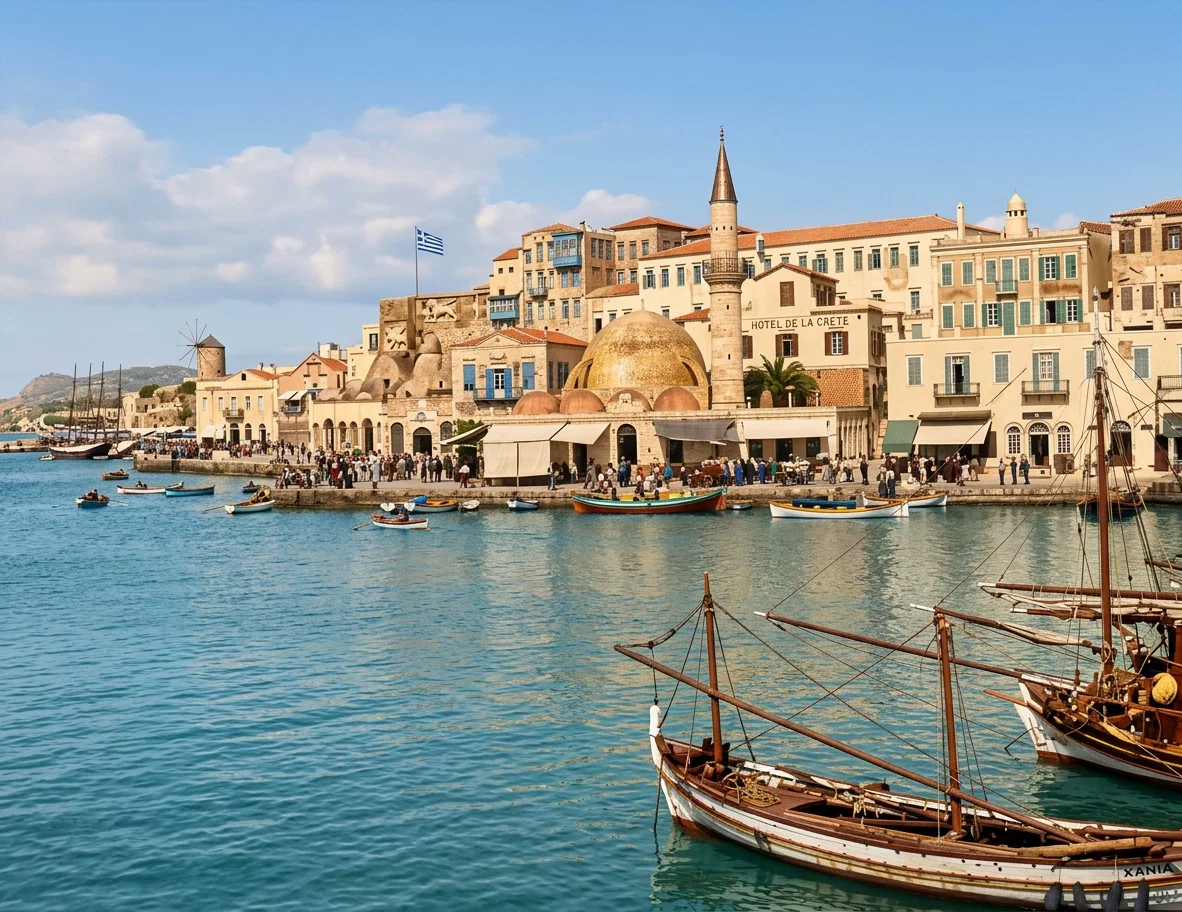
Canea, a City in Crete.
Leaving Stromboli behind, the southern coast of Italy, the “toe of the boot,” soon appeared in view; and then the northern coast of Sicily was seen. Passing through the Strait of Messina, we had a view of Messina on the right, and at our left, of the village of Reggio, the ancient Rhegium in Italy, where Paul spent one day. After passing these, we had a view of Mount Etna, on the Island of Sicily. As we again passed out of sight of land, we thought of the storm that broke over this part of the Mediterranean and wrecked Paul’s vessel. But He who called us from the West to go on a mission to the East; He who once said to the troubled Sea of Galilee, “Peace, be still,” knowing that we have not the power of endurance that Paul had, has spoken peace to the “Great Sea,” and in obedience to His voice it bears us safely upon its quiet bosom, so gently that our vessel seems almost motionless. A part of the time the glassy surface of the sea has such an oily smoothness that it might almost be said to be waveless; and when we are in our cabins, the boat seems as if it were standing still.
Wednesday, June 13, we study more about the third voyage of Paul, as we sail between Crete and Clauda. We are having precious seasons of Bible study and worship, in which we realize, as never before, the presence of the One who has promised ever to be with us. None of our company seem to have any doubt about being in the right path. Altho we all love our native land, and appreciate the full meaning of the word “home,” yet we do not regret that every day bears us farther and farther away from all those scenes so dear to us. Altho we value our friends so highly, and greatly miss their society, yet we go willingly to dwell among strangers in a strange land. Such are our present feelings, tho we know not what severe trials are before us, and we are aware that the great tests have not yet come. But this we know: we have the sure promise in Phil. 4:19, “But my God shall supply all your need according to His riches in glory by Christ Jesus.” (A bank-note on which there is no discount.) And if we need to be tested by fiery trials, they will surely have a place in our experience.
Thursday, June 13. Our course is farther south than was that of Paul during the days of contrary winds. Friday, June 14, we entered Port Said at 5 A.M. There we found a mixed multitude of people of different nationalities, most of them very earnest and persevering in their efforts to sell their wares to strangers. Some of them retained their patience and cheerfulness to the last, even tho unsuccessful; others manifested impatience at the first refusal to trade with them. They were indeed interesting object-lessons for our study.
At 12:30 P.M. we began to move down the Suez Canal. “From remote ages the Isthmus of Suez has been traversed by a canal, following nearly the line of the present one. Nothing certain, however, seems to be known as to who was its first constructor; but the credit is generally given to Pharaoh Necho, who reigned about 600 B.C. In the course of time it became clogged with sand; but it was cleared out by Trajan in the second century A.D., and was again cleared in 767. The Suez Canal is 99 miles in length from sea to sea, with a width of 327 feet for 77 miles, and of 196 feet for the remaining 22 miles, and its depth is 26 feet.”
We had proceeded but thirty-five miles on this canal, when a swift sirocco, sweeping from the Arabian Desert, came whistling through the rigging of our vessel, with its cloud of sand darkening the sky above, filling all the air around, and sanding our decks and cabins before the port-holes were closed against it. As our great steamer was unable to proceed with safety, it was tied to a strong post upon the bank, and stood quietly in the channel for about seven hours, a safe refuge from the storm that was sweeping over us. During the night our ship moved on, passing through three salt-water lakes, and arriving at the end of the canal at Suez about noon, Saturday, June 15. We remained here till 9 P.M., and then moved on down the Gulf of Suez. At first the waters were sleeping in oily smoothness; but very gradually they were stirred into motion by the gentle breezes, until we moved out into the Red Sea, where the rolling, dancing waves, with their sparkling, foaming whitecaps, added a more lively grandeur and sublimity to the scene, calling forth from our hearts lofty adoration of the loving Father,—
“Who holds them all within the hollow of His hand, Where every drop is subject to His wise command.”
Tuesday, June 18. We expect to reach Aden tomorrow morning, and must attend to the mailingof our letters this P.M. We feel assured that many prayers ascend for us. We behold the answers daily. Our steamer has seemed almost as steady as a house ever since we left Marseilles. Just now we passed the Twelve Apostles,—twelve large rocks standing up in a row in the Red Sea. June 19, a day of beauty, dawns upon the Gulf of Aden. Record of the quietness of the Red Sea, as well as of the Mediterranean, unbroken.
G. K. OWEN.