BETHLEHEM

8%

Pacific Press Publishing Company · Oakland, California · Jul 10, 1901

FromSigns of the Times, Vol. 27, No. 28.

Read the full edition

BETHLEHEM

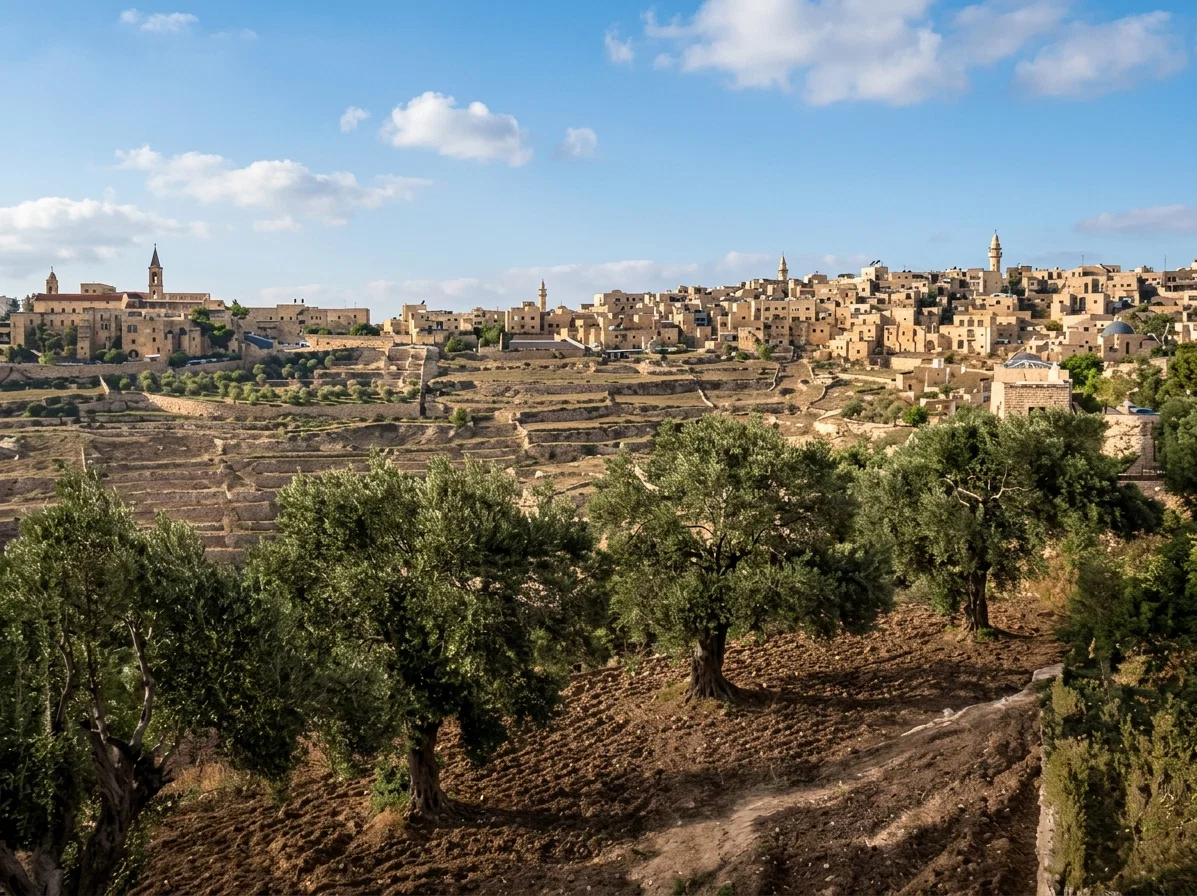
THE city of Bethlehem is situated about six miles southwest of Jerusalem. The name signifies “house of bread.” It is a place of great antiquity, as well as of frequent and prominent note. It never was a large city, altho surrounded by a fruitful country, and the center and scene of events of national and world-wide importance.
Bethlehem.
Bethlehem.
THE first mention we have of Bethlehem is in connection with Jacob’s return to Palestine from Padan-aram. There it is called Ephrath. Near here, as Jacob and his caravan camped after leaving Bethel, Benjamin was born, and Rachel died. The record says: “Rachel died, and was buried in the way to Ephrath, which is Bethlehem. And Jacob set a pillar upon her grave; that is the pillar of Rachel’s grave unto this day.” Gen. 35:19, 20.
IN the days of the judges, the city of Ephrath, or Bethlehem-judah, is again made prominent by the story of Naomi and Ruth. A man named Elimelech and Naomi his wife, with their sons Mahlon and Chilion, went from Bethlehem to the land of Moab because of a famine in Judah. The sons married women of Moab, and afterward both of them died, as also their father. Then the mother returned to Bethlehem, and Ruth, one of her daughters-in-law, went with her. Here Ruth married a kinsman of Naomi, and by this marriage came into the genealogical line thru which Jesus of Nazareth was proved to be a direct lineal descendant of Abraham. She became the mother of Obed, the grandfather of David. In Ruth 4:11 the name of Ephrath is varied to Ephratah.
WHEN the Lord rejected King Saul and his family as the royal line from whom should come the kings of Israel and finally the Messiah, He sent Samuel to Bethlehem to anoint a successor. “And Samuel did that which the Lord spake, and came to Bethlehem. And the elders of the town trembled at his coming, and said, Comest thou peaceably? And he said, Peaceably; I am come to sacrifice unto the Lord; sanctify yourselves, and come with me to the sacrifice. And he sanctified Jesse and his sons, and called them to the sacrifice.” Here Samuel anointed David, “and the Spirit of the Lord came upon David from that day forward.” 1 Sam. 16:4, 5, 13.
AT one time when Saul was king, the Philistines occupied Bethlehem and had a garrison there. David, with a company of men, was fleeing from place to place to evade the wrath of Saul. He had placed his father and mother in the care of the king of Moab for safety, while he and his men had their secret abode in the cave of Adullam. On one occasion David said to his men, “O that one would give me drink of the water of the well of Bethlehem, which is by the gate!” Then three of his mighty men “brake thru the hostof the Philistines, and drew water out of the well of Bethlehem, that was by the gate, and took it, and brought it to David; nevertheless he would not drink thereof, but poured it out unto the Lord. And he said, Be it far from me, O Lord, that I should do this; is not this the blood of the men that went in jeopardy of their lives? therefore he would not drink it.” 2 Sam. 23:15-17.
THE prophet Micah spake thus concerning this place: “Thou, Bethlehem Ephratah, tho thou be little among the thousands of Judah, yet out of thee shall He come forth unto Me that is to be ruler in Israel; whose goings forth have been from of old, from everlasting.” Micah 5:2. This prophecy was literally fulfilled in the birth of Christ. As the decree of Cæsar Augustus went forth that all should be taxed, the people went to their various places of nativity to be enrolled. “And Joseph also went up from Galilee, out of the city of Nazareth, into Judea, unto the city of David, which is called Bethlehem (because he was of the house and lineage of David), to be taxed with Mary his espoused wife, being great with child. And so it was, that, while they were there, the days were accomplished that she should be delivered. And she brought forth her first-born son, and wrapped him in swaddling clothes, and laid him in a manger; because there was no room for them in the inn.” Luke 2:4-7. And the shepherds of Bethlehem heard the first proclamation of the advent of Christ, as the angelic host sang, “Unto you is born this day in the city of David a Saviour, which is Christ the Lord.” Verse 11.
WHEN the wise men came from the East to seek the One who had been born King of the Jews, they naturally sought information in Jerusalem. Inquiry revealed the words of the prophet Micah, previously quoted. Hastening on to Bethlehem, they were guided by the star to the house where the infant Saviour was abiding. Then the wise men worshiped Him, and gave to His parents the costly presents they had brought in His honor. King Herod had secretly designed to put the child to death, so he enjoined the wise men to bring him word when they found Him. But on being warned of God in a dream not to return to Herod, they went home by another route.
HEROD was greatly angered when he found that his command had been disregarded, and he determined to make sure of his purpose. So he sent soldiers who “slew all the children that were in Bethlehem, and in all the coasts thereof, from two years old and under.” But God had anticipated his wicked design, and warned Joseph in a dream concerning it. Following the Lord’s direction, Joseph “took the young child and His mother by night, and departed into Egypt.”
THERE is no record that Jesus ever visited His native city again. If He did, the visit was of the same character as that to other towns, the place not being deemed a matter of sufficient importance to merit mention. There is enough of traditional idolatry connected with the nativity, without a record of any subsequent visit. After the Saviour’s birth there could be no real importance attached to a genealogical record in Bethlehem. However, the present population (about 3,000) are mostly professed Christians (Roman Catholic), and there is a large church marking the traditional “Grotto of the Nativity.” This church was built in the fourth century, by the Empress Helena.
W. N. G.