WOMEN OF INDIA

6%

Pacific Press Publishing Company · Oakland, California · Jun 26, 1901

FromSigns of the Times, Vol. 27, No. 26.

Read the full edition

WOMEN OF INDIA.

When a Hindu was asked if there was any point upon which all, however sectarian, were agreed, he replied, “Yes, we all believe in the sanctity of the cow, and the depravity of women,” and the Vedas declare woman to be an incarnation of sin.
A Sanskrit catechism reads thus:—
“What is cruel? “The heart of a viper. “What is more cruel than that? “The heart of a woman. “What is the cruelest of all? “The heart of a soulless widow.”
Another catechism reads thus:—
“What is the chief gate to hell? “A woman. “What bewitches like wine? “A woman. “Who is the wisest of the wise? “He who has not been deceived by woman, who may be compared to malignant fiends. “What is that which can not be trusted? “Woman. “What poison is that which appears like nectar? “A woman. “Who are fetters to men? “Women.”
“Blind sons support their parents, but a prince’s daughter extorts money from them.” That is, a son, however helpless, will care for his parents; but a daughter, however rich, will try to get all she can from them.
This estimate of women shows itself in all their social customs. The Indian wife must never appear in her husband’s presence with her face uncovered. She must leave the room if any other man appears. It is regarded as highly improper for a man to eat with his wife or any other woman, or to converse with one on terms of equality. The wife never addresses the husband by his name. To do so would be too familiar, an insult to his dignity. Some title of respect must be used, or, if they have a child, he may be addressed thru the child’s name, as the father of Kali, the father of Noni. If they have no child, she uses a respectful personal pronoun in addressing him or speaking of him to others. I had some very amazing experiences in trying to learn the husband’s name from the wife before I became acquainted with this custom. They can not be induced to pronounce it, tho some will venture to spell it, if they know how to spell. A short time ago in our Hindu girls’ school, one of the little mites insisted on skipping one word in her lesson. The teacher tried and tried to get her to pronounce it, but she as persistently refused. At last one of the older girls came to her rescue by explaining to the teacher that that was the child’s husband’s name, and how could she pronounce it?
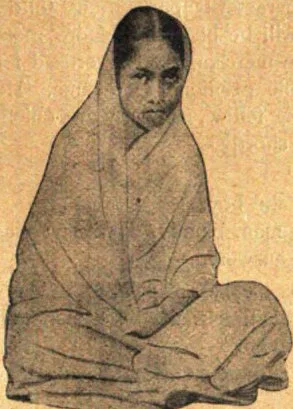
A Bride of Eight.
A Bride of Eight.
Nurse Girls of the West Indies.
From the time she enters her husband’s home to the day of her death, the Hindu woman is practically a prisoner. If she goes out at all, it must be in a tightly closed conveyance, shut in from all observation. In her home itself there are many sources of discomfort and trouble. There may be two or more wives of the same husband. There are sure to be a mother-in-law, whose word is law, aunts, sisters, sisters-in-law, daughters, daughters-in-law, nieces,—some married, some widows,—people of all ages, and children of many degrees of relationship. Friction in such families is inevitable. However patient, gentle, and submissive the woman may be, many occasions for envy, jealousy, and discord are sure to arise. Under such circumstances, superstitious, ignorant, and without any elevating associations, it is inevitable that Hindu women should be liable to untold sorrow and misery.
In addition to all this is the added load of anxiety as to the possible sex of her child; for on that, over which she can have no possible influence, depends, to a great extent, her future weal or woe. If a wife gives birth to daughters only, Manu, the great Hindu law-giver, authorizes the husband to take another wife, and another, and another, until sons are born. It is not surprising, under these circumstances, that the blessing invoked on women over the greater part of India should be, “Mayest thou have eight sons, and may thy husband survive thee.”
But sad as the lot of the Hindu wife is, in some respects that of the widow is far worse. A father, in selecting a wife for his son, will prefer one out of a family in which boys are more frequently born than girls, and will avoid one in which widowhood is frequent; for next to the loss of caste, the presence of girls and widows in a family is regarded as the greatest misfortune. A son is the dearest possession of a family. His death is supposed to be caused by some sin committed by his wife, either in this or a former life. If he had not married her, his death would not have occurred. Therefore she is regarded as under the curse of the gods, and during the remainder of her life she is subjected to many hard and bitter experiences in expiation for her sin. Her only hope of release from her sufferings is death, or, what is worse, a life of shame, a refuge which thousands choose in preference to the intolerable torments of their widowhood.
Oftentimes in listening to the “old, old story” from the lips of a missionary, the Hindu women will exclaim, “Your Shastras must have been written by women; they speak so tenderly of us.” When Jesus was on this earth, the poor, the down-trodden, the oppressed, the ignorant, and the sorrowful, were those whom He most pitied and helped. He is the same yesterday, to-day, and forever; and if He were on earth to-day, ministering to mankind, I think He would turn most pitifully to the women and children of India, as the class most in need of His compassion and help. And yet at least nine-tenths of the one hundred and fifty million women in this dark land, to whom the Saviour’s love and pity go out so unceasingly, have never even heard that they have such a Friend, have never even heard the name of Christ. “How shall they believe in Him of whom they have not heard?”
The horrors of the famine and the devastation of the plague are written and talked of everywhere; but there is nothing so awful as these sorrowing millions living and dying without Christ. If our friends at home could only realize the wretchedness and the sorrow and the suffering of their Indian sisters; if they could only see them groping in the darkness of heathenism, without one ray of light, with none to teach them, no one to care for their souls, I am sure hearts would be touched, and many would be ready to say, “Here am I, Lord, send me.”
GEORGIA BURRUS.
Calcutta, India.