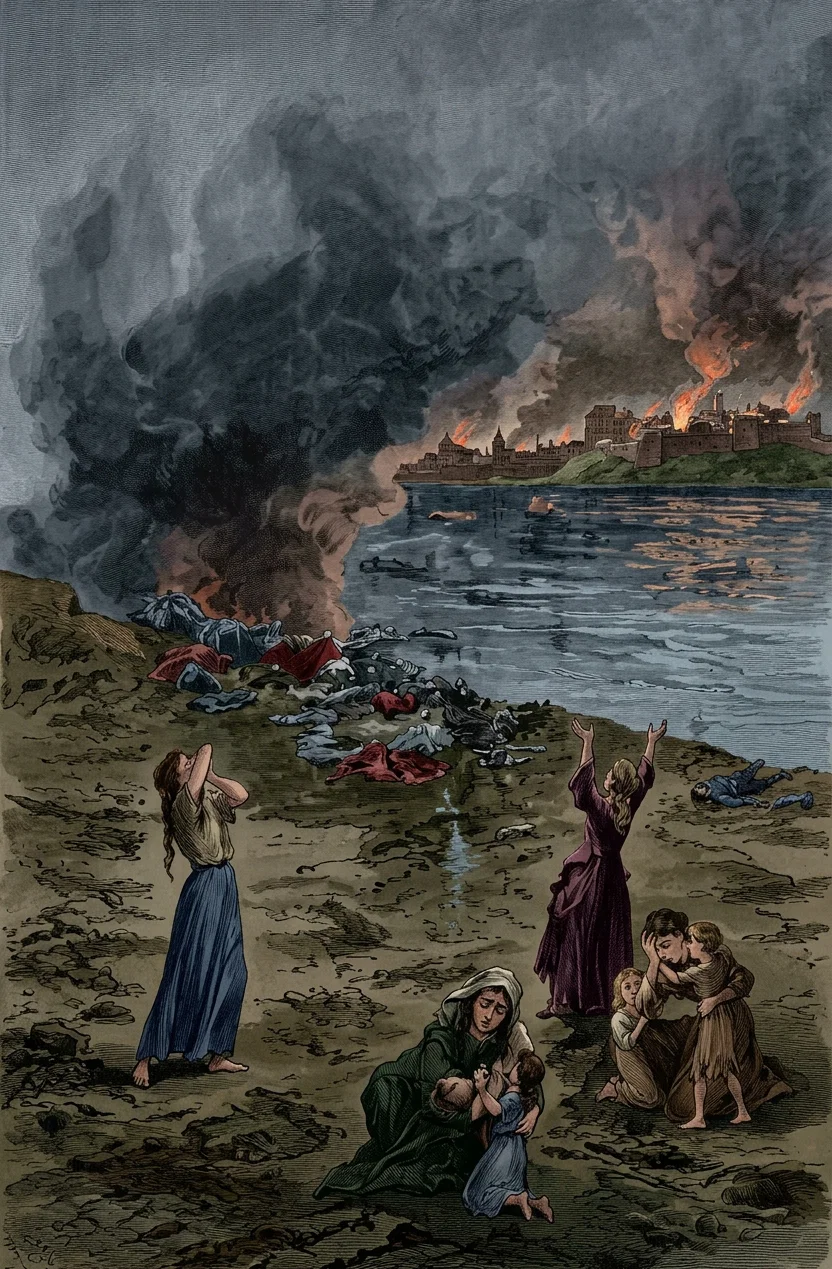
THE impending war between capital and labor is quite fully discussed in other columns of this paper. No one can fail to see that the struggle is on, and there can be no mistaking the fact that it will be a fierce one. If any are in doubt upon this point, let them read the following burning words of the apostle:—
“Go to now, ye rich, weep and howl for your miseries that are coming upon you. Your riches are corrupted, and your garments are moth-eaten. Your gold and your silver are rusted; and their rust shall be for a testimony against you, and shall eat your flesh as fire. Ye have laid up your treasure in the last days. Behold, the hire of the laborers who mowed your fields, which is of you kept back by fraud, crieth out; and the cries of them that reaped have entered into the ears of the Lord of Sabaoth. Ye have lived delicately on the earth, and taken your pleasure; ye have nourished your hearts in a day of slaughter. Ye have condemned, ye have killed the righteous one; he doth not resist you.
“Be patient therefore, brethren, until the coming of the Lord. Behold, the husbandman waiteth for the precious fruit of the earth, being patient over it, until it receive the early and latter rain. Be ye also patient; stablish your hearts; for the coming of the Lord is at hand. Murmur not, brethren, one against another, that ye be not judged; behold, the Judge standeth before the doors. Take, brethren, for an example of suffering and of patience, the prophets who spake in the name of the Lord. Behold, we call them blessed which endured; ye have heard of the patience of Job, and have seen the end of the Lord, how that the Lord is full of pity, and merciful.” James 5:1-11, R.V.
The foregoing words of Scripture are commented on elsewhere in this issue, so we will do nothing in this connection except to call attention to the fact that the second coming of Christ and “the last days” are the points to which the apostle is directing our attention; and in that time the rich men are laying up their treasure by oppressing the laborer. This scripture speaks especially of the “hire,” or wages, that are “kept back by ‘fraud.’”
In considering this matter, the imperfect standard of men must not be used. We must measure everything by the perfect standard of God. As we stand in the presence of God’s Word, and view matters in the light of divine love and tenderness, we will see a great many things as “fraud” that before we had regarded as all right.
The majority, perhaps, of the wealthy are professing Christians, and the Master has a right to their services. They should recognize our heavenly Father’s own statement that, “Thou shalt remember the ‘Lord thy God; for it is He that giveth thee ‘power to get wealth, that He may establish His ‘covenant which He sware unto thy fathers, as it is ‘this day.” Deut. 8:18. Then the man who has “power to get wealth” has received that ability from his Maker, and it should not be used in serving self; it should be used in serving the Lord.
The wealthy man may pay his laborers good wages, but his duty does not end there. Those thousands or those millions that he is amassing belong to the Lord, and they should be turned into streams of blessing for humanity. And where this is not done, the Lord is defrauded of the service due Him, even tho that particular man pays all his employes liberally. Any one can see that the text is a startling warning against the man who does not pay his hired help their proper wage, and all ought also to see that the Word of God most clearly shows the responsibility of the rich man to use his means in helping others in ways that are far broader and much more generous than merely paying good wages.
We are responsible for the right use of all we possess. Every pang of hunger, and all of the squalor and degradation and suffering that we might have relieved, but have refused, will be charged to our account, and we will have to settle it before the bar of Him whose knowledge is so perfect that no fraud, or unjust or oppressive principle, can enter His court. If you do not believe this, read the last sixteen verses of the twenty-fifth chapter of Matthew.
The man who has the ability and embraces the opportunity to amass millions has a big responsibility resting upon him. Such men usually have the qualifications of great generals, and are able to organize whole armies of laborers, who profitably and successfully execute their plans. After the plans for gathering wealth are so ably executed, these same men have the opportunity afforded them of spreading great blessings among mankind. This can not be done as a general rule by giving
away their money. Something may be accomplished by building libraries and founding colleges, but it is only in the most general way that such deeds accomplish any good. The donors are not brought into close touch with the people in that way. The benefits of the library or the college that they have founded may be enjoyed, and the benefactors may receive the blessings of the hundreds who enjoy them. But these things alone do not bring the wealthy into that close touch with suffering humanity that enables them to sense the prevalence of poverty and the depth of the degradation that results from it.
There are many charitable organizations, state, church, and private. These are not to be ignored. They do untold good. But there are wealthy men in this country who, single-handed, have it in their power to do more to uplift and benefit the poverty-stricken than whole platoons of these organizations. The society is usually hampered for lack of funds, but these individuals have their millions. The executive officers of the society are bound about by rules, and often cases are brought to them that
they can not help “because they do not come ‘within their prescribed regulations.’” But these individuals with their millions could promptly make a rule for each case, and spread their blessings without hindrance or delay.
Societies have been duly organized, and fully equipped with president, secretary, and by-laws, and have gone forth to buy up sections of land, and form colonies where happiness would be secured to the poor people who would be invited to the benefits of the society. But such societies usually lack the able hand of an experienced executive, and so they sooner or later result in failure. The man of millions, or even of a much lesser sum, could take some of the thousands of acres of idle land that he holds as a speculation, divide them into small farms, and then notify business men, clergymen, lawyers, doctors, and others who are continually coming in contact with
that portion of humanity whom misfortune has overtaken, to put them in communication with such individuals. Then let them investigate their cases personally, or else have a thoroughly competent person do it for them, find out what they need in the way of advice, and settle them in a pleasant home on this land. The home should not be given them, for that would not encourage the thrift and energy that puts manliness in men. The homes could be properly fitted out and sold to them on terms that they could meet, and the money could be used again and again in helping still others. In this way the benefits would be constantly widening.
There are thousands of acres held as game-preserves. The deer and the elk must look beautiful in those wooded retreats; but their beauty would be increased rather than diminished by placing among them thousands of families with the children, who ought to be more dear to us than the beasts.
Now if such a work as this would have to be done by some society, it would be no more than speculative fancy to talk about it. But if the men who can build railroads, organize steamship lines, conduct great and successful manufacturing establishments, would only (as individuals) take hold of such an enterprise, they would make it succeed. They would find difficulties, and much to try their patience; but the obstacles would be no greater than the ones they have overcome in making their present work a success.
Why should not the owners of the big factories that employ thousands of men and women, locate their plants in country districts, and arrange for every family to own some land that the children might cultivate while the father was in the shop? In this way all could share in the work of making the living, and the right kind of manly independence would be built up. The man in the factory should be encouraged to take an interest in the cultivation of the soil. He will be a more intelligent and useful mechanic if his nature has been touched by the pleasing knowledge of plant growth. Men would not be so turbulent if they were in closer touch with the natural, and not so wholly given to the artificial, that so fully composes the ordinary city and factory life. If the manufacturer would make it possible for his men all to have a good garden, if he would if necessary supply a skilful agriculturist to interest and to teach them, the workmen would find both a profit and a delight in the benefits and pleasures of nature, that would make the meeting of the labor union most uninteresting indeed.
But even here the manufacturer who would take hold of such a thing for the selfish purpose of6avoiding strikes would not likely make it succeed. But he who takes hold of it from the motive of helping his fellow-mortals will surely have the joy of seeing many of them made contented and happy.
In a financial way there are thousands of men who are about in the position of one who is in a well. If you leave him there, he must give up and die; but if a strong hand lets a rope down and draws him out, he is as able as any one to fulfil the obligations of life. To-day it is within the reach of the wealthy to turn the curses of the poor into blessings; they may, so to speak, let the rope down to the man in the well. To-day they may plan wisely, and also execute the plans, that will relieve the distress of the poor and unfortunate; but soon it will be too late. And every wealthy man who continues selfishly to hoard his money, and who refuses to give thought to the magnitude of all that may be done for the relief of men, will soon be called to do as stated in the text at the beginning of this article,—“Weep and howl for your miseries that are coming upon you.”
There are many vagabonds and wrecks of humanity who would only abuse any proffered help; but there are also thousands of deserving men and women, who, if the right ones would take an interest in giving them counsel and the small financial help that would put them on their feet, would become a blessing in their home and the whole neighborhood where they might live. This is the time for prompt action. We pray that at least some hearts may be touched by these suggestions. T.