EBAL AND GERIZIM

11%

Pacific Press Publishing Company · Oakland, California · Jun 19, 1901

FromSigns of the Times, Vol. 27, No. 25.

Read the full edition

EBAL AND GERIZIM.

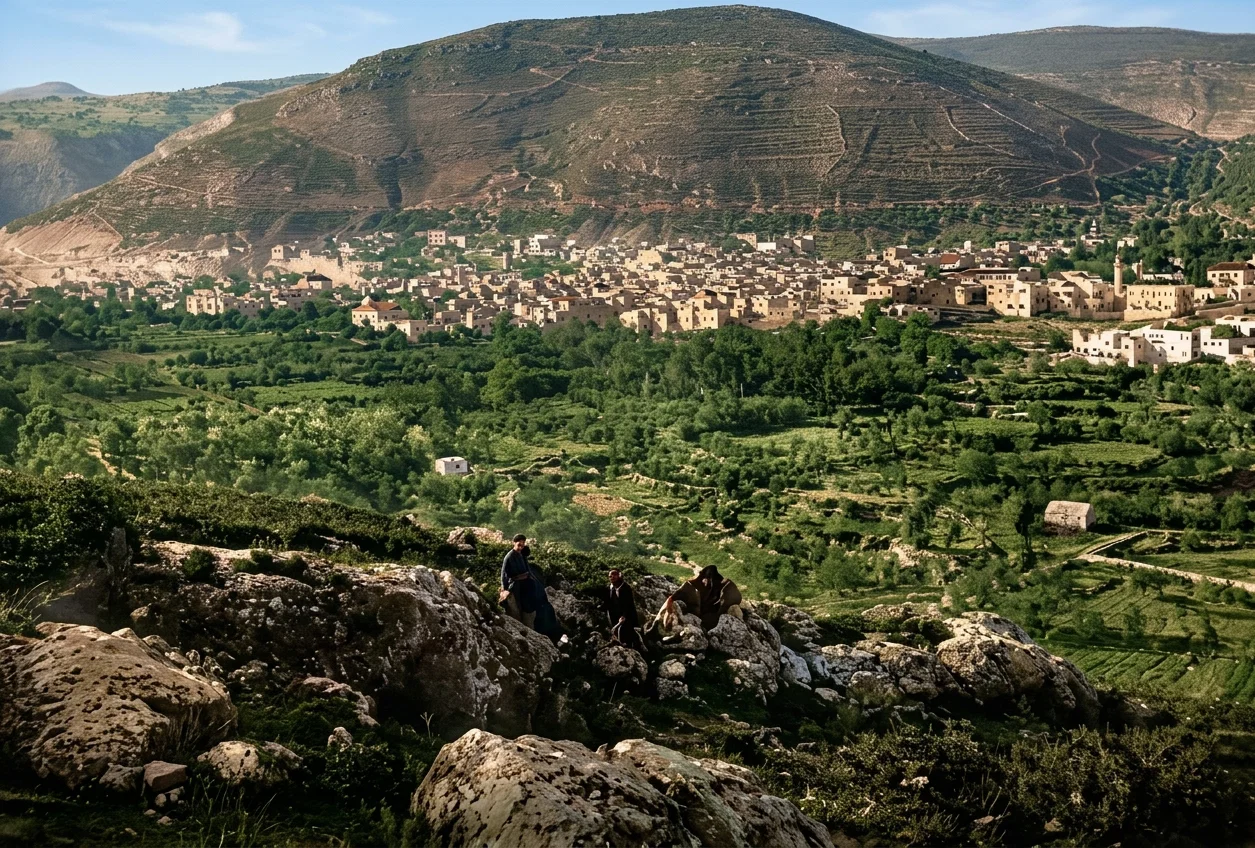
THESE two mountains, forming the opposite walls of a narrow valley in Palestine, were witnesses of some of the most solemn scenes of which we have record. The valley of Shechem holds a very important place in sacred history. It was here that Abraham built his first altar in the land of Canaan. Coming from Haran to Canaan, “Abram passed thru the land unto the place of Sichem, unto the plain of Moreh. And the Canaanite was then in the land. And the Lord appeared unto Abram, and said, Unto thy seed will I give this land; and there built he an altar unto the Lord, who appeared unto him.” Gen. 12:6, 7. Here, too, Jacob pitched his tents after his sojourn in Mesopotamia. Here he dug the well which supplied the people with water for many centuries. Here he buried under an oak the images which his wives had secretly brought with them from Padan-aram. And it is said to be one of the most beautiful spots in all Palestine.
NABLUS (Ancient Shechem) AND MT. GERIZIM.
BUT the most notable event, that which indelibly fixes the place in mind, is the assembly of Israel soon after their entrance into the promised land. Moses had twice given direction concerning this convocation. The first record is given in Deut. 11:26–30: “Behold, I set before you this day a blessing and a curse; a blessing, if ye obey the commandments of the Lord your God, which I command you this day; and a curse, if ye will not obey the commandments of the Lord your God, but turn aside out of the way which I command you this day, to go after other gods, which ye have not known. And it shall come to pass, when the Lord thy God hath brought thee in unto the land whither thou goest to possess it, that thou shalt put the blessing upon Mount Gerizim, and the curse upon Mount Ebal. Are they not on the other side Jordan, by the way where the sun goeth down, in the land of the Canaanites, which dwell in the champaign over against Gilgal, beside the plains of Moreh?”
THE second reminder of this obligation is found in Ch. 27:1–8: “And Moses with the elders of Israel commanded the people, saying, Keep all the commandments which I command you this day. And it shall be on the day when ye shall pass over Jordan unto the land which the Lord thy God giveth thee, that thou shalt set thee up great stones, and plaster them with plaster; and thou shalt write upon them all the words of this law, when thou art passed over, that thou mayest go in unto the land which the Lord thy God giveth thee, a land that floweth with milk and honey; as the Lord God of thy fathers hath promised thee. Therefore it shall be when ye be gone over Jordan, that ye shall set up these stones, which I command you this day, in Mount Ebal, and thou shalt plaster them with plaster. And there shalt thou build an altar unto the Lord thy God, an altar of stones; thou shalt not lift up any iron tool upon them. Thou shalt build the altar of theLord thy God of whole stones; and thou shalt offer burnt-offerings thereon unto the Lord thy God; and thou shalt offer peace-offerings, and shalt eat there, and rejoice before the Lord thy God. And thou shalt write upon the stones all the words of this law very plainly.”
THIS service was conducted just after the taking of Ai. “Then Joshua built an altar unto the Lord God of Israel in Mount Ebal, as Moses the servant of the Lord commanded the children of Israel, as it is written in the book of the law of Moses, an altar of whole stones, over which no man hath lift up any iron; and they offered thereon burnt-offerings unto the Lord, and sacrificed peace-offerings. And he wrote there upon the stones a copy of the law of Moses, which he wrote in the presence of the children of Israel. And all Israel, and their elders, and officers, and their judges, stood on this side the ark and on that side before the priests the Levites, which bare the ark of the covenant of the Lord, as well the stranger as he that was born among them; half of them over against Mount Gerizim, and half of them over against Mount Ebal; as Moses the servant of the Lord had commanded before, that they should bless the people of Israel. And afterward he read all the words of the law, the blessings and cursings, according to all that is written in the book of the law. There was not a word of all that Moses commanded, which Joshua read not before all the congregation of Israel, with the women, and the little ones, and the strangers that were conversant among them.” Joshua 8:30–35.
“ACCORDING to the directions given by Moses, a monument of great stones was erected upon Mount Ebal. Upon these stones, previously prepared by a covering of plaster, the law was inscribed,—not only the ten precepts spoken from Sinai and engraved on the tables of stone, but the laws communicated to Moses, and by him written in a book. Beside this monument was built an altar of unhewn stone, upon which sacrifices were offered unto the Lord. The fact that the altar was set up on Mount Ebal, the mountain upon which the curse was put, was significant, denoting that because of their transgressions of God’s law, Israel had justly incurred His wrath, and that it would be at once visited, but for the atonement of Christ, represented by the altar of sacrifice.”—Patriarchs and Prophets, p. 502.
BESIDES this repetition of the law, it was to be rehearsed in the hearing of the people every seven years. “And Moses commanded them, saying, At the end of every seven years, in the solemnity of the year of release, in the feast of tabernacles, when all Israel is come to appear before the Lord thy God in the place which He shall choose, thou shalt read this law before all Israel in their hearing. Gather the people together, men, and women, and children, and thy stranger that is within thy gates, that they may hear, and that they may learn, and fear the Lord your God, and observe to do all the words of this law; and that their children, which have not known anything, may hear, and learn to fear the Lord your God, as long as ye live in the land whither ye go over Jordan to possess it.” Deut. 31:10–13.
THESE records show how important it is that people should know the law of God, and remember it. Wherefore should they know and remember it?—Evidently that they should obey it. “Fear God, and keep His commandments; for this is the whole duty of man.” Eccl. 12:13. It was because of disobedience to God’s law that “death passed upon all men.” Death came because of sin, and “sin is the transgression of the law.” 1 John 3:4. The Gospel of Jesus Christ calls attention to the fact that He gave His life to vindicate the law and purchase back the lives that sinners have forfeited by its transgression. Forgiveness of sin comes by faith in Jesus Christ (Rom. 5:1, 2), and by faith “we establish the law.” Ch. 3:31. G.