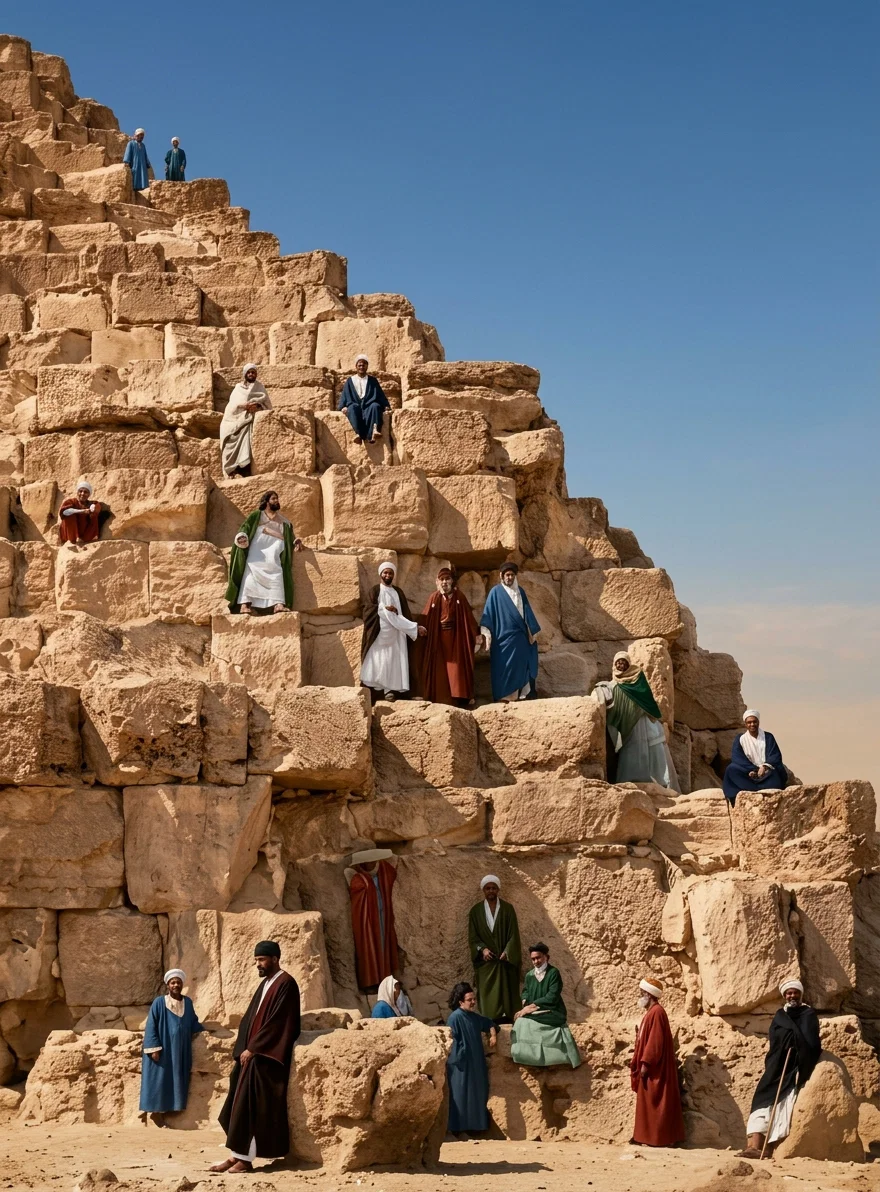
HOW the fingers of Time are crumbling the sere leaves of human glory! How the feet of Time are treading them into dust again! How the intangible elements are toying to-day with the temple and tower, the pyramid and the proud city of yesterday!
A Near View of the Great Pyramid, Once Smooth and Polished, Now Ragged and Crumbling in Decay.
TO-DAY has its lesson for to-morrow, and yesterday its lesson for to-day. The glory of the ancients has crumbled into dust before our eyes. Their lives have gone out like a whisper in the night; but the same stars that shone upon them—the same stars out of which they tried to read their destiny—are shining upon us to-day with the same luster. They builded their polished pyramids that the fame of their name and glory might go down to everlasting generations; but under the noiseless tread of the ages they are ground into powder, that generations to come might see the wasting process of human vanity.
THE great pyramid of Cheops is a standing witness to the frailty and destructibility of all things that human hands have fashioned. Forty centuries ago one hundred thousand skilled workmen were toiling under a torrid sun, year in and year out, to perpetuate the glory of their king and country. Their country now is the “least among the nations.” The once polished stones of their monarch’s monument are disintegrating under the rays of the sun he worshiped, and that kingly pile is now a shattered, corroding heap. The wasting away of the glory of Cheops keeps time to the process of destruction in every other monument to human pride, every work of man. The human aspirant for glory has pressed the record of his speech and his doings into tablets of clay. To-day these books of brick are lisping, stammering, jibbering, in a pitiful attempt to articulate the glories of the human during the heyday of heathenism.
In all this wasting away of the handiwork of man there is the continual retelling of the old story of sin. Sin brought in time, the finite, and the human, a new order of things to the universe of God; and until the history of sin is finished, wasting and desolation are the appointed portion of the works of man.
GOD has permitted men to build, out of the most indestructible material in the earth, massive monuments to self, in order that the slow elements of destruction might teach men their own weakness, their own nothingness; and that then looking up into the imperishable heavens, they might throw themselves upon the mercies of Him who created the stars, who “bringeth out their host by number;” who “calleth them all by names by the greatness of His might;” who holds them by His power so that “not one falleth.” This is the lesson for men to draw from the perishing pyramids. It is the lesson of the triumph of eternity over time; of the infinite over the finite; of a loving Creator over a rebellious creature; of righteousness over sin. The finite has lifted its hand against the infinite, set up the throne of selfishness in the very shadow of Calvary, and flung defiance at that Word which caused the earth to spring out of nothing. A patient Creator allows man’s folly to be manifest to his posterity thru the wasting away of those things which man has made to perpetuate his memory. BUT it is not alone in the pyramids of Egypt that the memorials2of human fame are fading away. Every monument to self, to worldly fame, to human glory; every work of selfishness of whatever kind or wherever it is, every work that is not of God, is summoned to its trial in the court of eternity; The test is on, and precedents are barred. “Every man’s work shall be made manifest; for the day shall declare it, because it shall be revealed by fire; and the fire shall try every man’s work of what sort it is.” 1 Cor. 3:13. “His eyes behold, His eyelids try, the children of men.” Ps. 11:4.
WE have looked upon the most glorious and most substantial works of men, and have seen their dust scattered by the desert winds; we have seen the fragmentary records of human achievements gathered together from crumbling mound or broken tower, still trying to tell their shattered story. We have seen sickly childhood, tottering age, and the feeble frame of the wasting invalid, and we have seen the plumed hearse and black-robed mourners leading a perpetual procession to the tomb. We have seen all this, and we have asked: Is there, then, nothing substantial, nothing imperishable, nothing perpetual but death and decay in all the twinkling, star-sprinkled universe of God? Go out in the stillness of the night, when the prattle of humanity has been hushed upon the bosom of the crooning old earth, and look up into God’s great torchlight procession, marching and counter-marching to the orders of heaven; and then fall down upon your knees and ask God about it. Question the Maker. He is not bound by time or distance; His ear is always within hearing of the lips of His feeblest children. Ask Him if there is nothing stable, tangible, perpetual in all His realm.
HE will tell you that “from everlasting to everlasting” He is God. He will tell you that tho “All flesh is grass, and all the goodliness thereof is as the flower of the field” that perisheth, yet the word that has gone out of His lips “shall stand forever.” Isa. 40:6–8. “I am the Lord, I change not.” Mal. 3:6. “The things which are seen are temporal; but the things which are not seen are eternal.” 2 Cor. 4:18. While you are looking upon the dissolution of earthly things, the Lord will tell you that there is “a building of God, an house not made with hands, eternal in the heavens” (2 Cor. 5:1); that the kingdom which He promises to the ransomed of earth is “an everlasting kingdom.” Dan. 7:27. Are you mourning the loss of human love, and wondering if there is any hope to which the soul can anchor? Then know that God has loved you “with an everlasting love,” and seeks to bind you to Himself with His everlasting cable of lovingkindness. Jer. 31:3. Are you discouraged and cast down, forsaken and oppressed? Then know that “underneath are the everlasting arms.” Deut. 33:27. When trouble comes in like a flood till the very earth seems to tremble beneath your feet, then know that “the foundation of God standeth sure, having this seal, The Lord knoweth them that are His.” 2 Tim. 2:19. As He knows the stars and “calleth them all by name,” so He knows you, calleth you by name, knoweth your frame, and remembereth that you are dust. At the same time “the Spirit itself maketh intercession for us with groanings which can not be uttered.” Rom. 8:26.
THEN there is an eternal Rock to which the most storm-tossed can anchor; there is an eternal habitation for the most foot-sore pilgrim; in the midst of change and destruction, there is One who is “the same yesterday, to-day, and forever;” tho the words and works of men are crumbling and fading away, the word and works of God “stand fast forever;” the pyramid may become the plaything of the summer breeze, but “the foundation of God standeth sure;” the record of human selfishness will fade from the memory of the redeemed, but the story of Calvary will be sung by the angels as long as God shall live. “God so loved the world, that He gave His only begotten Son, that whosoever believeth on Him should not perish, but have EVERLASTING LIFE.” C. M. Snow.