CHILD WIVES OF INDIA

7%

Pacific Press Publishing Company · Oakland, California · Jul 3, 1901

FromSigns of the Times, Vol. 27, No. 27.

Read the full edition

CHILD WIVES OF INDIA.

It is the custom of infant-betrothal and child-marriage that entails the greatest amount of suffering upon Hindu women, and is the cause of hundreds of thousands of child widows. Indian custom demands that every respectable family should secure husbands for their girls at the earliest possible age. It frequently happens that girls of seven or eight are given in marriage to men old enough to be their grandfathers. The younger the girl is married the better, and the age of the husband does not matter. The great majority of girls in this country are married before they are twelve years of age, an immense number before they are ten, and many even at a much earlier age. It is said that in Bengal, out of every one thousand girls between five and nine years of age, 271 are married; and that twenty-eight in one hundred are wives or widows at an age when, if they were in Europe or America, they would be in the nursery or infant school.
The immense amount of suffering and disease arising from this cruel custom of child-marriage can not be estimated. What is likely to be the physical condition of both mother and child, when the former herself is but a child of twelve or thirteen, and even more a child in all true knowledge? Think of a child being called upon, at an age when she should be playing with dolls, to undertake the education of children of her own, and perhaps be the mother of a large family before she is twenty years old! It would be marvelous indeed if the young wife were not broken down in health by such a constant physical and mental strain.
At sixteen years of age these wives of India are not so large, strong, or well-matured as most American girls are at ten. A little Hindu girl of ten looks like our girls of five or six. Imagine such a child given over to a man forty or fifty years old, who has neither love, kindness, nor humanity in his heart for her, and who deliberately tortures her to such an extent, that to avoid him she attempts to destroy her own life, as is often the case, by drowning herself in the nearest tank, well, or river, or by swallowing a dose of opium!
The scene that occurs when one of these child wives is sent away to her husband's home is oftentimes heart-rending, and the child tries in every way to delay her departure as long as possible. Child tho she is, she knows only too well the fate that awaits her.
While passing along the street one day, my attention was attracted by the piercing screams of a child whom a number of people were trying to get into a closed conveyance. On inquiring the cause of the disturbance, I was told that the child had been married and was being sent away to her husband's home. The child was clinging to her mother's feet, and imploring in heart-rending tones, “O mother, mother, don't send me away from you. I can not go there; I will die if you send me away.”
Mothers have said to me, “Mem, it breaks our hearts to part thus with our children; but what can we do? It is our fate. God has made us women. We must submit.”
Surangini was the joy of her mother's heart, and the brightest, happiest girl in our school. At the age of ten she was married, and shortly after was sent away to her husband's home. Think what a prospect for a little girl, taken away from her parents and playmates, handed over to a man old enough to be her father, whom she had never seen, wholly at the mercy of an unknown mother-in-law, who in all probability will find nothing but fault with her, and punish her in the most cruel manner imaginable. And in all her trouble, no sympathizing friend to whom to turn, no ear to listen to her grief. No wonder the poor child dreaded it; but there was no help for her, for after marriage there is no place on earth for a Hindu woman but her husband's home, and the only salvation for her is to live and die under his roof.
In a few months' time Surangini returned for a visit to her mother, and the change that had taken place in the bright-faced, happy girl was heart-breaking. Child tho she was still in years, her childhood was past forever. Never can I forget the sad, hopeless look on that child's face, as her mother related to me the story of her suffering, and the abuse she received in her mother-in-law's house.
As I write these lines, I have just returned from a visit to one of these child wives, with one of our nurses. Three months ago this girl gave birth to her second child, the elder being now three years old. Since that time she has never known a well day; and in all probability, if she recovers at all she will be an invalid for life.
One mother said, when asked if she had any children, “I had one little girl, but she died one week after her marriage; and I am so glad she is dead, for now she can suffer no more.”
I do not say that all Hindu wives are thus mistreated. There are Hindu men and women whose hearts are tender and kind; whom to know is to love and respect. There are good mothers-in-law, and homes where little-girl wives are loved and treated tenderly; but for every one such home there are ten thousand of the character I have described.
Calcutta, India. GEORGIA A. BURRUS.
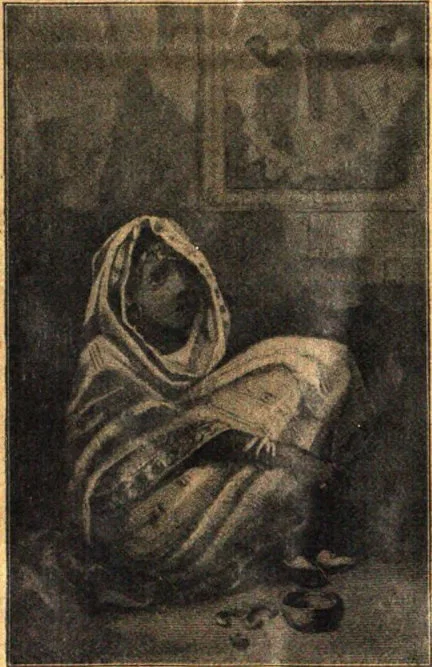
A Child Wife.
A Child Wife.
A Bride of Eight.
“They beat me when I cried for my mother.”
A Bride of Eight. “They beat me when I cried for my mother.”