In July, 1898, Hawaii was annexed to the United States. Thus this ancient island kingdom and historic mission field came under the American flag.
The group consists of eight inhabited and four uninhabited islands. Honolulu, the capital, is 2,100 miles from San Francisco; 4,400 miles from Sydney, N. S. W.; 2,300 from Tahiti; 3,400 from Yokohama; and 4,900 from Hongkong. It is thus a port of call for vessels trading between San Francisco or Vancouver and South Pacific ports or the Orient, and its commercial importance is apparent.
The islands are volcanic, composed almost entirely of the products of eruption. They are mountainous, but none of the mountains reach the altitude of perpetual snow. Extinct craters abound. One of these, on the island of Maui, is the largest in the world, covering an area of about sixteen square miles, and having a depth of 2,720 feet. Mauna Loa, on the island of Hawaii, is a noted volcano. Sixteen miles from Mauna Loa is a volcano with the largest active crater in the world. A party of missionaries who visited it in 1823 described the crater as “nine miles in circumference, with vertical sides 1,000 feet deep, covered at the bottom with a lake of liquid lava, at one end red and boiling. Around the edge or from the midst of this fiery lake, fifty-one conical craters sent forth jets of lava or smoke and flame.”
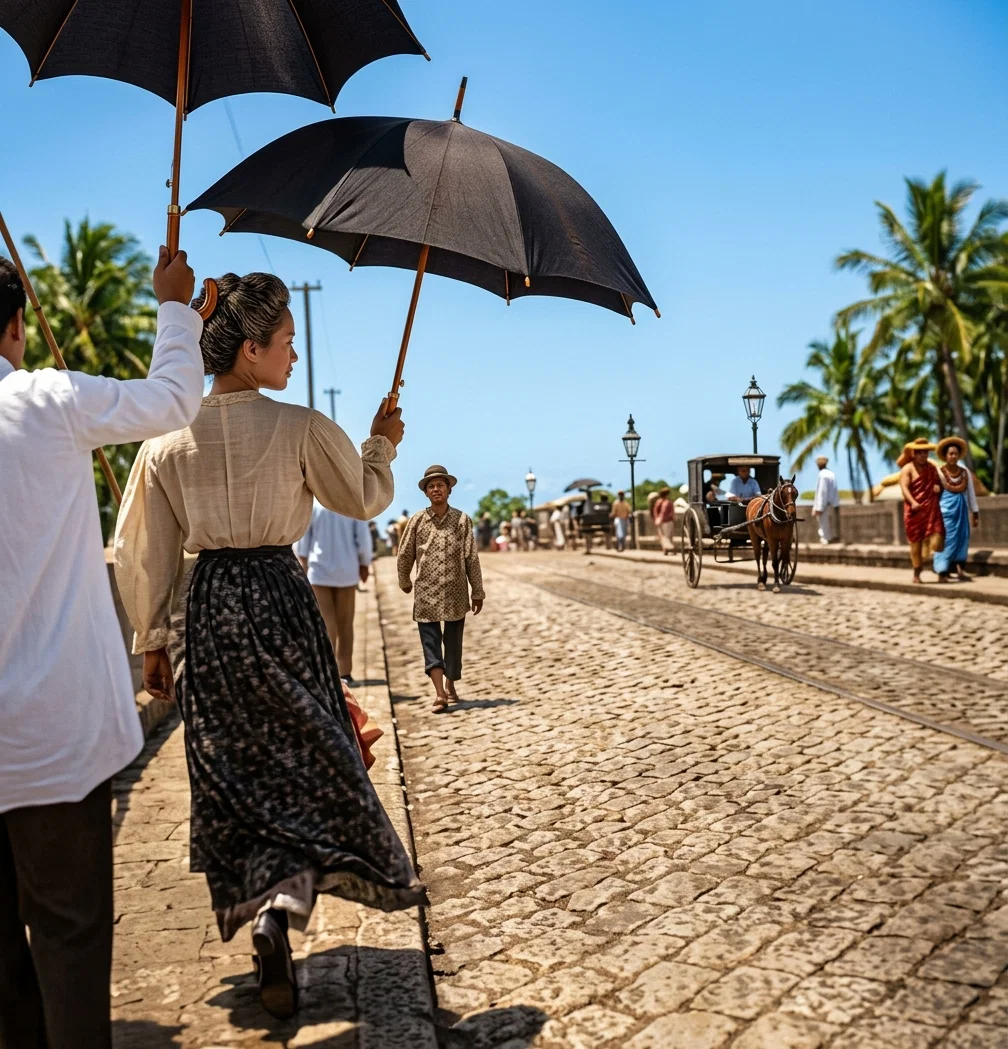
A Street in Honolulu.
The scenery is picturesque, as the islands abound in mountains, valleys, and deep ravines. In Oahu “the valleys are remarkable for beautiful scenery, peaks, cliffs, lateral ravines, cascades, and tropical vegetation combining to charm the eye.”
In 1820 these islands were entered by a party of missionaries under the auspices of the American Board. They found a fine race of savages so far as physical development is concerned. Their religion is thus described by Mr. Ellis, an English missionary:—
“Tho less superstitious than the Tahitians, the idolatry of these islands was equally barbarous and sanguinary, as in addition to the chief objects of worship included in the mythology of the other islands, the supernatural beings supposed to reside in the volcanoes and direct the action of subterranean fires, rendered the gods objects of peculiar terror. Vast offerings were presented to the spirits supposed to preside over the volcanoes, especially during the periods of active eruptions. The requisitions of their idolatry were severe, and its rites cruel and bloody. Grotesque and repulsive wooden figures, animals, and the bones of chiefs, were the objects of worship. Human sacrifices were offered whenever a temple was to be dedicated, or a chief was sick, or a war was to be undertaken; and these occasions were frequent. The apprehensions of the people with regard to a future state were undefined, but fearful. The lower orders expected to be slowly devoured by evil spirits, or to dwell with the gods in burning mountains.”
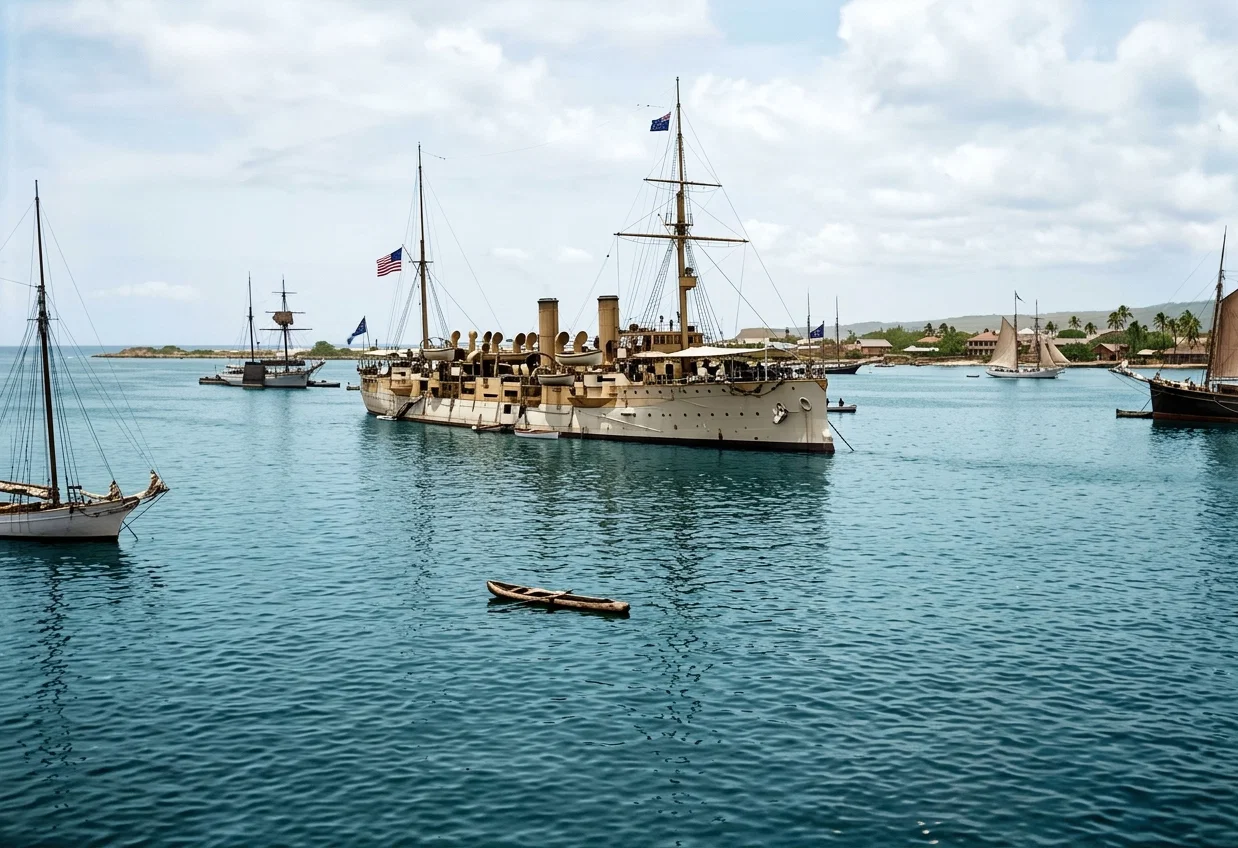
U. S. Cruiser Philadelphia in Honolulu Harbor.
The people ate the heart and liver of victims offered in the temple as a religious rite. The victor chiefs ate the same parts of any prominent warrior slain in battle, believing that this would put them in possession of the valor of the dead man. When the king died, the year before the missionaries came to the islands, a council of chiefs was held to consider what should be done with his remains, and some gravely proposed that he should be eaten. Their counsel, however, did not prevail.
When the missionaries arrived, the new king, Kamehameha II., had abolished taboo and idolatry, and the islands were practically without any religion. This was favorable to their work. But the degradation and superstition of idolatry had not been removed, and the people were no better morally than the natives of other South Sea islands. Infanticide was practised; polygamy and polyandry were common, and virtue was unknown.
The king owned all the land, and apportioned it to the chiefs according to his pleasure. The people were slaves under the chiefs, and anything they had might be taken from them. The missionaries tell of a man who carefully concealed a fattening pig, hoping that he and his family might have a feast. At length the pig was killed; but as it was roasting in the peculiar earth-oven of the islanders, the odor betrayed its whereabouts to a passing chief. He lingered near until it was done, then bore it off in triumph, leaving the poor man and his family to supply as best they could the loss of their roast dinner.
A royal princess came down to the beach to greet some missionaries who had just landed. A native who was standing by had a live sea-fish, probably a squid. The princess could not resist the tempting morsel. She seized the fish, without so much as “by your leave,” and thrust its head into her mouth. With her mouth filled, the black juice that the fish throws out to darken the water in defending itself streaming down her face, and its arms writhing around her cheeks, she greeted the strangers with what she could of dignity and grace.
The king and the chiefs with their families were the first pupils of the missionaries, and the king’s mother was the first convert. In a few years several powerful chiefs were converted, and their earnest work for the people had a great influence for good. The Bible was given to the people in their own language. And when the missionaries had been on the islands eight years, as the fruit of their work there were 12,000 regular church attendants, 445 native teachers, and 26,000 pupils in schools. From 1838 to 1844 there was one of the most remarkable revivals known in history. During these six years 27,000 natives were received into the churches.
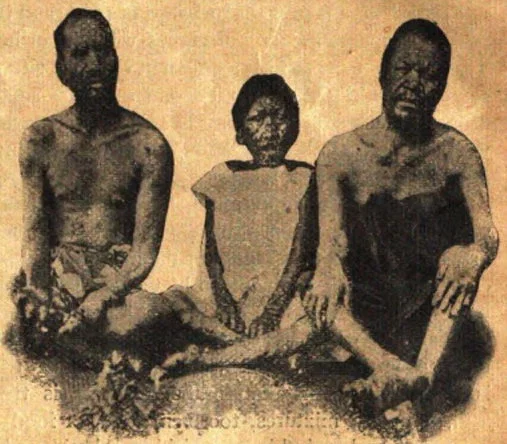
Island Lepers.
In 1850 a missionary society was organized on the Hawaiian Islands, with a board of eighteen managers, one-third of whom must be natives. This society has done effective work in Micronesia and the Marquesas Islands. Thus these people who had so lately received the religion of Christ, sought to impart its blessings to others, showing that the generous love which is the true spirit of the Gospel, had found a place in their hearts.
When Captain Cook discovered these islands, the population was estimated at 400,000. A census taken in 1897 showed the native population to be 31,000, with 8,000 half castes. There were besides, in addition to the Americans and Europeans there, 24,400 Japanese and 21,600 Chinese. Honolulu is said to contain “the most mixed population of any city in the world except Constantinople.” So many foreigners are there, and their influence is so corrupting, that it has been found necessary to keep the churches somewhat under outside supervision.
Leprosy is prevalent; in 1880 there were 800 victims of the disease on the islands. These are isolated on Molokai Island. The Hawaiian Missionary Society is doing good work among these sorely afflicted outcasts.
Christian laborers are at work among the 45,000 Japanese and Chinese, of whom more than 40,000 are said to be Buddhists. Missions and mission schools have been established among them, and a few churches have been organized. The Seventh-day Adventists have a church in Honolulu, with a flourishing school and mission among the Chinese, and a sanitarium which is open to all nationalities.
And so the islands are still missionary ground. Indeed, any place is missionary ground where there are souls to be won to Christ. E. J. B.