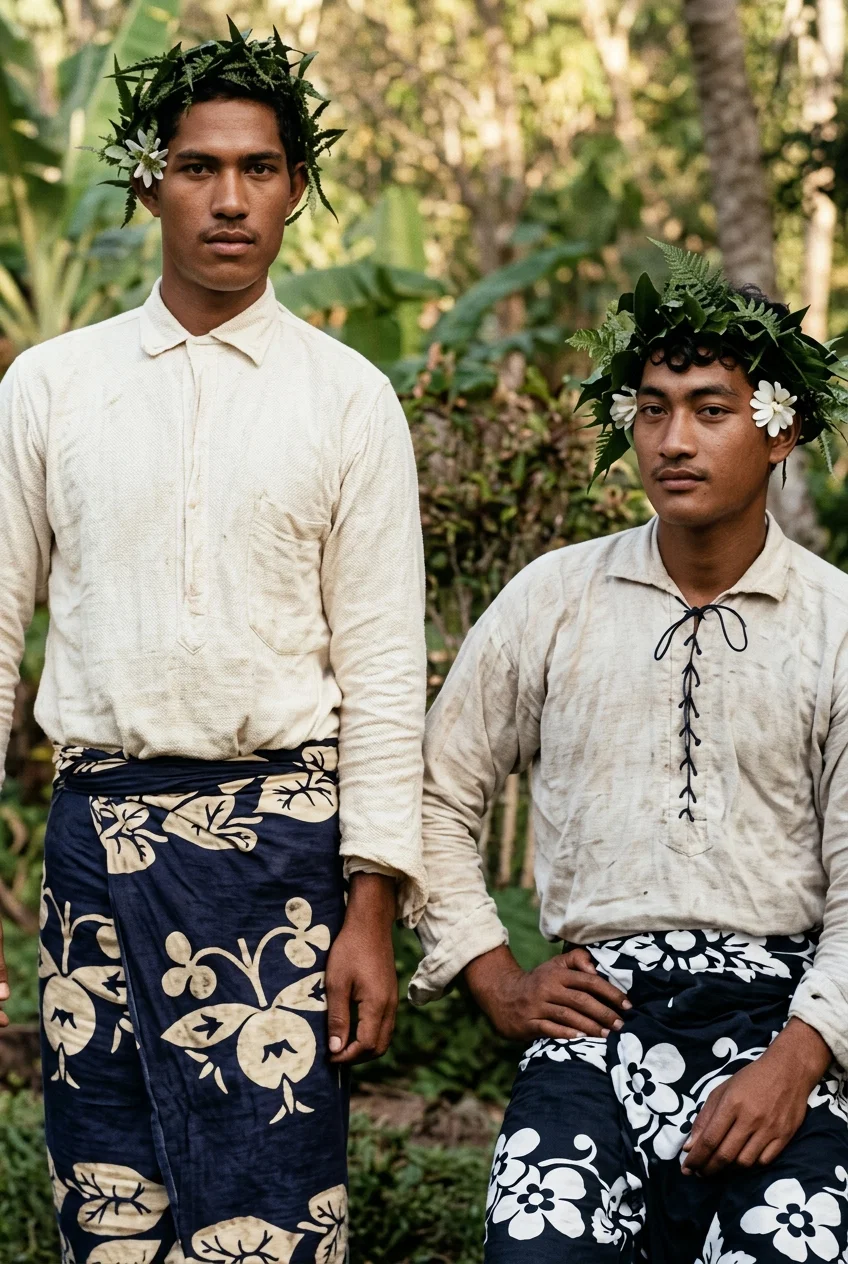
IN the Society Islands the men work harder than the women do, tho none of them are in danger of overdoing in the line of work. The larger part of those living in the smaller islands and country districts have no regular employment. They usually cultivate a few vegetables, and perhaps some bananas and pineapples for their own use; but they spend most of their time in eating, sleeping, and talking.
As the man of the house is not very busy, he gets the food and cooks it. He probably has no ripe vegetables in his garden, so he starts early in the morning for the mountains, and several hours later returns with a heavy load of plantain. He then makes the oven, which is a hollow in the ground, where small stones are first heated, and then the food is put in and covered over to bake. Perhaps he was out fishing the night before, and has some fish to be cooked and eaten with the plantain. If he has coconuts he grates some and squeezes out the milk from the grated nut. Salt and lime juice are added to the milk, and it is called “mite hoari,” said to be a very palatable sauce to eat with the plantain and fish. After dinner the man feels that he has done a good day’s work, and he lies down and sleeps for a few hours. It is not necessary to go after plantain every day, for one load is usually made to last about a week. During the breadfruit season very little plantain is used.
Tahitian Workmen.
Nearly every native owns some land and has some coconut trees. The nuts are used for making copra, which is shipped to the larger countries and used in making hair-oils, co-nut, etc. When they are ready to make the copra, the natives begin by splitting the nuts and hanging them up on racks to dry. When they are partially dried, the kernel is dug out of the shell and spread in the sun. If the weather happens to be rainy, the nut does not dry very fast, and it molds so that it is often badly rotted by the time it is ready to sell. But the money received for their copra is about the only income that many families have, and they covet it so much that they will watch closely for a chance to steal a few pieces from a neighbor to add to their own; or they will steal the nuts whenever they have an opportunity.
Those living near Papeete often do quite a business in raising bananas and other foods, and selling them in the market. Native foods are much more expensive in Papeete than in country places; for so many people in one place make a greater demand for them, and there is always a ready sale for raw fruits and vegetables. Some men spend their whole time in making doughnuts, griddle-cakes, and “poi,” and selling them in the market. They cook during the day, and toward evening put their food into a wheel-barrow and take it over to the market, where it is arranged on a table and offered for sale. It sells well; for natives like “good things” to eat, and can seldom resist the temptation to buy if they have any money in their pockets.
Vanilla-growing has become quite an industry in Tahiti, and some natives have large plantations. During the season when the vanilla is in bloom, many workers are employed to go out each morning and fertilize the blossoms. This is considerable work when there are many plants. After that no further attention is required until the beans are full grown. Then they are gathered and dried. As the natives dry the vanilla, the process takes several months; but now a professional drier buys most of it of the natives, and dries it in a week or two with artificial heat.
Another occupation is fishing. Nearly all do more or less in this line, tho many use all the fish they obtain for their own families. Others make quite an extensive business of it. Large nets are used for fishing inside the lagoon; the spear and the hook and line also are in use. Some go outside of the reef in sail-boats, and sail back and forth with lines dragging behind. The hooks used in such cases are often made of mother-of-pearl and bone, and large fish are caught in this way. Men are often out the whole night; and if they do not have success, they may stay all day too without coming home. Sometimes they have an extra good haul, and make as much as $20.00 in one night. There is always a ready sale for fish, for the islanders are very fond of them.
In Papeete many men have steady employment doing manual work for the white people. Besides the work around stores and ships, many of them work as cooks in private families. Some are also employed as government clerks or as clerks in stores. The sailors on the small boats running between the islands are natives, and the captain is often a native.
Some young men are teaching in public schools. The standard of education, however, is not as high there as it is in this country.
The Tahitians have a natural talent for music. Papeete can boast of four trained bands of musicians, of which most of the members are either natives or half-castes.
In places where the natives have seen the most of white people, they have been aroused to more ambition, and are more industrious than those who come in contact with none but their own people. But the influence of the Gospel has done more than anything else to uplift and civilize the islanders.