TOURISTS visiting Tahiti nearly always take a trip around the island. A good road runs around the outside close to the sea; so as one rides along, he has a view of the sea on one side and the island scenery on the other. We pass by some settlements where for quite a distance the houses stand side by side, and then again we ride thru a lonely glen where no signs of life are visible except vegetable life, where the air is cooled by the dense shade and the water dripping continually from the rocks above. Beautiful ferns and vines cover the hills with their foliage.
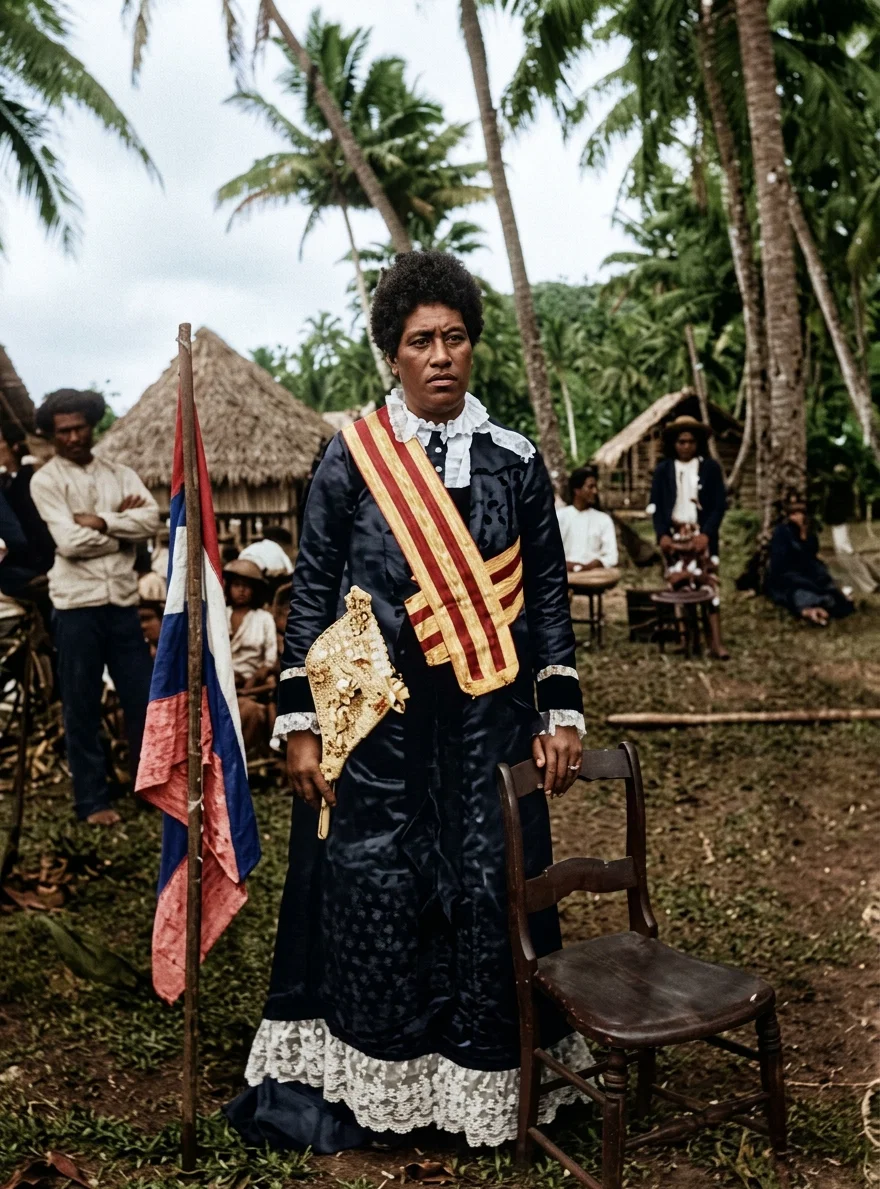
Ex-Queen of Raiatea.
In traveling around the island, one has a chance to see a variety of houses, from a fine European residence down to the poorest and dirtiest of huts. Occasionally we see a house where the surroundings show signs of thrift and industry. Some of the most tasty residences in European style are those belonging to natives, who have had success in the vanilla business, and have accumulated considerable money in a short time. At one time we stopped over night at such a place. The house had just been finished, and was fitted up with nice new furniture; but the family still lived in their old home, a rude hut that stood near the new building. They seemed to think that the new house was too good to use, or perhaps they felt more at home in the old one.
No nails are used in building a native hut. Posts are first set, and poles put up as studding, rafters, etc. The roof of thatch is tied on to the poles with cords, and the walls are of bamboo poles fastened on with either buran bark or cord. Some are provided with a board floor, tho a floor of poles covered with hay is more common. Others have only the bare ground for a floor. A broom for sweeping it is made of a bunch of weeds, tied together, and fastened to a long stick, which serves as a handle.
Even tho they may live in a European house, Tahitian women are seldom neat housekeepers. The floors and windows are not kept clean, and the woodwork is never washed. When it gets too dirty, it is painted over again. Some floors are never washed; others are scrubbed once in six months or a year, and some as often as once a month. Coconut husks are used for scrubbing brushes, and after the floor is rinsed, lime-juice is applied to whiten it.
But little furniture is found in a native house. There are always small chests where they keep their treasures, but that is often all the furniture there is. Occasionally a house affords a table, and an old chair is often brought out for the benefit of a white visitor. When there are several visitors, some have to sit on the chests, or else practise sitting down on the floor with the natives themselves. In the towns, furniture is more plentiful, and some have their houses furnished quite cozily.
But few bedsteads are seen in the country. The natives usually prefer sleeping on the floor, where the bed is composed of a native mat, a pillow, and a thin spread. Each individual has a spread of his own. Others sleep on a tick stuffed with cotton, which is something like a feather bed, and not very healthful.
You might think a cupboard or sideboard would be needed in every house. Some do have a rough shelf nailed up for dishes, and I have seen cupboards, but they are scarce. Soup-bowls are the only dishes commonly used at meals. They hold the liquid food, and the vegetables and other dry foods are laid upon leaves. Nearly every family has plates, but they are not used often. Very few have knives, forks, or spoons. Cooking utensils also are scarce. A teakettle serves as a water-pail, a coffee-pot, and a kettle for boiling vegetables, as it is often the only kettle a family has.
The table-cloth is made of large leaves woven together. It is spread upon the floor or ground either indoors or out; for the people prefer sitting on the floor to eat to sitting at a table. When the meal is over, each person rinses out his own bowl, and leaves it turned over on the floor to dry, and the table-cloth is thrown away.
These household customs make life easy and free from care for the women. They never worry because their houses are not neat, as many American women do, but can lie and sleep for hours at a time during the day, while their houses remain untidy. They do much visiting; and when they feel like working, make hats or patchwork.
Of course they have to do some washing and ironing, since they wear clothing; but they do not use the same washing utensils as we do. They take their soiled clothes and soap to a river or pool of water, then sit down in the edge of the water, and soap and pound the clothes with a stick until they are clean. They lay them on a stone or a board to pound them. This method cleans the clothes well, but is rather hard on the buttons. For those who have not been accustomed to sit down and work in this way, it is very tiring to the muscles; but the natives think it hard to stand up and work. They also sit while ironing. Large charcoal irons are used, which are heated by charcoal fires inside. Our irons would be of no use to them, as they have no stoves upon which to heat them.
Some of their customs are not bad; they are better suited to that climate than our customs would be, tho education makes them seem odd to us. These people belong to the same grand human family that we do, and tho their skin is brown, their souls are just as valuable in the sight of God as are the souls of white men. B. J. CADY.